
Water: Emilia-Romagna leads the alliance of EU regions for water security
The Region is a member of the Alliance of European Regions for Water Security and Climate Change Adaptation, a collaborative platform that aims to provide a forum for sharing experiences and solutions and to strengthen the role of local and regional authorities in EU water policies

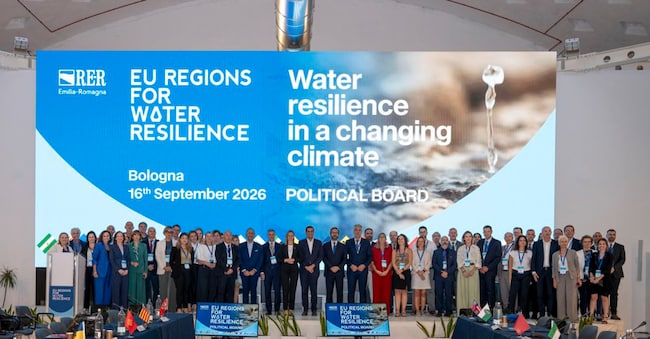
(Il Sole 24 Ore Radiocor) – Calling on European regions to work together to develop a common strategy to protect themselves from floodwater which, when it strikes suddenly, inundates towns and the countryside and puts communities, infrastructure and economic activities at risk. But also to cope with water scarcity, with prolonged droughts, groundwater and rivers under pressure, and water resources that are becoming increasingly difficult to preserve. This is the objective behind the Alliance of European Regions for Water Security and Climate Change Adaptation, which was launched in Brussels last March. It is a permanent platform for political and technical collaboration between regions, established on the initiative of Emilia-Romagna, and aims to provide a forum for sharing experiences and solutions and to strengthen the role of the regions in EU water policies.
Launched just six months ago with 18 regions across nine EU countries, the Alliance now brings together 29 regions from 10 European countries, which aim to cooperate and contribute directly to the formulation of European policies on water security, climate preparedness and adaptation. Furthermore, on 16 and 17 September, it held its first International Conference at the Dama Tecnopolo in Bologna, featuring political and technical discussions between the member regions. The event, strongly championed by the President of the Region, Michele de Pascale, marked the Alliance’s first annual meeting and brought together representatives from European institutions, regional and local authorities, policy-makers and researchers on the implementation of the European Strategy for Water Resilience and on the role of the regions in climate adaptation and territorial security.
Region-specific solutions
In particular, the group aims to step up investment in the prevention of floods, droughts, extreme rainfall, storm surges and water shortages. It also intends to improve regions’ access to European funding, promote green and blue infrastructure, the renaturalisation and modernisation of water networks, and accelerate research and innovation, including through Big Data, supercomputing and advanced technologies. Furthermore, it advocates the sharing of governance models, early-warning systems and best practices for emergency management and reconstruction in line with the ‘build back better’ principle. Water management is, in fact, an issue with economic and social dimensions, as well as environmental ones.
Over the past four years, more than twenty European regions have been hit by severe flooding, with damage estimated at over 63 billion euros. Furthermore, by 2030, half of Europe’s river basins could be affected by extreme weather events and droughts, and these are challenges that local and regional authorities intend to tackle as key players. According to the European Committee of the Regions’ ‘State of Regions and Cities 2024’, regional and local authorities are responsible for implementing 70 per cent of climate mitigation measures and 90 per cent of adaptation actions, whilst at local level 80 per cent of investments are carried out. It is precisely from this that the Alliance’s call stems to build a European governance framework capable of combining common strategies with solutions tailored to the characteristics of individual regions, increasing investment in prevention and adaptation, and pooling knowledge, research, technologies and administrative capacities.
Water as a strategic issue of our time
“Water is one of the major strategic issues of our time. For too long in Europe, we have regarded it as an readily available resource, almost taken for granted. Today we know that this is no longer the case,” commented President De Pascale – “Floods, droughts, water scarcity and extreme weather events are already changing the living conditions of our communities and affecting territorial security, agriculture, industrial production, ecosystems and the competitiveness of our economies. This is why water security is not merely an environmental issue and cannot be addressed only when it turns into an emergency.”


