
Water is a crucial resource, but there remains a gap in both action and knowledge
Goal 14 of the UN 2030 Agenda on life below water is one of the most behind schedule and suffers from a lack of monitoring, which efforts are being made to address, including through the use of AI. A further boost could come from the Nature Restoration Act

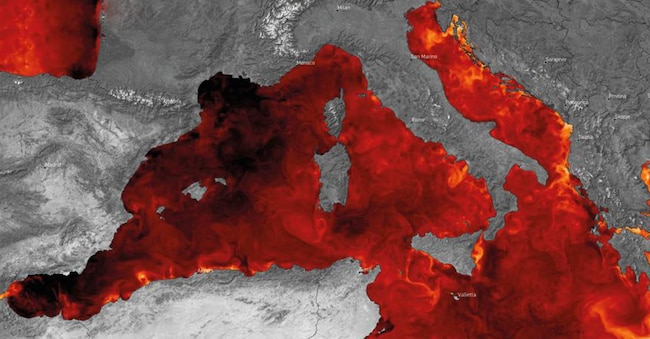
Blue gold: a precious resource for human survival and a treasure trove of biodiversity. Water, increasingly threatened by climate change, is one of the key focuses of the UN 2030 Agenda – which dedicates Goal 14 to the sustainable use of the oceans and marine life. Yet it is precisely here that significant delays are being observed: a gap in action and knowledge that we are seeking to bridge, not least with the help of artificial intelligence. And an opportunity to be seized has arisen from the EU Nature Restoration Law.
A bleak picture
The latest UN update is contained in the report “Progress towards the Sustainable Development Goals”, published in early June, which highlights in particular the rise in ocean acidification, ocean warming and the fact that the goal of sustainable fishing remains a long way off. It also calls for greater investment in science and innovative technologies. “The situation looks bleak, with progress being very slow,” says Ivan Manzo, spokesperson for the ASVIS (Italian Alliance for Sustainable Development) working group on Goal 14. He goes on to cite some global figures: only 8.4 per cent of the oceans are classified as marine protected areas – a figure still far short of the 30 per cent target by 2030 set by the Kunming-Montreal Global Biodiversity Framework – whilst 35.5 per cent of marine fish stocks remain overexploited.
If we narrow our focus to the Mediterranean, explains Giovanni Coppini, director of the ‘Global Coasts as a New Frontier’ programme at the CMCC (Euro-Mediterranean Centre on Climate Change), ‘the picture that emerges is worrying: 2025 was the second-hottest year on record, with an average sea surface temperature of 21.2 degrees Celsius, surpassed only by the record set in 2024 (21.3 degrees). And for the third consecutive year, the entire basin has experienced marine heatwaves, with intense events affecting 93 per cent of the surface area.” Added to this is rising sea levels, which have already risen by six centimetres over the last 20 years, with projections of up to more than half a metre in the worst-case scenarios. “These are signs,” he says, “that we can no longer ignore.”
In the EU – according to Eurostat’s latest update on the UN 2030 Agenda, published in early June – the acidity of surface waters increased by 3 per cent in 2025 compared with 2019. There are, however, some tentative signs of improvement. Protected areas account for 13.7 per cent of the total, 2.8% more than in 2019 (though the data only goes up to 2023), and the exploitation of fish stocks has decreased, with a median value of 0.85, representing a 35% drop compared with 2018. Nevertheless, Coppini points out, the Mediterranean has the highest percentage of unsustainable stocks in the world. ‘Another sore point,’ he notes, ‘concerns the implementation of the target to reduce marine pollution: in the Mediterranean, up to 82 per cent of waste is plastic, and the eutrophication of coastal waters – that is, pollution caused by the accumulation of nutrients in the water – remains a critical issue.”
In Italia, according to the latest ASVIS Report (the next one is due to be published in October), “Goal 14,” Manzo points out, “has shown some signs of improvement since 2020, before stabilising”. In particular, our country is still a long way from achieving sustainable fishing: according to the latest available data (2023), 62 per cent of fish stocks are overfished. Progress is also insufficient in the area of marine protected areas, which stand at 11.6 per cent. “We are concerned,” continues the ASVIS representative, “as Goal 14 is one of the objectives lagging furthest behind. At this rate, we will not be able to meet the target by 2030. We need a significant step forward in monitoring efforts and in the availability of accurate and up-to-date data.” All the more so because – as Coppini points out – Goal 14 remains the most underfunded of all the UN Agenda’s goals: to achieve it by 2030, nearly 175 billion dollars a year would be needed, but there is still a long way to go when you consider that from 2015 to 2019, to give just one example, less than 10 billion was allocated.”


