
Water, limited wastage and state-of-the-art purification in Lombardy
On the occasion of World Water Day, celebrated on 22 March, Istat has compiled a report on water management

3' min read
3' min read
(Il Sole 24 Ore Radiocor) - High water losses from distribution networks persist in Italy. According to ISTAT's report on water, prepared on the occasion of World Water Day. it turns out that in our country in 2022, the volume of total water losses in the water distribution phase amounted to 3.4 billion cubic metres, 42.4% of the water injected into the network. This indicator is rising very slightly compared to 2020 (when it was 42.2%). Although the losses have a very variable trend, the territorial and infrastructural differences re-propose the consolidated North-South gradient, with the most critical situations in the central and southern areas, falling in the hydrographic districts of the Apennine and insular belt.
On losses, strong North-South divide
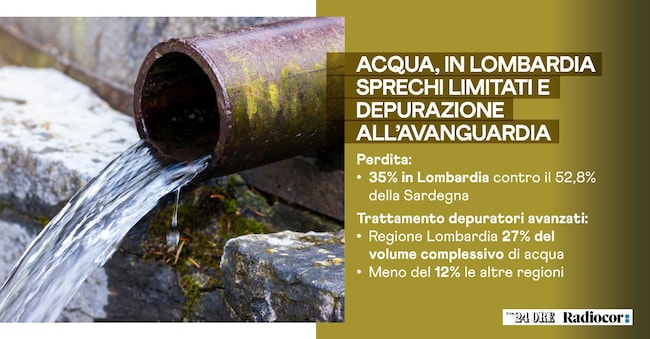
In 2022, the hydrographic districts with the largest total losses in distribution were Sardinia (52.8%), Sicily (51.6%) and the Southern Apennines (50.4%), followed by the Central Apennines (45.5%). The indicator reaches its lowest value in the Po River district (32.5%) and is slightly lower than the national figure in the Eastern Alps (40.9%) and Northern Apennines (40.6%) districts. At the regional level, Lombardy is among the most virtuous regions, with a figure of less than 35 per cent. Only the autonomous province of Bolzano, Emilia-Romagna and Valle d'Aosta do better. The regional capital, Milan, is also among the most virtuous in Italy, with losses of less than 25 per cent. The North-South divide in water management is repeated in other aspects as well, from the quality of service to households to wastewater management. Regarding this last aspect in particular, treated water from municipal wastewater treatment plants can represent a useful source of 'non-conventional' water supply to supplement the volumes used for various purposes, excluding drinking water, such as: irrigation, some particularly water-demanding industrial processes, various civil uses (such as street washing, fire-fighting, ornamental fountains) and environmental services (such as, wetland feeding). In this sense, they can help reduce the withdrawal of primary resources and cope with the increased frequency of periods of water scarcity resulting from ongoing climate change and the continuing historical inefficiencies of many water infrastructures.
27% of the purified water in the region is 'advanced' treated
.In 2020, there were 18,042 urban waste water treatment plants in operation in the country. According to ISTAT, moreover, 70% of the volume flowing into the purification plants, corresponding to a total of 4.7 billion cubic metres (slightly less than the volume of Lake Bracciano), undergoes advanced treatment, producing wastewater with a better level of quality than other types of treatment, due to the greater reduction of polluting loads. This volume can be considered a resource potentially available for subsequent reuse and is equivalent to just under a quarter (22%) of the total withdrawals made on average in the 2015-2019 period for irrigation and industrial uses. The largest share of volume (38%) is generated by advanced-type purifiers in the North-West, 24% in the North-East and 21% in the Centre. On the Islands, 4% of national volumes are treated. Advanced plants in the Lombardy region alone treat 27% of the total volume (1.3 billion cubic metres); all the other regions contribute less than 12%: Lazio with 11% and 529 million cubic metres, and Piedmont with 10% and 476 million cubic metres. Lombardy has the largest number of purification plants with advanced treatment, 19% of the total, while Lazio has 9% and Piedmont 4%. Veneto and Emilia-Romagna, with more plants than Latium and Piedmont, treat approximately the same quantities of effluent: 10% and 9% respectively.
Families more satisfied with services in Lombardy
Finally, as regards household satisfaction with services, in Lombardy 'very satisfied' are 29.7%, the Italian average is 21.5%, with the South at 14%, 'fairly satisfied' in Lombardy are 63%, in Italy 64.9% and in the South 67.8%, while 'not very satisfied' in Lombardy are 6.6%, against 10.9% in Italy and 14.6% in the South, and finally 'not at all satisfied' are 0.7%, against 2.6% in Italy and 3.7% in the South.


