We are walking archives: our first hundred years
More than 25,000 designs, 12,000 symbol-products and a history that begins in Rome in 1925: a journey to the heart of creativity with the guidance of Silvia Venturini Fendi.

7' min read
7' min read
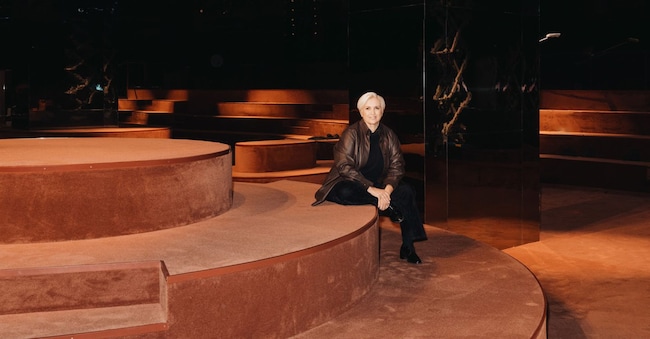
There are not many days when the skies of Rome look like those of Dublin, with the slanting light coming from the sea and the grey clouds galloping high. It is in this Irish atmosphere that I visit the Palazzo della Civiltà Italiana at EUR, the travertine-clad 'Square Coliseum', which retains its metaphysical aplomb even without the sun sculpting its 216 arches. It is here, in this temple of rationalism, that a close encounter with the world of Fendi awaits me. Since 2015, the maison has made it its beating heart: the building houses offices, workshops, management, the archive. The fabulous Fendi archive, the magic cavern of the family, the brand and its unforgettable demiurge Karl Lagerfeld. Among the tidy wardrobes, among the display cabinets with the Artist's Bag and the shelves with the historic suitcases that once belonged to Sophia Loren and Silvana Mangano, I meet Silvia Venturini Fendi, the third generation and artistic director, on the eve of some important transitions: the celebration of the hundredth anniversary of the maison, founded in 1925 in Rome by her grandmother Adele Casagrande with her husband Edoardo Fendi; the co-ed collection for winter 25-26 in the expanded Milan showroom; the large boutique, on the corner of Corso Matteotti and Via Montenapoleone, also in Milan, whose inauguration is expected in the autumn. One hundred years is a crucial passage: so much history, so much world, so many changes. The archive is a good starting point to begin a conversation that will be a journey into memories, thoughts, places, time. Also in the future.
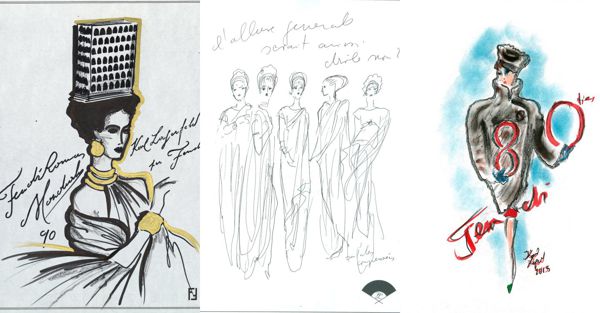
From the sliding doors, the attentive hands of the white-gloved attendants pull out a folder. They open the pages: drawings and sketches by Karl Lagerfeld flow before their eyes. His entire oeuvre in the 54 years he spent at Fendi (a record in the fashion world) is all here, from the first sketches in 1965, when he arrived in Rome wanted by the five Fendi sisters to revolutionise fur, to 2019, when he disappeared shortly after completing the Autumn/Winter collection of that year. There are 25,000 documents: a figure that is not surprising when you think that for some collections the designer went as far as 800 designs. Silvia Venturini Fendi dwells on one sheet in particular, which does not contain a drawing but a sentence, written by Karl with strokes as light as tulle: "Every end is a new departure". She feels it is hers, she has learnt from the Maestro not to look backwards: 'I was trained to look only forwards,' she declares. So what is her relationship with the archive? 'I don't frequent it much,' she replies in a composed and pensive tone, 'I don't have a great need for it. The company has been part of my life since I was born. A large part of the archive I know by heart, I have an incredible memory of collections from when I was six years old, clothes I used to see my mother wearing that have remained imprinted in my mind'. She recalls an expression Lagerfeld applied to her as to himself: 'We're walking archives'. This is how the designer enters into the merits of her relationship with Fendi's history: 'When I work on collections, I don't have a great need to go down and see the pieces in the archive: in fact, I don't even like it; I use my memories, which may be linked to a perfume or to something that doesn't even correspond to reality. My archive is filtered by memory. It is a sort of condition that I carry within me, as if I had unconsciously incorporated notions, from which a humus was created that produces what makes me say: this is Fendi'.
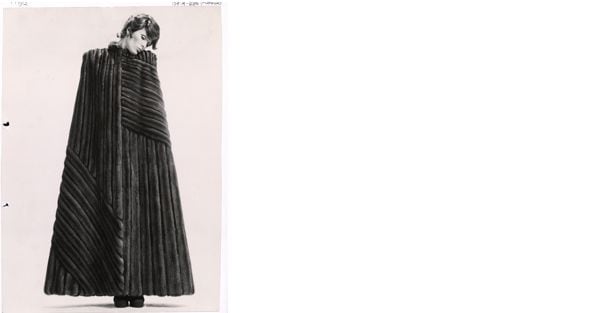
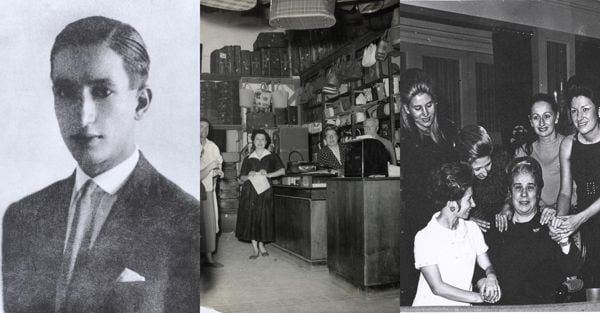
A considered detachment, then, from a documentary heritage that the designer cultivates first and foremost in her own inner world. "I am often asked to describe the Fendi woman," she says, anticipating my question. "It's very difficult, it's made up of so many facets. It is my life, it is the real women I have known: my grandmother, my mother, her four sisters. The collection on the catwalk in Milan celebrated the centenary, using as a common thread a series of portraits and family photos, which often coincide with the history of the company. In one, for example, there is my grandmother Adele on the day of her seventieth birthday, surrounded by her collaborators and with us grandchildren busy reading the poems we had written for her on parchment in the afternoon". Grandma Adele, the extraordinary woman who started the Fendi story in the 1920s by opening a leather goods and fur workshop in Rome. She had learnt the art of saddlery in Florence and wanted to start her own business, to which she also brought her five daughters. One of them, Anna, is Silvia's mother. "The inspiration is a personal memory of emotions, more than of shapes," the designer continues, showing me a historical image of a lace and mink dressing gown, "a piece that would be unfeasible today. But I really love the taste for lingerie and I wanted to bring it back into clothing'. What is new is the attitude, the thought towards the present, even if some forms are timeless. "Time is the sternest judge, it makes you realise if things have value," he says. "When I see some things from the archive, I think I would still want them today. I am a devotee of quality, which allows you to give long life to what you love. I select and preserve: in that sense I am an archivist, for sure".
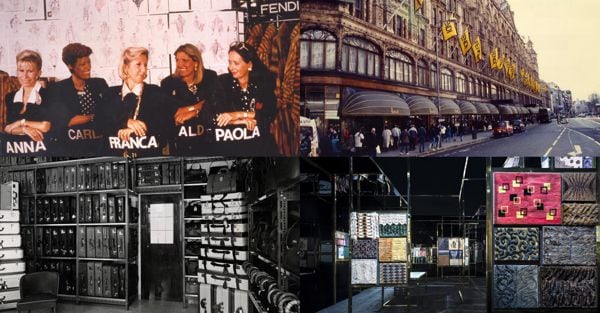
A sense of time and quality are the two ingredients that have enabled the family and the company to build up the archive's heritage piece by piece. In addition to Lagerfeld's designs, 12,000 products are preserved, starting from the 1960s up to the latest collections. All material is digitised and the search is ongoing to recover missing vintage pieces from auctions and private individuals. "The value of the archive was understood by the Fendi sisters even back then," the designer reveals. "Just think that my grandmother and my aunt Carla, when Lagerfeld threw away a design, would take it out of the bin, iron it and put it in the archive. Today it is a working tool for us. One day it would be nice to have a part of it open to the public. It would help us to understand how fashion is also a tool other than how it is perceived, which allows us to read the history of a country, the social condition of women'.
Speaking of the comparison between the imaginary and the real, the conversation inevitably shifts to Rome, the city that is part of the brand's identity, which goes through a thousand crises and as many rebirths. But about which Silvia Venturini Fendi has no doubts: 'My love for Rome is unconditional: I have learnt it, I have absorbed it. We have sometimes thought of moving to Milan, but our Roman-ness has always prevailed over everything. This is a city that has formed us, and it is very similar to what Fendi is. The Rome of today is beautiful, because it is not perfect. Rome is brazen in its contrasts, any form of style coexists here, from the Baroque to the Egyptian obelisk, the sacred and the utterly profane dialogue together. Of course, we Romans should be the first to take much better care of it'. And he adds, smilingly, an anecdote: 'It is said that Roman women are a bit of a freak.