
We are more fond of sad songs than happy ones: a study confirms this
For the past 50 years, pop music has been dominated by sad songs. But what is this due to?

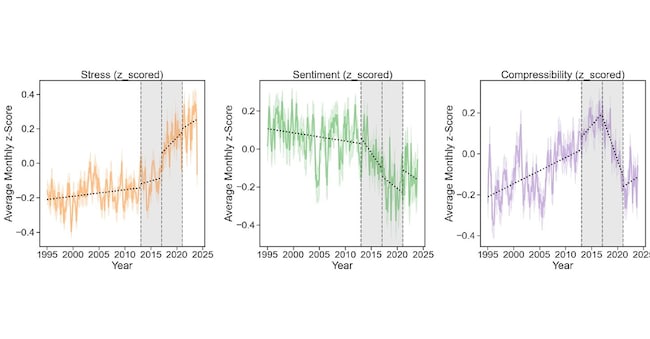
Recently, in the magazine Scientific Reports, the lyrics of no less than 20,186 songs were analysed: all those that appeared on the weekly Billboard Hot 100 charts between 1973 and 2023. These lyrics were processed by an algorithm to assess their 'mood', distinguishing between positive and negative sentiments. Analysing the songs that dominated the charts, one notices that the closer one gets to the present day, the more the songs deal with sad themes. Between the 70s and 80s we find hits such as Tie a Yellow Ribbon Round the Ole Oak Tree, Tonight's the Night (Gonna Be Alright), Ebony and Ivory and Walk Like an Egyptian. These tracks do not present melancholic themes or atmospheres that convey negative feelings. However, from the last decade of the last century until the early 2000s, the themes began to darken: the rise of pop and R&B was accompanied by melancholic or mournful lyrics, often related to love pains, as in End of the Road by Boyz II Men. Another emblematic example is Elton John's 1997 version of Candle in the Wind, one of the best-selling singles of all time, revived after the tragic death of his friends Gianni Versace and Lady Diana. The same is true for the 2010s and 2010s. The 'modern melancholy' is characterised by darker lyrics and slower rhythms: songs such as Old Town Road or Heat Waves were huge sales and public successes, confirming this trend towards a more introspective and mournful musical narrative.
What is this all about?
According to the study, psychologists have found an increase in stress-related negative language. The increase in cases of depression and anxiety means that modern life influences the media and vice versa, creating a kind of vicious circle (or loop). The analysis states, however, that there is no direct link to the economy: the change in average household income does not seem to be reflected in the themes of the hit parades. Furthermore, major traumatic world events, such as 9/11 or the COVID-19 pandemic, did not produce even more sombre songs. On the contrary, these periods saw an increase in richer songs both textually and harmonically and melodically. This is a significant counter-trend, as pop music has shown a general impoverishment in lyrics and structures in recent decades. This phenomenon is due to the fact that, according to the study, music serves as a means of escape when reality becomes too oppressive and heavy.
Music within our society
Music has always been used as a 'painkiller' for our mood. Suffice it to say that, in almost all cultures, the moment of mourning is accompanied by music, both because sound reaches where speech fails and because it helps to ease the pain. A fundamental point to ponder, however, is the fact that sad music represents an 'easy card' for artists and producers: the dominant theme of the last century is love, which finds its outlet mainly in melancholic tones. It is undoubtedly easier to write about break-ups or betrayals than about happy love. In this regard, the answer Luigi Tenco gave to someone who asked him why he only wrote sad songs is famous: he replied that when he was happy, he went out of the house; he certainly did not stay locked in his room writing songs immersed in melancholy.
We must also consider that the modern mentality leads us to believe that by watching a dramatic film or listening to a sad song, we have witnessed something 'great', making us feel good about our conscience. Listening to a sad song gives us the idea of not having wasted time, but of having invested it in something true and sincere; a thought, this, that I do not share.
Recently, in the journal Scientific Reports, the lyrics of no less than 20,186 songs were analysed: all those that appeared on the weekly Billboard Hot 100 charts between 1973 and 2023. These lyrics were processed by an algorithm to assess their 'mood', distinguishing between positive and negative sentiments. Analysing the songs that dominated the charts, one notices that the closer one gets to the present day, the more the songs deal with sad themes. Between the 70s and 80s we find hits such as Tie a Yellow Ribbon Round the Ole Oak Tree, Tonight's the Night (Gonna Be Alright), Ebony and Ivory and Walk Like an Egyptian. These tracks do not present melancholic themes or atmospheres that convey negative feelings. However, from the last decade of the last century until the early 2000s, the themes began to darken: the rise of pop and R&B was accompanied by melancholic or mournful lyrics, often related to love pains, as in End of the Road by Boyz II Men. Another emblematic example is Elton John's 1997 version of Candle in the Wind, one of the best-selling singles of all time, revived after the tragic death of his friends Gianni Versace and Lady Diana. The same is true for the 2010s and 2010s. The 'modern melancholy' is characterised by darker lyrics and slower rhythms: songs such as Old Town Road or Heat Waves were huge sales and public successes, confirming this trend towards a more introspective and mournful musical narrative.

