
"Are we really rich?": Mario Tozzi questions the myth of accumulation
The science popularizer highlights the difference between sapiens and other living beings: the speed with which the former consume more than necessary

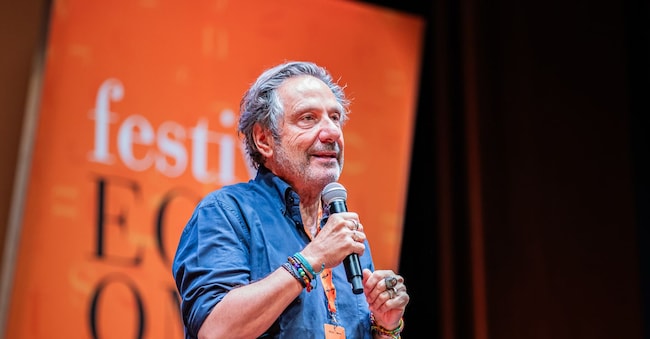
What really distinguishes sapiens from other living beings? Not intelligence, not the ability to communicate, nor the ability to build tools. The real difference is another: the speed with which human beings transform the world and accumulate resources. This is the starting point for the talk by science popularizer, CNR researcher and geologist Mario Tozzi at the Fuori Festival dell'Economia in Trento, a talk that crosses anthropology, ecology and social criticism to question the relationship between modern man and nature. Tozzi starts from a simple observation: no other living being has created imbalances on the planet like sapiens. And above all, no other accumulates. 'If we saw a monkey climb a tree, take all the bananas and store them to sell, it would seem absurd to us,' he observes. Hence the thought: are we really different from other animals because we are more intelligent, sensitive or creative? In reality, Tozzi argues, many species communicate, build tools, organise social relationships.
Meeting with the indigenous chief
Other living beings do not do certain things simply because they do not need to. "The monkey didn't invent the smartphone because he doesn't need it'. At the heart of the story is a meeting with Gui, a 41-year-old indigenous chief whom Tozzi met during a trip to the Amazon last spring. Gui's first question to him is disarming: 'Are you sure you are rich with all the things you have?' A phrase that becomes the thread running through the entire speech. Gui lives in a village without technology, where daily life is marked by hunting and small-scale fishing. There is no intensive cultivation, no systematic exploitation of resources: only what is needed is taken. Every evening, the inhabitants get together to talk, sharing time more than objects. They have no technology. They speak several languages - one for each village, in addition to Portuguese - and only use the money brought by tourists to buy the right to demarcate their land from the Brazilian government. Tozzi tells of being invited to hunt and fish. After fishing, Gui lights a fire in a few moments (obviously without lighters or matches) and picks fruit directly from the tree. In the Amazon rainforest, every gesture is practical knowledge, experience handed down and adaptation to the environment. Even smell becomes a key element. Gui tells Tozzi that he 'stinks', because animals immediately recognise the smell of a man who is a stranger to the forest. That is why he smears ants on him: the formic acid, he explains, would have masked his smell, making him less recognisable to the animals.
The Difference Between Economy and Ecology
The heart of the speech comes when Gui explains to Tozzi the difference between economy and ecology. He fishes because he likes it and because he has to eat, not to accumulate money, buy a boat or expand a business. 'We,' Tozzi seems to suggest, 'often turn means into ends. In that community, the very concept of accumulation does not exist. There is no currency: with neighbouring tribes, barter is practised, exchanging what is left over for what is needed. The role of the village chief is also significant: his main task is not to command, but to avoid conflict. Coexistence is based on balance and cooperation rather than competition. Tozzi then dwells on the education of the children. In the village they play freely in the central square, next to a burning fire and cutting tools. Parents do not constantly intervene to protect them or impart prohibitions because the children have to learn by experience.
The health theme
On the subject of health, Gui once again reverses the perspective of modern man. When Tozzi asks him what they do if someone falls ill, the village chief replies that he is probably better off than Tozzi himself. Noticing his hoarse voice, he rubs on his chest a balsamic substance extracted from an Amazonian tree, similar to that used in common balsamic ointments. 'The Amazon is an open-air pharmacy,' the populariser points out. The talk does not naively idealise the indigenous world, but uses that experience as a critical mirror of contemporary society. Through Gui's story, Tozzi questions some of the most deeply rooted beliefs in us: that progress necessarily coincides with accumulation, that well-being depends on possession and that nature is an infinite resource to be exploited. The final question remains unanswered, but runs through the entire intervention: are we really more evolved, or simply faster in consuming the world we inhabit?


