The Confindustria Bergamo General Meeting

‘We need fairness and a lighter tax burden to encourage employment’

Zanetti: “We don’t have any workers on the 100,000-euro flat-rate scheme.” Orsini: “Energy costs are unsustainable; the issue has got out of hand.”

5' min read

Translated by AI
Versione italiana

5' min read

Translated by AI
Versione italiana

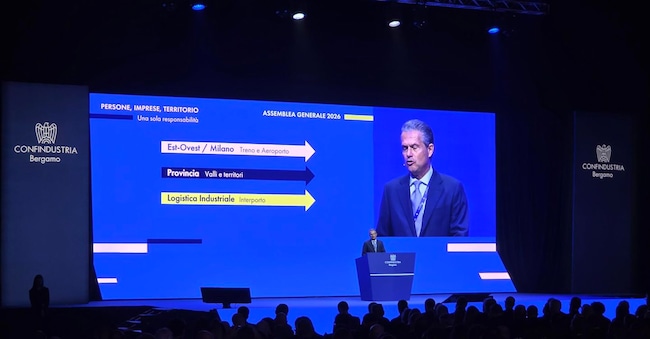
A local industrial sector that must be kept strong, whilst at the same time enabling it to cope with the major transformations currently taking place. Matteo Zanetti’s argument centres on this need; at his first annual general meeting before the association’s members, the president of the Bergamo Industrialists’ Association outlined the key points of a comprehensive strategy, calling for changes at various levels.

Whilst Bergamo can rightly take pride in the achievements of its manufacturing sector (140,000 people employed in manufacturing, over 20 billion in exports, and a local business cluster comprising almost 1,500 companies), the position it has achieved – as Zanetti observes – is certainly not guaranteed for ever.

Loading...

Whilst at a local level the hope is for accelerated infrastructure development – such as the construction of a high-speed rail link to Milan – in broader terms the critical issue looking ahead concerns demographics, with projections indicating a double-digit decline in the working-age population within the next 25 years. Whilst the problem has long been that of creating enough jobs, today the challenge is the opposite and concerns whether there will be enough people to support business growth.

This is an issue that must be tackled using a variety of approaches, starting with the development of a region that must become increasingly attractive if it is to ‘persuade’ local young people to stay or encourage those from elsewhere to settle here. Then there is immigration, with the hope of regular inflows that are consistent with labour market needs and accompanied by training and integration. But the other area requiring action is that of wages, which have been eroded in real terms in recent months by further price rises. The aim must be to tackle the tax wedge by narrowing the gap between the labour cost to the employer and the worker’s actual take-home pay. The call to the Government is therefore to introduce a tax system that is more favourable to employment and to reduce social security contributions, particularly for younger people, as well as to lower personal income tax on average incomes.

“Even for the sake of tax fairness,” Zanetti emphasises, referring to the measure set out in the Budget Law to extend the flat tax to the self-employed, “because here, amongst our workers, we don’t have any who are on the 100,000-euro flat-rate scheme.”

Europe is being called upon to take action on energy, once again treating its cost and availability as essential conditions for competitiveness, just as a change of direction is needed regarding the timing and approach of the Green Deal, given that the EU’s manufacturing sector is losing jobs, with the automotive sector representing the most striking example of a transformation that we risk being subjected to rather than shaping.

“If decarbonisation means forcing the industries that are supposed to drive the environmental transition to close down,” he explains, “then that means something isn’t working.”

Businesses are being asked to continue to focus on innovation, capitalising on trends and helping to develop new technologies – at least in part – as well as utilising them, for example by seeking to become part of the robot manufacturing supply chain, which already encompasses many of the skills found within Bergamo’s supply chain.

Another key issue concerns scale, with greater scale becoming a key prerequisite for competitiveness, all the more so in light of the transformations currently taking place. Scale is not an end in itself, but a means of gaining easier access to knowledge, supporting investment and competing.

Investments for which we must be able to continue to rely on the banking system, which is undergoing a process of further consolidation that nevertheless risks distancing regional areas from decision-making centres. “We must remind those involved of their responsibility to provide credit to the productive sector,” explains Zanetti, “ensuring that mergers do not automatically lead to a reduction in the overall amount of credit granted to businesses; to respond within a reasonable timeframe; and to delegate significant powers regarding the granting of credit at a local level.”

Loading...

The President of Confindustria

This was followed, during the meeting, by an interview with Confindustria’s chief executive, Emanuele Orsini, who covered a wide range of the most pressing issues of the moment. These ranged from the need for a forward-looking industrial policy to the call to extend the ‘Hyper-Amortisation 5.0’ scheme by one year – a measure that ‘has already generated nine billion in investment, out of the 2.8–3 billion committed by the State’.

The most critical issue is that of energy, with gas prices forecast to rise further in January (110–120 euros per MWh), making swift action essential. ‘It’s an issue that has got out of hand. The countries that are faring best,’ he explains, ‘are those with an energy mix that works: it is obvious that the Italian manufacturing sector is in serious difficulty if, at a time like this, even basic industries such as steel production are facing unsustainable costs.’

There are also calls to extend the interconnector rules (in Italia, these allow large, energy-intensive industrial customers to directly finance the construction or upgrading of cross-border power lines, in return for an exemption from certain costs; the scheme is due to expire at the end of December) as well as to decouple electricity prices from gas prices: ‘If hydroelectric power costs 25–40 euros per MWh and the PUN (National Single Market Price) reaches 276 euros, we must say “enough is enough”. And this does not mean being against energy producers; it means calling for a high degree of responsibility’.

Criticism has been levelled at Europe over the ETS scheme, ‘a diabolical scheme created for a very noble cause in which we all believed’.

“In 2016,” explains Orsini, “it was worth 5.6 euros per tonne; now it’s at 89.9, because some people are speculating. We need to have a discussion about this. Our MEPs have realised that safeguarding businesses also depends on this. We must be honest: the money raised through the ETS exceeds 80 billion across Europe; nearly 15 billion goes to the European Commission to cover its running costs. They should pay for their own running costs.”

And finally, on the subject of the agreement reached with the trade unions regarding representation: ‘A landmark moment,’ he explains, ‘we are now measuring representation – how much we are worth, who we are. And it is an important step in the fight against ‘pirate’ contracts. There will be safeguards for business growth and spending power, with the link between contracts and inflation – something we had already introduced in the metalworkers’ contract. The truth is that the others will have to fall into line with us: on wages, we’ve done our homework, with 94 per cent of contracts signed.”

Copyright reserved ©
Loading...

Brand connect

Loading...

Newsletter

Notizie e approfondimenti sugli avvenimenti politici, economici e finanziari.

Iscriviti