
We need the shadows to see the light
The French writer Éric Chevillard in 'Holy Heaven' imagines an afterlife where we know everything, understand everything, but can do nothing more

4' min read
4' min read
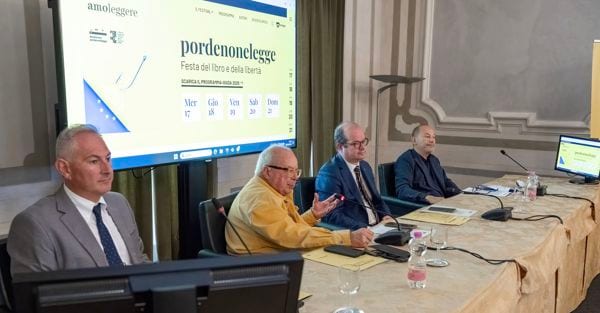
'Talking about a book is a bit like going back into that fog that preceded it, from which it was born to dispel it,' Éric Chevillard tells me over a coffee in Pordenone, where tomorrow, Friday 19 September, he will be on stage at the Arena Europa, guest of Pordenonelegge, for a staged reading with Paolo Di Paolo.
I have just finished interviewing him, forcing him to find another, much more imperfect form to say what he has already said. Earlier, he had said that he loves short, concentrated forms, and at the opposite end of the spectrum, continuous digression, aware of the paradox: 'On the one hand I feel that I would never want to stop writing, on the other that I write to put a point on it'. I hope, therefore, that asking him about his latest book: Santo cielo (preface by Paolo Di Paolo, translation by Gianmaria Finardi, Prehistorica, pp. 176, euro 17) can be seen as a digression on the subject.
Goodness... what is it about?
It is the story of a man who dies and finds himself in the afterlife somewhat bewildered by what he discovers. In this celestial sojourn he has a complete view of the world below him, as if he were on a belvedere. He sees people living on earth and has absolute knowledge of what life has been like, of all that he has not understood. Everything is now revealed to him. He realises that heaven is a kind of bureaucracy, where you go from office to office to understand things. Heaven is a bit of a fantasy of life after death, it investigates the ghost we have, the desire to have perfect knowledge of life, its meaning, and everything that has happened in one's existence
Albert Moindre, the protagonist, learns where he lost his umbrella, he knows if a certain woman really loved him, how many women really loved him, how many chickens he ate, how many steps he climbed, what happened to his friend he lost sight of. In paradise all is revealed to him, he has the solution to all questions, from the most anecdotal to the most profound, he can finally know who is the greatest writer of all, as if there is a supreme truth to which he can have access.

