
We support mankind by aiming at techno-humanism

3' min read
3' min read
Speed changes shapes. Even the most familiar face, with the features we know best, subjected to accelerated movement becomes less recognisable. Thus technology races and whirls the planet, changing its appearance. Man runs after it: he deludes himself if he believes he is in control. But he also has an extraordinary capacity to adapt, and that is a resource that should not be underestimated.
In recent decades we have lived through an era of acceleration and asymmetry, which has taken away social rights and increased inequality. Now we are entering a new phase. Similar and different. Let's take an example that may sound like science fiction, but is near future: in the next twenty years millions of people will install a plate called the Brain-Computer Interface, a chip connected to an external device to improve communication, in their skulls. The dark part is that the chip will have access to our innermost thoughts. The bright part is that the brain will be able to express its creativity without the limitations of voice, body, language. Such a challenge requires open technology: a brain operating system cannot be closed, in the hands of one company. It must be an open system - of all and for all - just as technology must be a common good.
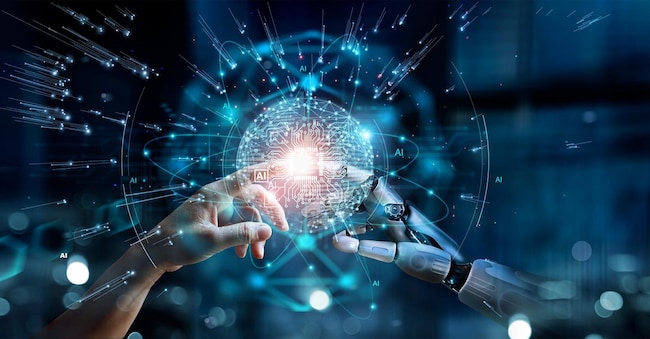
But this is only one of the fronts. More generally, technological development can lead to disastrous consequences, but also multiply medical possibilities, knowledge of the universe, the fight against climate change. We are moving towards a technological landscape that is increasingly difficult to understand. Artificial Intelligence will reach a point where it will be impossible to stop it. It will be able to self-programme, self-improve, and at a speed that man can no longer follow. That is why it must be equipped with super-intelligence. Allow him to think faster. Support man so that he is not replaced. David Foster Wallace recalled that the mind is a good servant but a bad master. Technology must serve man, not dominate him. Let us not ask whether it is friend or foe: let us ask how to give it the right direction. The one that will improve everyone's life.
Yet, to imagine slowing down is an illusion. Stopping technological progress is impossible. We have reached such a level of globalisation that if one part of the world tries to slow down, another speeds up. Just as global fluidity affects every life, so Artificial Intelligence will affect our lives. In an unbalanced way, because each country will use it in its own way. And from competition between man and machine it will move to competition between man and man.
This is where Europe can - and must - exercise its historic responsibility: not in regulating Artificial Intelligence, but in trying to guide it. If it is not possible to contain it with regulations, to inspire it with values. In a world racing towards the future without asking itself towards which one, Europe can be the conscience of the transition. This is where technohumanism is born: a new alliance between thought and machine, between culture and code.

