Test drive

Mercedes C-Class Electric. We put it through its paces: here’s how the AI saloon with a range of over 750 km performs

The Stuttgart-based manufacturer’s new electric car features cutting-edge technology and high-calibre engineering solutions that reaffirm the role of the European and German automotive industries

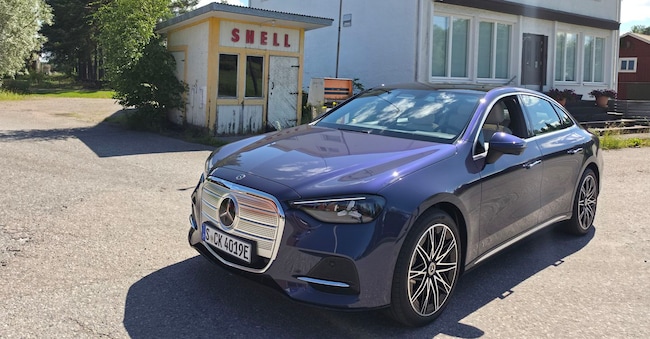
Mercedes Classse C Elettrica Mario Cianflone

5' min read

Translated by AI
Versione italiana

5' min read

Translated by AI
Versione italiana

With five generations – six if we include the original 190 – the Mercedes C-Class is one of the cars that have made history. And now, with this new, all-electric version, it is no longer a ‘Baby Benz’ but a full-size saloon, almost 5 metres long, with lines that exude Mercedes pride in every detail. Starting with the front end and its massive grille, which forms part of the Stuttgart-based manufacturer’s latest design language. And on board, there’s a wealth of cutting-edge technology, very similar indeed to what we’ve already seen on the CLA which, unlike the C-Class, is not only fully electric but also offers a mild-hybrid powertrain.

We went to try it out in Helsinki, Finland, on a short test drive to see how this lithium-ion Mercedes (which, incidentally, does not replace the ‘old’ hybridised petrol-electric variant) is a comfortable, agile car with sound handling – quite different from that, let’s face it, boring driving experience of the typical SUV.

Loading...

We tested the 4Matic all-wheel-drive version. This model is powered by two permanent magnet synchronous (PSM) motors capable of delivering a total power output of 360 kW.

Mercedes Classe C Elettrica, tutte le foto del debutto in Finlandia

Photogallery32 foto

The manufacturer’s performance figures state that the car accelerates from 0 to 100 km/h in 4.0 seconds. The real engineering innovation lies in the rear axle, which houses a two-speed automatic gearbox. The first gear (11:1) is a short ratio designed to ensure rapid acceleration, maximum towing capacity and efficiency in urban driving; the second gear (5:1) engages at higher speeds, reducing fuel consumption on long motorway journeys. Furthermore, on all-wheel-drive versions, the front engine is fitted with a disengagement unit (DCU) that disconnects it almost instantly when maximum traction is not required, reducing energy losses by up to 90 per cent.

The system is powered by a lithium-ion battery pack with 94 kWh of usable energy, providing a range of 750–760 km. Thanks to its 800-volt architecture, the saloon supports ultra-high-power DC charging of up to 330 kW. Under ideal conditions, this allows 80 per cent of the range (starting from 10 per cent) to be restored in just 22 minutes at a charging point. The manufacturer’s figures put consumption at 14.1 kWh per 100 km. During the brief test drive carried out on the roads around Helsinki, this figure proved to be a realistic representation of real-world conditions, in that the variation was minimal, meaning the car is genuinely very economical.

The German manufacturer has, however, already announced the arrival of a rear-wheel-drive variant capable of reaching a range of 800 km. Deceleration is managed by an integrated ‘one-box’ braking system, capable of recovering up to 300 kW of energy and bringing the vehicle to a halt almost exclusively through regenerative braking.

Behind the wheel, the car proves to be very responsive, just like many electric cars, and extremely enjoyable to drive, as it instils that sense of stability and precision that is not found in any Chinese car in any category, even those with similar technologies such as the 800 internal network.

Clearly, the low centre of gravity, the next-generation platform and the fine-tuning of the suspension system make this car comfortable and sporty to drive – in this respect, it embodies the very best of the C-Class philosophy.

From a technological point of view, the Hyperscreen system on the dashboard – with its triple-screen configuration – is particularly impressive, as it results in a total screen size of no less than 39.1 inches. It must also be said, however, that it fails to fully convince. This is because, from an ergonomic point of view, there are limitations – as is usually the case – with the physical controls and, above all, with the overuse of touch controls. Among the drawbacks – even though Mercedes has tried to remedy them – are the steering wheel controls: although there are physical controls, these touch-sensitive buttons are really awkward to use. This is probably an area where the Stuttgart-based manufacturer needs to step in and bring about a turning point in terms of ergonomics.

The proprietary MB.OS operating system coordinates all the vehicle’s functions, from infotainment to battery management and the Mb.Drive driver assistance systems. Based on artificial intelligence, it powers the MBUX virtual assistant (which integrates ChatGPT-4o and Google Gemini) and ensures continuous over-the-air (OTA) updates, keeping the car’s software up to date over time without the need to visit a garage. Built on a native electric platform, the new C-Class boasts a wheelbase extended to 2,962 mm (+97 mm compared to the outgoing model), which greatly enhances interior space for passengers. The boot offers a capacity of 470 litres, complemented by a second front storage compartment (frunk) of 101 litres, useful for stowing charging cables or small items of luggage. In terms of driving dynamics, the set-up is geared towards maximum ride comfort thanks to the Airmatic air suspension with predictive damping and the rear-axle steering with up to 4.5°, which reduces the turning circle to just 11.2 metres.

Loading...

Finally, great attention has been paid to on-board energy management: the new multi-source heat pump recovers residual heat from the powertrain, the battery and the outside environment, enabling the passenger compartment to be heated from -7 °C in half the time and using half the energy compared with traditional solutions. For the first time in the model’s history, the interior is also available in a certified 100% vegan configuration.

The real star of the cabin is a massive screen measuring almost a metre (99.3 cm, to be precise) that takes up virtually the entire dashboard. Behind the three spokes of the steering wheel sits the 10.25-inch digital instrument cluster – the smallest display in the line-up, ensuring it remains clearly visible at all times whilst driving. Everything else is handled by the other two 14-inch screens: the central one controls navigation and on-board functions, whilst the passenger has their own dedicated screen to watch a film or browse the web even whilst on the move. There’s no need to worry about safety, though: there’s a camera that monitors the driver’s gaze and dims the passenger’s screen if it detects that they’re becoming distracted. What’s more, right in the centre of the dashboard, there’s a webcam designed for making video calls on the fly, directly from the car. Prices start at €70,300, but it’s easy to reach €80,000 if you include a few optional extras.

Copyright reserved ©
Loading...

Brand connect

Loading...

Newsletter

Notizie e approfondimenti sugli avvenimenti politici, economici e finanziari.

Iscriviti