
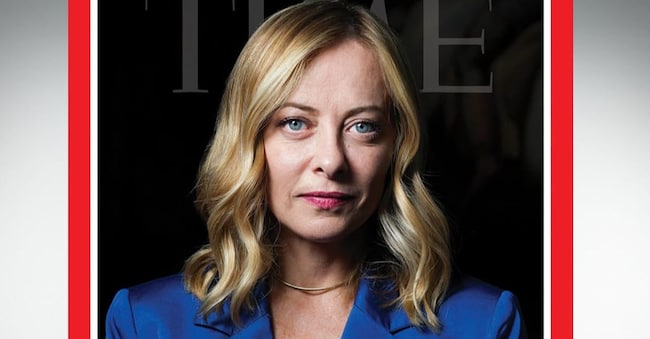
The weekly Time magazine dedicates its cover to the premier: 'Where Giorgia Meloni is leading Europe'
The PM: 'First of all, we must defend who we are, our culture, our identity, our civilisation'

3' min read
Key points
3' min read
Giorgia Meloni on the cover of the American weekly Time. The publication dedicates an extensive article to the Prime Minister entitled 'Where Giorgia Meloni is leading Europe', signed by Massimo Calabresi, tracing a complex and multifaceted profile of the Fratelli d'Italia leader. The preview of the article reads: 'Fascism is a subject from which Giorgia Meloni, Italy's prime minister, cannot escape. When she won power in 2022, leading a movement born from the last loyalists of Benito Mussolini, critics in Italy and Europe saw in her nationalist rhetoric and defence of 'western civilisation' a dangerous turn to the right for the country'. US President Joe Biden himself had pointed to his election as a sign of the growing danger of authoritarianism globally, it is recalled. Yet, Time points out, Meloni 'has displaced many of her opponents': at home, Meloni 'has moderated some of her more radical positions, while on the international stage she has been more pragmatic than ideological, earning the respect of very different political figures, from Biden to European Commission President Ursula von der Leyen to US Vice President J.D. Vance'. Almost three years into her term, Meloni is described as 'one of the most interesting figures in Europe', whose leadership style could have a significant impact far beyond Italy's borders.
Meloni to 'Time': we must defend our culture and identity
"First of all, we must defend who we are, our culture, our identity, our civilisation," says Prime Minister Giorgia Meloni in her interview with 'Time', which dedicates a long article to her with the cover image and the headline: "Where Giorgia Meloni is leading Europe". "You are an honest person," she begins, speaking to the interviewer: "Is there anything about fascism that my experience reminds you of, of what I do in government?" The premier opposes what she calls a 'homogenising' globalism, but is an advocate of European integration. She is the first woman leader in Italy and says she has had to 'deal with ridiculous stereotypes' in her career, but rejects the government's attempts to remedy or correct other forms of discrimination, which she calls 'quotas'.
The idea of nationalism
.On her idea of nationalism, the premier explains that 'first we must defend who we are, our culture, our identity, our civilisation'. Her nationalism, she adds, 'is mainly a way to defend ourselves against a globalisation that has not worked'. And he declares his intention to 'rebuild our identity, rebuild our pride, the pride of being who we are.... Whatever the cost'. According to the report, Meloni's skills were evident in her last White House meeting with Donald Trump. Meloni prepared him with a stack of cards with her position on any issue that could be addressed, and she survived the public test with composure, Calabresi points out. 'I'm a Capricorn,' says the premier, 'Let's say I'm fixated on a few things'. The author goes on to report that once the press had left the Oval Office, when the conversation with Trump focused on Ukraine, Meloni passionately defended Zelensky and the need to support Ukraine to the end. Trump listened and responded, but without the exchange becoming polemical, to Meloni's account: 'He is a fighter, and I am a fighter'.
One of the most interesting figures in Europe
.Time dedicates its new cover story to Prime Minister Giorgia Meloni, explaining on X that 'almost three years into her term, Giorgia Meloni has emerged as one of Europe's most interesting figures. And the way she leads the nation could change the world'. In the portrait-interview, the American periodical traces the premier's political and personal history, from her childhood to her first steps in youth engagement, up to the two and a half years of centre-right government. On the international stage, Time writes, Meloni has behaved less like a right-wing revolutionary than a pragmatic conservative. Meloni embraced the European Union, NATO, and Ukraine, worked to isolate China, and deftly worked to reconcile the strained relationship between America and Europe at the start of President Donald Trump's second term. Along the way, she won over leaders from across the ideological spectrum, from Biden to European Commission President Ursula von der Leyen to Vice President J.D. Vance. Meloni is building a new kind of nationalism, Time adds, populist, nativist and pro-Western, but committed to European and Atlantic alliances. "First of all, we have to defend who we are, our culture, our identity, our civilisation," Meloni says during her interview with Time, claiming conservative victories in stabilising Italy's notoriously chaotic government and improving its debt rating.

