
Welcome, the network that helps refugees integrate
The UNHCR project photographed 11,700 vocational integration pathways in 2023 thanks to 220 companies

4' min read
4' min read
Italy is a welcoming country. This is well known by the Ivorian sociologist who, through UNHCR's Welcome project, did an internship in the HR department of a company, where he is now employed as a manager. Or the sub-Saharan boy who, as a trainee in a large supermarket chain, now holds the position of assistant manager.
"There are many stories like these,' explains Chiara Cardoletti, UNHCR representative for Italy, the Holy See and San Marino, 'because those who enter Italy with this programme then stay there. The numbers of 'Welcome. Working for refugee integration' confirm this: in 2023, 11,700 career paths for refugee people were set up through 220 companies. And the trend shows growth. The number of people placed in 2023 has increased by 32% compared to the previous year, women have grown from 18 to 20%, as have permanent contracts, which represent 6% of the total, while they were at 5 in 2022. Since 2017, the year in which the project started, there have been 34,000 placements and 742 companies involved. 'Results that show that integration is possible,' Cardoletti adds, 'and that only by working in a network can an efficient system of inclusion be created. An important goal, envisaged by Goal 17 of the UN Agenda 2030, which aims to strengthen the global partnership for sustainable development. "Welcome" is in fact a multistakeholder model, in which key players in the world of work collaborate: companies, associations, public bodies. The system works through three key processes: the reception process activated by a welcome net, the selection and training process managed by Adecco, and the employment process made possible by the numerous companies involved in the project. Facilitating communication between stakeholders is 'Welcome in one click', a digital platform launched to strengthen integration paths. "Integration that we see in the numbers, but also in the enthusiasm of the companies participating in the project," Cardoletti concludes, "which have experienced how diversity is a value that creates economic and social wealth.
The sectors involved are diverse, with accommodation and catering in first place, followed by manufacturing and construction. But the IT sector is growing, thanks to the many skills arriving from Afghanistan, Syria and Pakistan, or the gold and fashion industry.
'We joined the Welcome programme in November 2023,' explains Gianni Moscatelli, Ovs Human Resources Director, 'because we are aware of the importance of our social role. The world is changing and every company has a responsibility for what it will leave to future generations'. A commitment, in fact, that began before the meeting with UNHCR. After the start of the conflict in Ukraine, in fact, Ovs had offered support to the victims of the war, sending a truck to the Fernetti crossing with boxes of clothes for the refugees and supplying clothing to Caritas. Focusing instead on work, the 'Welcome' project resulted in 74 interviews and 15 hirings, two of which have already been transformed into permanent contracts. "The entry of people with a challenging background and an important baggage of diversity has positively contaminated the shops," Moscatelli concludes.
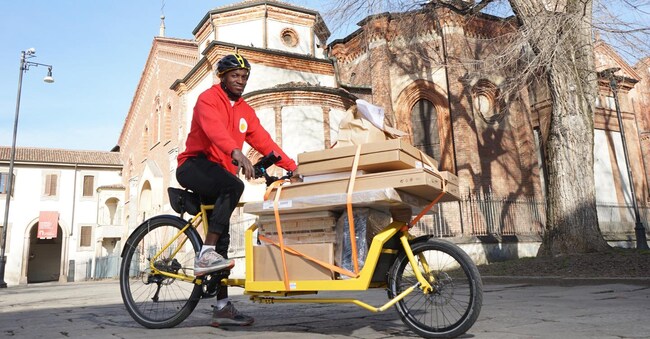
Not only big companies in the Welcome project. "We are a social enterprise of sustainable delivery," explains Naima Comotti, co-founder of Magma, a company founded in Milan with the aim of demonstrating the feasibility of an ethical and sustainable delivery service. We started with an experiment and we were right: our project in 2022 turned into a business. Today we offer a last-mile home delivery system, by bike and cargo bike, which is committed to providing the platform's couriers with a fair contract, proper training and the necessary equipment. But we don't just deliver products for companies, we also do social deliveries, taking, for example, unsold food to solidarity networks'. A company with a social vocation, Magma immediately included fragile workers in its team. Of the 12 hired, four come from migratory backgrounds and of these, two were hired on a permanent basis: a 24-year-old boy from Senegal who also participates in an inclusion project through football, and a 25-year-old boy from Gambia who is one of the team's most experienced couriers in social deliveries.


