
Welfare, against the traps of the bonus economy a plan for the new generations
Elsa Fornero's proposal to overcome the fragility of the Italian economy: a bipartisan initiative to be pursued regardless of who wins the elections. From the Notariat proposals to support the house plan

Key points
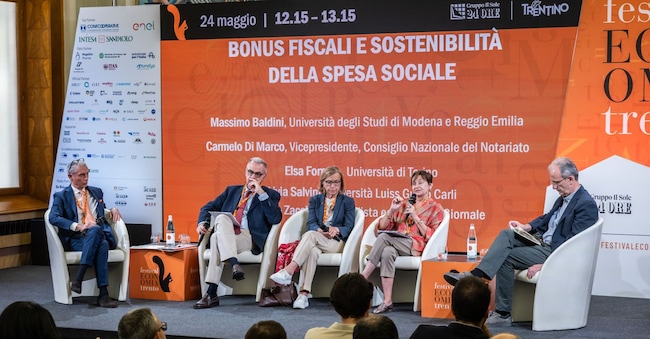
A plan for the new generations (Png) to overcome the structural fragilities of the Italian economy characterised by low growth. A bipartisan plan, with the prospect of going beyond next year and becoming a platform on which whoever wins the political elections can work. Launching the idea was Elsa Fornero, honorary professor of Economics at the University of Turin and former Minister of Labour and Social Policies in the Monti government, during the panel 'Tax bonuses and sustainability of social spending' at the Trento Festival of Economics. A proposal to try to outline a broader time horizon.
The condemnation of lack of growth
"The policy of bonuses is a demonstration of the inability of politics to conceive and even more so to implement medium-term policies, strategies and visions," said Fornero, who did not hesitate to define them as an expression of 'populism': "Instead of transparent and well-directed measures, they confuse the cards by giving everyone the impression, in turn, that they are benefiting from politics. Bonuses are the essence of Italy's malaise: for 25 years they have condemned us not to grow'.
Ballast on structural reforms
It was precisely on the role of bonuses that the other speakers (moderated by Marcello Zacchè, columnist for 'Il Giornale') discussed. Massimo Baldini, lecturer at the University of Modena and Reggio Emilia, explained the possible effects of bonuses that are linked to the economic patrimonial situation measured through the Isee. Bonuses often tend to be concentrated on families with a low average economic situation indicator. Therefore, they tend to exclude or predominantly disregard middle-income households, which at the same time are those who pay the largest share of the tax burden. This disproportion could create political discontent. Then, Baldini pointed out, 'there is a long-term effect of bonuses, and that is that they cost a lot of money, they congest the budget and are an expression of short-term political choices, which are often short-sighted' and thus prevent the structural reforms that are needed.
The disincentive for women to work
There is then another distortion pointed out by Livia Salvini, professor of tax law at the Luiss University: 'In the family sphere, the second income earner is usually the woman, i.e. the woman earns less. So it is clear that where these bonus measures tend to decrease or even cancel themselves out as income increases, especially if family income, the one who is induced to give up her job is the woman'. The risk, therefore, is to disincentivise women's work. What to do? 'One can intervene contingently with some bonuses, even if they are modified or reduced over time, such as those for working women or mothers. But for women's work,' Salvini suggested, 'we need structural incentive measures and certainly not these episodic bonuses'.
Real estate market increasingly less 'young'
Carmelo Di Marco, vice-president of the National Council of Notaries, noted that 'the real estate market draws essential respite from facilitative measures. Facilities that concern both property purchases (reduced registration for purchases and sales between private individuals, which account for almost 90% of the total, and reduced VAT for business purchases) and building renovation and energy requalification work. However, a careful examination of market data must be made. In 2025, in fact, the number of subsidised home buyers under the age of 45 was less than 50 per cent. 'Before talking about concessions, there is a problem,' Di Marco explained, 'of access to the market that depends on the insufficiency of policies to support the economy and the incomes of the younger generations. But there are also other data that should give us pause for thought. The under 45s of today who have the concrete prospect of buying a house are exactly half of those who were under 45 twenty-six years ago. And looking ahead to 2040 there will be almost 10 million elderly people, many of whom live alone and own their own homes. And this implies that several million used housing units will be put on the market. So all institutional actors are called upon to play their part and to confront each other for solutions looking at what will happen in the coming years.


