Middle East

West Bank: Amnesty accuses Israel of ethnic cleansing

According to the human rights NGO, the forced displacement of Palestinians, particularly in rural areas, is the result of a systematic state policy

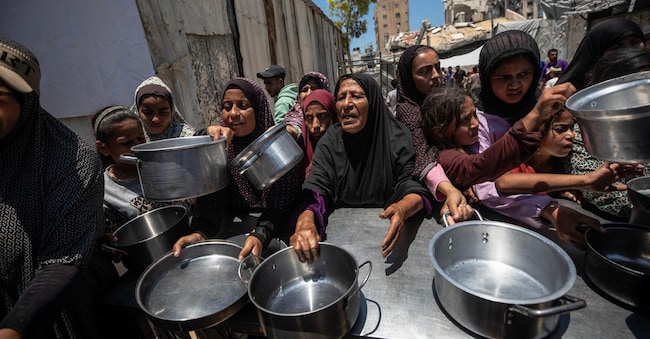
epa13027909 Profughi palestinesi con pentole e padelle di metallo in mano mentre si radunano per ricevere pasti caldi da una mensa di beneficenza nella parte settentrionale della città di Gaza, 10 giugno 2026. La distribuzione di cibo è avvenuta in un momento di grave carenza di aiuti di prima necessità in tutta l'enclave. Le agenzie delle Nazioni Unite hanno riferito che, nonostante un cessate il fuoco nominale, l'ingresso di aiuti essenziali a Gaza rimane fortemente limitato.  EPA/MOHAMMED SABER EPA

3' min read

Translated by AI
Versione italiana

3' min read

Translated by AI
Versione italiana

Israel is reportedly conducting a campaign of “ethnic cleansing” against Palestinians in the occupied West Bank, with the deliberate aim of annexing Palestinian territory. The accusation is contained in a new 149-page report published by Amnesty International, according to which the forced displacement of Palestinians in the West Bank is the result of an organised state policy and not merely the result of the nefarious actions of individual violent settlers.

UN data indicates that over 100 villages in the West Bank have been emptied — either completely or partially — between January 2023 and April 2026. At the same time, the UN has recorded more than 7,280 cases of individual evictions of Palestinians due to the demolition of homes and structures by Israeli forces (a figure that includes people displaced more than once).

Loading...

Israel, which has in the past dismissed such allegations — including those of ethnic cleansing — as unfair and long-standing prejudice, has not yet responded to the report.

“These abuses are not the result of a few isolated incidents. Settler violence is a key component of a state-sanctioned campaign of ethnic cleansing,” said Agnès Callamard, director of Amnesty. “What we are witnessing is a deliberate, state-led annexation, in total violation of international law, before the eyes of the whole world.”

Some Israeli leaders have, in the past, condemned the most serious acts of violence by Jewish settlers, but tend to regard them as exceptions. Several senior ministers in Benjamin Netanyahu’s government are pushing for a formal annexation of the territory, whilst various officials have expressed support for Israeli sovereignty over the West Bank.

Amnesty claims to have identified dozens of bills in the Israeli parliament, the Knesset, aimed at extending Israeli civil law and jurisdiction to settlement blocs, as well as to courts trying Palestinians. Recently, the parliament passed a measure making the death penalty the default punishment for Palestinians in the West Bank who are convicted of politically motivated murders.

Israele, sì della Knesset alla pena di morte per palestinesi

Last year, US President Donald Trump stated that he would not allow Israel to annex the West Bank. The US-brokered ceasefire between Israel and Hamas militants, aimed at ending the war in Gaza, also recognised Palestinian aspirations for statehood.

The challenges facing the Bedouin tribes and the escalation following 7 October

The large-scale displacement of Palestinian Bedouin communities in the territory — writes Amnesty — is caused by settler violence, the expansion of new settlements and Israel’s appropriation of vast areas of unregistered land. Several human rights organisations had already raised the alarm about this type of displacement before 2023, but the situation has deteriorated drastically following Hamas’s attack on Israel on 7 October 2023, which triggered the war.

Many human rights groups argue that Bedouin communities engaged in pastoralism in rural areas of the West Bank are the most vulnerable to displacement. Unlike Palestinians in the cities and urban centres of the West Bank, villagers have less capacity to resist pressure from settlers, who are often armed, as they establish new outposts around Palestinian villages.

The group Peace Now — which monitors the settlements — estimates that 212 of the 363 outposts currently in the West Bank (at the very least) have been established since 2023. The outposts are built without permission from the Israeli authorities, who sometimes dismantle them. At other times, however, they turn a blind eye or legalise them retrospectively.

Much of the international community regards the settlements as illegal. Israel, on the other hand, views the West Bank as a disputed territory whose status is to be determined through negotiations.

The Amnesty report analysed 27 hamlets and villages in the West Bank from which Palestinians were displaced between 2023 and 2025. The researchers interviewed dozens of Palestinians and lawyers, spoke to witnesses of settler violence, reviewed over 420 videos and analysed government statements and other reports.

Amnesty claims that the international community has so far been unable to take action to stop the displacements.

In the occupied West Bank and East Jerusalem — territories captured by Israel in 1967 and claimed by the Palestinians for their independent state, along with the Gaza Strip — there are over 700,000 people.

Copyright reserved ©
Loading...

Brand connect

Loading...

Newsletter

Notizie e approfondimenti sugli avvenimenti politici, economici e finanziari.

Iscriviti