
West in search of new leadership to combat decline
. .

3' min read
3' min read
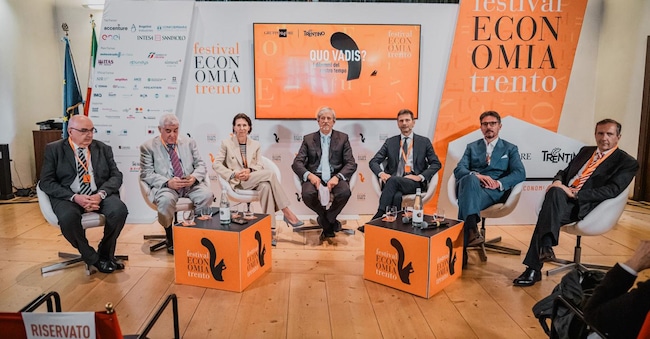
The two wars. Protectionism and global interdependence. Fragmented Europe, squeezed between the US and China. Polarisation in the age of social. Rising inequalities. Dissatisfaction generating radicalism and trust in populist leaders. And more. Will the forthcoming European elections succeed in expressing a leadership that lives up to the expectations and challenges of the present? How to move in this context of high volatility without getting hurt? This was discussed at the round table on 'Leadership Crisis and the Decline of the West' in front of a packed hall in Palazzo Geremia. With the president of the Italian Stock Exchange Claudia Parzani, Luigi Gubitosi, president of Luiss University, Ambassador Pasquale Salzano, president of Simest, a company of the Cdp group, which supports the internationalisation of Italian companies; Sergio Marullo di Condojanni, ceo of Angelini Industries ($2 billion in revenues in 22 countries on three continents); the economist Fabio Scacciavillani, asset manager and founder of Nextexperience and the president of Confcooperative Maurizio Gardini.
For Parzani, at such a complex and in some ways challenging time, the absolute imperative is the responsibility of all players, public and private. "The first problem is that there is too much individualism. It is no time to go it alone in Europe. We must have the door open to the world. But the level of teamwork must be raised. The positive transnational examples are there'.
Scacciavillani notes that 'globalisation failed because China abused the good faith of Westerners. The asymmetries with which rules have been applied in the West and China have caused this'. The example of TikTok, controlled by the Chinese parent company Bytedance, which, faced with the prospect of being blocked in the US, filed a lawsuit against the American government, was given: 'Imagine if a Western company filed a lawsuit against the Chinese government: what hope would it have of obtaining justice? None'. A narrow alley that of the new post-globalisation blocs between the US and China from which 'it is difficult to get out'. Gardini of Confcooperative recalled 'the Western presumption in the 1990s when it was thought that globalisation would also fuel the growth of democratic processes in countries like China, with an almost missionary thrust'. The result? 'Delocalisation caused the development of a Chinese production model in strong opposition to the West'.
In this development without rules, there is no shortage of paradoxes. Like that of Beijing, which continues to push energy consumption with coal-fired power stations to produce solar panels. Due to overcapacity, as is happening with electric cars, European and Western production is being thrown into crisis. 'We need to raise the level of European policies that are truly revolutionary and can help us make a difference, with active protectionist defence measures that help EU companies,' argues the president of Confcooperative.
Gubitosi believes that it is 'exaggerated to speak of the decline of the West'. The US remains the world's leading economic and financial power and will remain so. Of course 'there are major geopolitical concerns. Not only wars, but also 'the future challenges of artificial intelligence. A field where we compete on three factors: data, PC computing and algorithms. TikTok has all the personal data of the Chinese, and also of many Western countries. It is normal that there are concerns. In a multipolar world it is important to find rules'.


