
Western Balkans in the EU: summit in Rome. Italia steps up the pressure
The countries of the Friends of the Balkans Group have approved the “Charter of Rome”. On 14 July, new negotiations will begin on the accession of Ukraine, Montenegro, Moldova and Albania to the EU

Key points
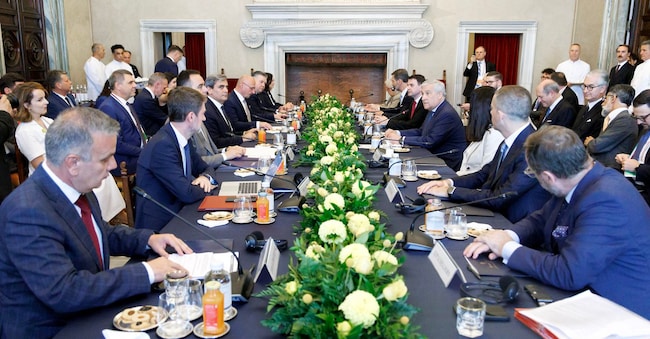
Italia continues to take steps to pave the way and speed up the entry of Western Balkans into the European Union. On Friday 20 July, Villa Madama hosted the ministerial meeting of the “Friends of the Western Balkans” group and the Foreign Ministers of Balkans. The meeting was chaired by the Minister for Foreign Affairs, Antonio Tajani. The group comprises seven European Union member states (Italia, Austria, Croatia, Greece, the Czech Republic, Slovakia and Slovenia) which are cooperating to support the accession of the six Balkan countries that are candidates or potential candidates for EU membership. These are, specifically, Albania, Bosnia and Herzegovina, Kosovo, North Macedonia, Montenegro and Serbia. Hungary was also invited for the first time, in recognition of its commitment to supporting the integration of the Western Balkans.
The “Rome Charter”
The group has adopted a policy document put forward by Italia on future accession treaties. The aim of this ‘Rome Charter’ – according to a statement from the Farnesina – is to ‘preserve the credibility, predictability and unity of the enlargement process’. The text reaffirms the principle of full equality among Member States following accession, ruling out models of differentiated participation or forms of ‘second-tier’ membership. It also reiterates the need to keep the ultimate objective of the candidate countries’ European path clear and stable, whilst avoiding new levels of conditionality. Any safeguard clauses and transitional measures – it explains – must be based on objective needs, be proportionate, temporary and tailored to the specific circumstances of each country.
Italia’s pressing
Two months on from the previous ministerial meeting, held in Bratislava, the Rome meeting aims to give fresh impetus to the process of European Union enlargement to the Western Balkans and to strengthen the region’s contribution to European strategic autonomy. Among the issues discussed were food security, the resilience of supply chains and the enhancement of connectivity. Also taking part in the proceedings were the Deputy Director-General of the FAO, Maurizio Martina; the European Coordinator of the Western Balkans–Eastern Mediterranean Transport Corridor, Marian-Jean Marinescu; and the Secretary-General of InCE, Franco Dal Mas.
The EU-27 give the go-ahead for the opening of a new EU accession cluster for Ukraine
Italia has always acted as the main ‘bridge’ and driving force behind the integration of this region into the European Union. In the last few hours, gthe Ambassadors of the Twenty-Seven have agreed to move forward with the EU accession process for Ukraine and Moldova by opening cluster 6 on external relations, and to provisionally close negotiation chapters 25 (science and research), 26 (education and culture) and 30 (external relations) for Albania; and negotiation chapters 8 (competition policy) and 29 (customs union) for Montenegro. The news was announced by the rotating presidency of the Council of the EU. “We are building a more resilient Europe: another step towards the EU for Ukraine and Moldova,” commented European Council President Antonio Costa on X.
New negotiations on 14 July regarding the EU accession of Ukraine, Montenegro, Moldova and Albania
An EU official explained that on 14 July, during the General Affairs Council, there will be ‘several Intergovernmental Conferences (IGCs) with countries applying for EU membership. Internal negotiations within the Council are still ongoing, but the Irish Presidency aims to hold conferences with Ukraine, Montenegro, Moldova and Albania”. In the case of Ukraine and Moldova, therefore, a new ‘cluster’ will be opened as part of the formal negotiations, whilst for Montenegro and Albania the aim is to close certain negotiation chapters. As for Serbia, the matter has been discussed in recent days within Coreper, the body comprising the ambassadors of each EU country, which is responsible for preparing all the work and decisions of the Council of the European Union. However, the same source added, “no agreement has been reached on the opening of the three chapters under consideration; consequently, we are not in a position to schedule an Intergovernmental Conference with Serbia. I believe that work is ongoing and we will need to assess the progress made in this regard before the end of the month’, the European source clarified.


