familyandtrends

What Adriano and Olivetti can teach Italian family businesses
by Bernardo Bertoldi

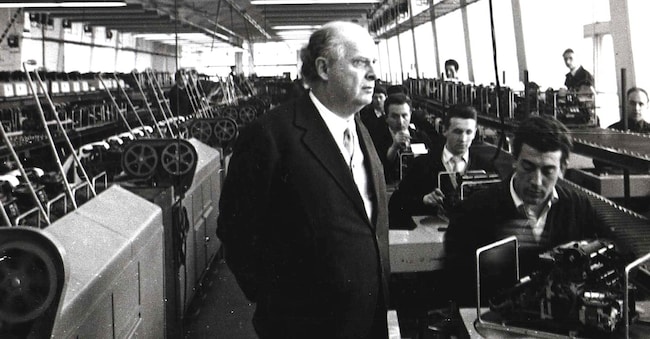
Adriano Olivetti. (©PUBLIFOTO/LAPRESSE)

4' min read

4' min read

familyandtrends had the opportunity to spend a few days in Adriano Olivetti's former home in Ivrea and to understand, once again, what an extraordinary entrepreneur he was. It is not only about an entrepreneur who, with the concept of Community and the construction of factories integrated into the territory and connected with the well-being of those who worked there, would be light years ahead of many companies today; it is also about an entrepreneur who forged an extraordinary enterprise.

Camillo, Adriano's father, produced mechanical devices, mainly meters for electricity, a sector that was developing in Canavese thanks to the abundance of water jumps thanks to the activity of entrepreneurs such as Bernardo Genisio. In order not to depend on a few large customers, Camillo diversified his business by devoting himself to typewriters, which made it possible to reach a wider public and reduce the concentration of customers.

Loading...

When Adriano joined the family business in 1924, Olivetti had 200 employees in Canavese; in 1960, when he died, it had 36,000, more than half abroad. This is enough to understand Adriano's entrepreneurial scope, but the company he forged was not just 'big' it was the most technological in the world.

An example of this is the Programma 101 developed in the Electronic Research Laboratory wanted by Adriano before his death. The P101 was the first personal computer in history and was developed between 1962 and 1964. Bill Gates and Steve Jobs were 7 years old. When it was presented by the president of Olivetti USA, Gianluigi Gabetti, in New York in 1965, it was something so new and difficult to describe that the press called it a 'computer that sits on top of a table', i.e. desk-top computer. Being 'on top of a table' was something inconceivable in a world where computers were mammoth assemblies of transistors that took up entire rooms and could only be handled by skilled technicians. Advertising presented the P101 as an everyday, personal and portable object, even showing it on a bedside table or in a bathroom. The iPhone would not arrive until forty years later.

The story of Adriano and Olivetti has, at least, two things to teach family businesses.

The first: the relationship with the current generation is not easy for anyone; not even for someone who is destined to become an extraordinary entrepreneur. Let's see what Adriano's was like from his own living words: 'The environment in which I found myself, at the age of twenty-five, facing the difficult and complex problem of transforming an industry founded on semi-artisan systems into a larger, modern enterprise, was largely dominated by the highly original figure of my father and the small town where we were born. My father was gifted with a brilliant economic talent, he despised the capitalist structure, the banking system, finance, the stock exchange, securities. So he wanted to be an engineer against his own deepest calling. Because he was intelligent and tenacious, he was a good engineer. Many of the leaders to whose courageous initiative we owe the birth of modern industry were of his type: domineering, centralising, scarcely able to utilise the experience of others. My father was dominated by the idea of independence, of not owing anything to anyone, of not being subject to control or ties of any kind. He therefore proceeded with extreme caution and prudence, adapting the company's development to his own financial resources and personal organisational activity'.

Adriano had great respect for his father, which makes words like 'dominating, centralising, scarcely able to utilise the experience of others' even more significant. Young people reading these words should not see them as a harsh judgement of their father: they are merely the expression of the different point of view of someone who feels the duty to adapt the company to the changing competitive environment and feels constraints he wants to free himself from.

The second: the owner family bears a huge responsibility because it took less than five years to inflict a wound from which not even the most technological company in the world has been able to recover. The words of Gianluigi Gabetti, then president of Olivetti USA, explain this responsibility well: 'In the four years following Adriano's death, what brought everything down at Olivetti was the crisis of the family shareholders. In 1964 it became clear that the financial problems were not so much with the company as with a shareholding structure that had gone into debt up to its neck due to the thirst of individual family groups to compete for control of the company, once the many uncertainties that had arisen after Adriano's death had been resolved. The only one who could not participate in that competition was his son Roberto, who had few shares. Roberto would perhaps have been the best suited to continue the entrepreneurial activity at Olivetti, it was he who wanted to continue the electronics business and when he had to bow to the sale of electronics to General Electric, he managed to keep the P101 (legend has it that it was renamed the calculator and not the calculator and in this way did not pass to the Americans).

Adriano and the stupendous company he grew have much to teach in many areas and, perhaps, they also have some lessons for family capitalism: for young people, never worry about the difficulties of relationships, but focus on the evolutions necessary for the company; for the entrepreneurial family: never be thirsty to command the company, but always be a responsible and generous source for its growth. Looking at the Ivrea office building from the window of Adriano's home office, one cannot help but think what Olivetti, the Canavese, the technology industry and Italy would be today if he, his son and his family had continued to lead it.

Bernardo Bertoldi (Professor of Family Business Strategy - University of Turin - bernardo.bertoldi@unito.it)

Copyright reserved ©

Brand connect

Loading...

Newsletter

Notizie e approfondimenti sugli avvenimenti politici, economici e finanziari.

Iscriviti