
What if clean, breathable air is now a luxury for the few?
Indoor environments concentrate the most pollutants we breathe. A biomachine and a cleantech start-up try to solve the problem.

A year ago The New Republic published an investigation entitled Clean air is the new luxury, reporting on how purifying what we breathe has become the premium feature of new residential buildings in the world's most polluted cities, such as New Delhi, but also in the metropolises of the global North such as New York or London. This is a global business on the rise, which will increase, according to Fortune Business Insights, from $25 billion in 2024 to $132 billion in 2032. This is the result of new ecological awareness, starting with the fact that indoor air is often more polluted and more variable than outdoor air, because the substances that enter from outside are combined with those from the products you use to clean, those from cooking, heating, building materials, glues and paints. Recent research by the University of Birmingham had measured particulate levels in UK homes, finding some exceeding WHO limits on nine days out of two weeks.
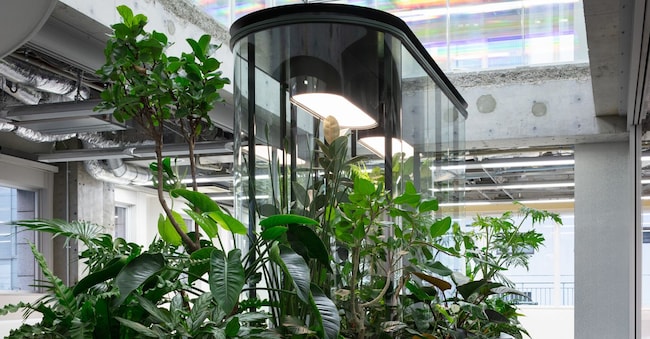
As in every phase of expansion, luxury tends to democratise and several players with new solutions are entering the market. One of the most interesting is the Air Factory created by Pnat, a spin-off of the University of Florence born in Stefano Mancuso's working group to study possible interactions between plants and architecture. It was invented by architect and Pnat co-founder Antonio Girardi, who defines it as "a biomachine, the result of research into the purifying power of plants in closed environments". It is a natural system that absorbs and digests indoor pollutants through its roots and leaves: there are no filters to clean, just plants to take care of, a new circular economy of the indoor atmosphere. "It is a shrine equipped with an aspirator for the air, which is forced to pass through the cube and then comes out clean: 75 centimetres by 75 are enough to produce 170 cubic metres of pure air, enough to breathe better in a 70 square metre room". A mixture of geometry, engineering and botany, which A2A is incorporating on every floor of its new Porta Romana headquarters in Milan. At the last Biennale di Architettura, version 2.0 of the Air Factory was tested and presented, not only b2b for offices, but as a design element on the consumer market for any flat. "Our approach remains scientific," Girardi explains. "We have collected data from the purification experiment at the Biennale and are building the twin prototype, on the market before next summer."
Fybra is another innovative Italian project that tries to answer the same questions: how can we not be poisoned by the air we breathe inside our homes and offices? Gaetano Lapenta is the founder of this Milan-based company, whose original intuition stems from the discomfort of his daughter, who often had a cough and sore throat when she returned from school because the air in the classrooms was unbreathable. It responds to a different dilemma from the Air Factory, because the public administration has buildings that cannot be compared to those of a new tower in the centre of Milan, structures that are often old and difficult to change by putting air quality at the centre: rather than a purifier, what was needed was an advanced and easy-to-use sensor. This is how Fybra was born, which applies machine learning algorithms to indoor pollutants (Lapenta by training is a statistician), measures values in real time, and makes evaluations on when to ventilate spaces, when to open, how long, and when to close in order to have optimal air without dispersing heat in winter or coolness in summer. "Good ventilation today must go hand in hand with energy saving: if air quality requirements urge us to open, those of saving urge us to keep closed". Fybra is the tool that Italian schools and offices are adopting to understand where the right balance lies in order not to get sick indoors, but without wasting money or energy. Air quality has become such an issue that some high-end hotel chains in North America are offering customers a certification scheme called FreshAir, created by a sensor company, to ensure that customers who are loyal and/or willing to pay three per cent more are promised air that is certified as clean in their rooms. It immediately became an issue of trade union demands, with hotel workers in the US protesting against the certification: clean air should not be a benefit, because it is not only the right of customers, but also of those who clean the rooms.

