
What if Father Christmas was a Sámi shaman?
In the very long Arctic night, the healer arrived on a reindeer sleigh and descended down the chimney into the huts of the last indigenous people of Europe: immersed in the snow, you could not get through the door
by Lara Ricci
In the very long Arctic night, melancholy, like the cold, penetrates everywhere. Isolated for months in the frozen Sápmi, where in the few hours of faint light the earth and sky are tinged with all the palest shades of white, grey, green, blue and violet, and the only vivid colours are those of the northern lights that unpredictably wind and stretch across the bruised landscape, it was a great joy for the Sámi to see the shaman descend into the opening of the goahti.
The last indigenous people of Europe in winter lived in huts made of tree trunk cones covered with bark, to waterproof the surface, and then covered with earth to retain heat. Heated with a fire, smoke would escape through a central opening. In past centuries, it sometimes snowed so much that it overwhelmed the goahti and, with the entrance blocked by snow, the only way out or into the house was through the chimney.
In those months of minimal activity when not a soul was seen for weeks, nor did anyone know what was going on in the rest of Sápmi - the original Sámi name for what westerners called Lapland and which includes the northernmost territories of Norway, Sweden and Finland - it was a feast to receive the sight of the shaman. On his reindeer sleigh he would go from camp to camp bringing news and trying to cure the sick, and some speculate that this is the origin of the legend of Father Christmas who, like him, arrives in his reindeer sleigh and slips into the chimney laden with gifts.
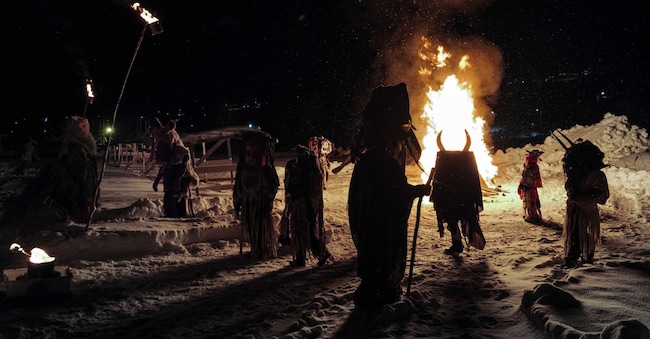
When we try to verify the hypothesis, which had been put to us years ago at the Polar Museum in Tromsø, by asking Taina Máret Pieski, the director of the Sámi Siida Museum of Culture in Inari, Finland, she misunderstands the question and, albeit politely, promptly points out that the traditions of her people have nothing to do with those of the West of Father Christmas or St Nicholas: 'In our culture we have instead juovlastállu, a very different figure. He is a kind of ogre who, instead of bringing gifts, brings punishments for children who do not let adults rest. Or eats them. Dressed in black, he wanders through the Arctic night with a dog, a terrifying stash of rats and a high-pitched, cruel-sounding whistle. When he finds a dirty house he stops and goes inside. He has a steel straw that he uses to suck the breath out of people.
The peremptory response of the director of the Sámi National Museum, who was quick to distance herself from Christian traditions, immediately makes us think of the Steilneset Memorial, a light wooden structure planted on a cliff on the island of Vardø in the far north of Norway. Here, 91 candles commemorate the 77 women and 14 men burnt alive in Vardø during the ferocious witch hunt that inflamed Finnmark county from 1600 to 1692. One fifth of those killed were Sámi. Throughout the Sápmi they suffered terrible persecution when it was decided to Christianise them and, at the same time, exploit the natural riches of the far North, according to a well-rehearsed script (on this subject one can readThe Last Laplander and the other books in the noir saga by Olivier Truc, published by Marsilio, which also give an account of the present-day battles of this people who still claim the chance to make a living from reindeer herding, increasingly threatened by the world's lust for energy and raw materials and by global warming).


