US attack

US attack on Iran: bombs and planes to hit nuclear sites

Gbu-57 Mop bombs and B-2 stealth aircraft used to attack Iranian nuclear sites, implications and risks of a large-scale conflict.

by Silvia Martelli

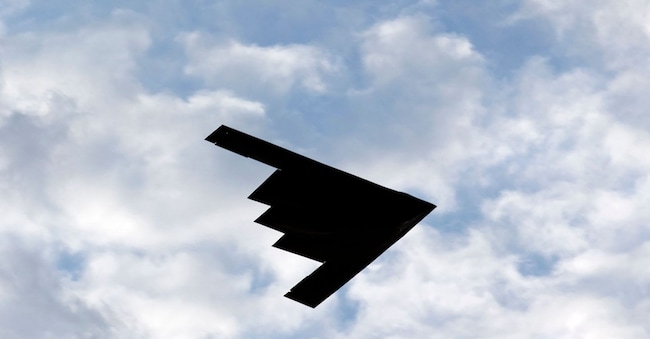
Un B-2 Stealth Bomber. (Photo by Jose Luis Magana / AFP)

4' min read

4' min read

According to Fox News reports, to hit the underground site at Fordow, US B-2 stealth bombers allegedly used six Gbu-57 Mop (Massive ordnance penetrator) bombs, a special type of device weighing over 13 tonnes that is the most powerful conventional weapon in the US arsenal, designed specifically to destroy fortified underground bunkers. Due to its imposing size - it is 6.25 metres long - the B-2 bomber can only carry one or two Mops per mission. According to the US Armed Forces, the bomb can penetrate over 60 metres of reinforced concrete, making it effective against the most heavily protected underground structures in the world. Let's see what ordnance and aircraft it is.

In the last few days, in fact, one of the most powerful and controversial weapons in the US arsenal has returned to the spotlight: the so-called 'bunker buster', the anti-bunker bomb designed to penetrate fortified underground structures. International attention has grown in parallel with the increasing tensions between the US, Israel and Iran, with the spectre of a direct conflict over Tehran's nuclear ambitions becoming more and more concrete.

Loading...

What is a "bunker buster"

.

The term 'bunker buster' refers to a category of bombs designed to perforate layers of reinforced concrete, steel and rock before exploding. The purpose: to destroy military installations underground or protected by heavy reinforcements. These weapons are designed to meet a specific strategic need: to strike command centres, missile depots and, in particular, nuclear facilities hidden or protected by deep, armoured structures.

The most powerful of these bombs currently available to the US is the GBU-57A/B MOP (Massive Ordnance Penetrator). It is an approximately 14-tonne device, capable of penetrating as much as 60 metres of reinforced concrete or over 100 metres of rocky terrain before exploding.

Why we talk about 'bunker buster' in relation to Iran

The link between the 'bunker buster' and Iran is not a new one, but it has become topical again these days. Iran's nuclear programme, repeatedly denounced by the US and Israel as potentially aimed at building atomic weapons, has some key sites protected underground. Prominent among them is the Fordow facility, dug deep into a mountain near Qom, and considered one of the most difficult to hit with conventional weapons.

The GBU-57 is one of the few existing weapons that could, theoretically, seriously damage installations of this type. According to various analyses, however, even the MOP may not be sufficient to completely destroy the deepest and most protected infrastructure.

In recent months, moreover, the US Congress has been debating whether to provide Israel with more advanced versions of these weapons or to collaborate in a possible pre-emptive strike, in the event that the Iranian programme crosses a 'threshold of tolerance' for Washington and Tel Aviv.

Fordow, the underground heart of Iran's nuclear programme

The Fordow (or Fordo) facility is one of the most sensitive and discussed sites in Iran's nuclear programme. It is located about 30 kilometres south of Qom, and was dug deep inside a mountain, precisely to withstand air strikes. Its existence was revealed in 2009 by Western intelligence services, triggering a wave of international concern.

Israele, il cratere provocato da un missile iraniano a Herzliya

According to International Atomic Energy Agency (IAEA) estimates, Fordow houses more than a thousand advanced IR-6 centrifuges for uranium enrichment, with the capacity to produce uranium enriched up to 60 per cent, a threshold considered very close to the level needed for military use (which is around 90 per cent).

It is precisely the protected, underground location that makes Fordow one of the main obstacles for any military option. Its structure is designed not only to make a conventional attack difficult, but also to ensure the continuity of the programme in the event of bombing: even in the event of partial damage, some centrifuges could continue to operate.

For this reason, Fordow is the very symbol of the technical and strategic challenge posed by Iran's nuclear programme. And this is why weapons such as GBU-57 are considered by experts to be one of the few solutions to seriously compromise the site.

How the bomb works technically

The GBU-57 is dropped from heavy bombers such as the B-2 Spirit, the stealth aircraft capable of evading enemy radar. The bomb uses the kinetic energy of its own weight and a delayed explosive charge, which is only activated after piercing the various protective layers. The explosion therefore takes place inside the structure to be destroyed, maximising damage.

There are also smaller and less powerful models, such as the GBU-28, used in the past in conflicts such as the Gulf War and Afghanistan.

The risks of escalation

.

The possible use of bunker busters against Iranian nuclear sites would have huge implications. On the one hand, striking underground installations would drastically reduce Tehran's uranium enrichment capabilities. On the other, such an attack would risk triggering a large-scale conflict in the Middle East, with retaliation not only against Israel, but also against US bases in the region.

Tehran also threatens global retaliation in the event of a direct attack, and the use of a weapon like the GBU-57 would represent an escalation never seen before in a conventional conflict.

Copyright reserved ©

Brand connect

Loading...

Newsletter

Notizie e approfondimenti sugli avvenimenti politici, economici e finanziari.

Iscriviti