
What is the downburst, the air bomb that sank the Bayesian
Also referred to as a 'downburst', it is a meteorological phenomenon associated with storm clouds
1' min read
1' min read
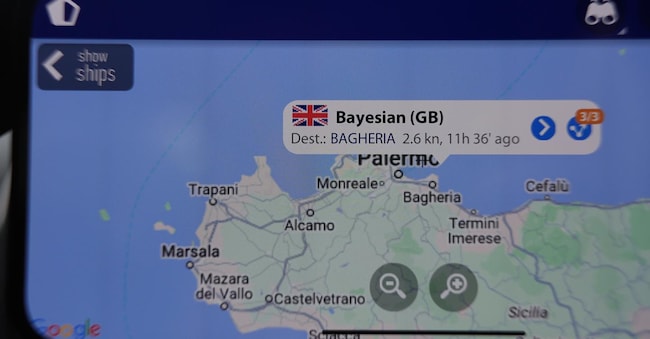
The Bayesian was not hit by a waterspout but 'by a downburst'. This was specified by Raffaele Cammarano, deputy prosecutor investigating the shipwreck of the sailing ship that sank off Porticello, in the Palermo area, becoming a death trap for seven people.
A downburst, also referred to as a 'descending burst', is a meteorological phenomenon associated with thunderclouds in which a strong downdraft of cold air impinges on the ground producing linear gusts at very high speed. Gusts that can reach speeds of up to 100 km per hour, depending on the size of the burst.
It is a kind of 'air bomb'. In fact, the impact with the ground creates a sudden burst - hence the term 'burst' - and often produces a rotating vortex with a horizontal axis. Since the inflow, which is directed towards the thunderstorm, flows alongside the outflow, which feeds the downburst itself, the vortex contains wind fields very close to each other with opposite direction and high speed; a downburst can remain on the ground for up to 30 minutes in the case of particularly violent phenomena.
The term downburst was coined by the Japanese-American meteorologist Tetsuya Theodore Fujita, known for the tornado scale, following a plane crash in 1976 caused by violent winds of that type. Last 29 May, it was a downbusrt that caused the wreck of a boat in Lisanza, on Lake Maggiore, with four fatalities, including the owner's wife and three secret service agents, two Italians and a former Mossad man.

