Davos

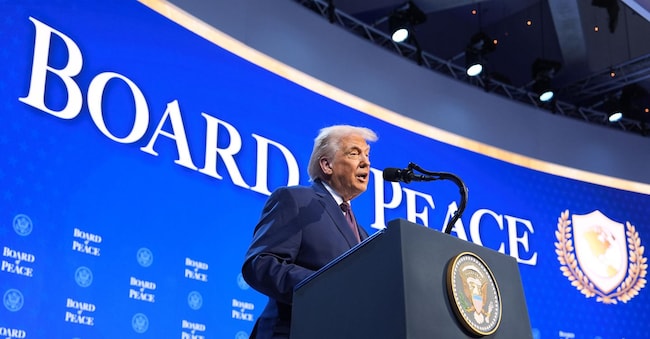
Trump launches the Board of Peace in Davos. Here is what it is and who is on it

A project that challenges traditional multilateralism, with adhesions from the Middle East, Asia and European disputes, while a permanent role for Trump is envisaged

Aggiornato il 23 gennaio 2026 ore 8:15

Donald Trump al World Economic Forum a Davos, Svizzera. (AP Photo/Evan Vucci)

4' min read

Translated by AI
Versione italiana

4' min read

Translated by AI
Versione italiana

In the midst of the World Economic Forum, US President Donald Trump relaunched one of the most controversial initiatives of his second term: the Board of Peace, a new international body that the White House intends should deal with the management and resolution of global conflicts. A project that deeply divides the international community and raises questions about the resilience of the multilateral architecture built after World War II.

From the reconstruction of Gaza to a global mandate

The Board of Peace was formally created as an extension of the US ceasefire plan in Gaza, with the initial objective of overseeing its demilitarisation and reconstruction. But the draft statute, circulated among the invited countries, tells a different story: no explicit reference to Gaza and a much broader mandate, defined as promoting "stability, peace and governance" in areas affected or threatened by conflict. It is therefore a development that has fuelled the fears of many Western allies, especially after Trump's statements that the Board 'could' come to replace the United Nations. At Davos, that phrase resonated as a direct challenge to traditional multilateralism.

Loading...
Trump firma lo statuto del Board of peace: collaborerà con Onu

Trump president indefinitely

The statute provides for Trump to be chairman of the Board indefinitely, even beyond the end of his term in the White House. Under him would operate a founding Executive Council that includes key figures from the Trumpian and international establishment, from son-in-law Jared Kushner to Secretary of State Marco Rubio to former British Prime Minister Tony Blair.

Another critical point is the membership mechanism: countries enter for a three-year term, but a contribution of one billion dollars is required to obtain a permanent seat. According to Washington, the funds would be earmarked for the reconstruction of Gaza; for many observers, however, the risk of opacity and real 'paid diplomacy' is evident.

Who joins and who backs out

So far, the Board has garnered the support of numerous Middle Eastern and Asian countries, as well as governments considered politically controversial. The adherents include Saudi Arabia, the United Arab Emirates, Egypt, Turkey and Hungary, but also Alexander Lukashenko's Belarus. Israel has given its assent, despite the Board's internal tensions and Prime Minister Netanyahu's international court cases.

More cautious - when not openly opposed - was the European reaction. France and Norway declined the invitation, raising doubts about the Board's compatibility with the UN's role. Spain also declined the invitation. China, although invited, reiterated its loyalty to an international system 'with the United Nations at its centre'. Russia has confirmed its membership, while Ukraine has ruled out any participation that would see it sit at the same table as Vladimir Putin, who is also at the centre of international legal proceedings.

The complete list of acceding states

According to information released by the US administration and confirmed by diplomatic sources, in addition to the countries already mentioned, Qatar, Bahrain, Pakistan, Morocco, Kosovo, Argentina and Paraguay have also accepted the invitation to join the Board of Peace. They are joined by Kazakhstan, Uzbekistan, Indonesia and Vietnam from Central and South-East Asia, as well as the Caucasus countries Armenia and Azerbaijan, already protagonists of a peace agreement brokered by the United States in 2025. The Trump administration's invitation to Canada to join, which had announced a conditional membership, subject to the definition of the new body's financial and governance mechanisms, was later withdrawn by Trump.

The clash between Trump and Carney became heated after the Canadian Prime Minister spoke in Davos of an era of 'rivalry between the great powers', the 'vanishing rules-based order' and the 'strong being able to do whatever they want' at the expense of the weak. In retaliation, US President Donald Trump then withdrew his invitation to attend the Board of Peace. "Dear Premier Carney, please let this letter serve as a representation that the Board of Peace is withdrawing its invitation regarding Canada's membership in what will be the most prestigious council of leaders ever assembled, at any time," Trump said on his social Truth.

Italy also looks at the initiative with caution. Prime Minister Giorgia Meloni spoke of possible constitutional criticismi and announced that she will not attend the signing ceremony. A position that reflects a broader European unease: supporting a project strongly tailored to Trump risks weakening the already fragile coordination of the Union in foreign policy.

Multilateralism under pressure

The UN, for its part, plays down. The head of UN humanitarian aid has reiterated that the organisation 'is not going anywhere'. Yet the Board of Peace's political message is clear: Washington intends to rewrite the rules of the game, flanking - if not replacing - the multilateral institutions with more flexible, but also more controlled instruments.

For Europe, and for Italy in particular, the question is not just whether or not to join a new body, but how to defend a system of global governance that guarantees balance, transparency and legitimacy. The Board of Peace could turn out to be a laboratory of alternative diplomacy or yet another factor of fragmentation. Much will depend on who will actually sit at that table and what rules they will agree to abide by.

Copyright reserved ©
Loading...

Brand connect

Loading...

Newsletter

Notizie e approfondimenti sugli avvenimenti politici, economici e finanziari.

Iscriviti