
What language is appropriate in the fight for justice?
Zadie Smith: 'I could not kill a person, I cannot rhetorically support someone's death. The language that protects the sacred nature of human life is under assault. Is it correct to say 'I want to kill Zionists'? No it is not"

"In Western societies at the top of the pyramid of life is man who uses nature's resources for his civilisation: they are societies based on exploitation and growth. We have seen what problems they have created... In the philosophy of the Innu and all First Nations (indigenous peoples of Canada, ed) there is no pyramid, but a circle, which we call the big tortoise, and which represents the Earth. In a circle there is no one above or below, everyone is equal. So an innu hunter who kills an elk does not think he has killed it because he is a great hunter: in its spirit the elk agrees to give its life to feed the man's family, and in return the man does not kill for pleasure, he kills as little as possible, just to feed himself, and thanks the spirit of the animal. The innu knows that it survives not because it exploits nature, but because the other species allows it to live. You say that Italia is your country, the innu says it belongs to its territory. For us, nature is a place that makes us live and protects us from the end,' explains Michel Jean, a journalist and writer of Innu origin, on the sidelines of the Turin Book Fair. In Maikan and in Kukum, Québec's best-selling book in 2021 (both Marcos y Marcos, translated by Sara Giuliani), he tells of how young natives were, until 1996, snatched from their families and deported to remote boarding schools run by priests whose task was to eradicate their culture. A phenomenon hushed up for more than a hundred years, 'out of shame and pain', a scandal that hit Canada a decade ago, when people started digging up the bodies of children from mass graves: tens of thousands of deported children died from the abuse and neglect. Novels, his, which only give the facts, as Jean is keen to point out, but which allow the reader to encounter that reversal of perspective typical of good books: in this case realising, at last, that we are the real savages.
This year's Book Fair was again not very scientific, and also not very political: where the great threats of our time, such as the climate crisis, the risks linked to artificial intelligence, as well as the wars that affect us the most, seem far away, with a few important exceptions, which we went looking for. For example, the meeting with Bernie Sanders (not yet taken place at the time of the closing of this article, you will find a report on ilsole24ore.com) or the one with the Turkish writer and journalist Ece Temelkuran, author ofStrangers like you (2026), How to break up a country in seven moves. The road from populism to dictatorship (2019 and 2021) and Trust and Dignity. Ten urgent choices for a better present (2021), all published by Bollati Boringhieri. 'You have called me brave,' he said, 'but it is not easy to be brave alone. It is nice to receive applause, but when they come to arrest you at 4am and you are in your pyjamas you need friends and solidarity from friends, and solidarity is not just a nice word, it becomes something your life depends on. In the last 10 years I have written three books in which I have tried to warn people that fascism is here to stay and that it will come even to those countries where democracy is taken for granted. In my latest work I want to make it clear that we are all foreigners, we all become exiles if we live in a country we no longer recognise. And then the voice of exile becomes the voice of us all'.
"Human beauty resists industrialised evil," she said, referring to the empty chair next to her, dedicated to a Kurdish writer and politician in prison: Selahattin Demirtaş, as is the custom of the Pen, the writers' association that defends freedom of speech and of which an Italian section has been created, chaired by Sandro Veronesi. "When we writers write, we want to tell others that we are beautiful people and that we can only be so when we are all together. Staying beautiful people, like staying brave, is not easy when you are alone, we need each other, that is why I want to thank you'.
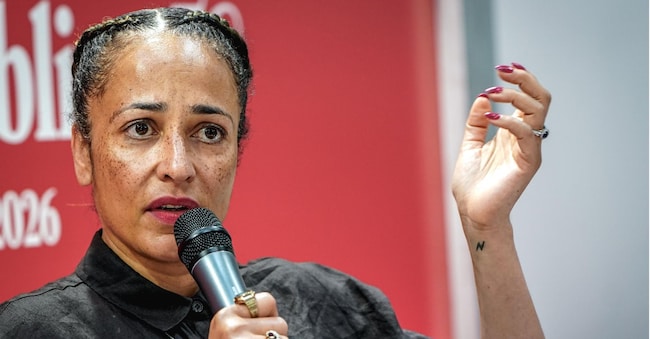
"What language is appropriate in the fight for justice? - asked a wonderful Zadie Smith, whose collection of brilliant, funny, moving essays (Alive and Dead, translated by Martina Testa, Sur) has just come out, in front of a very warm audience - I could not kill a person, I cannot rhetorically support someone's death, I am a writer and I will not support it. Humanist pacifism must be defended. The language that protects the sacred nature of human life is under assault. Is it correct to say 'I want to kill Zionists'? No it is not'.
One can also be engaged by studying the authors of the past, such as the under-appreciated in Italia Carlo Collodi: 'Collodi with Pinocchio teaches the critical spirit, when he becomes a flesh-and-blood child, all neatly dressed, he is mocked by the author, who criticises the bourgeois way of understanding life'. Daniela Marcheschi, a great Collodi expert, deduces this from the three suspension points in the novel's ending - not a happy ending. Points removed in some editions, distorting its meaning. But she also deduces it from her philological investigation: 'We find many phrases taken from his satirical articles about adults and children, for example when he puts his hands in his pockets and finds the money it is a reference to the bourgeoisie who were ruining Italia'. Collodi, he explains, 'was not conservative as some say, he was liberal-Mazzini, he was progressive. He distanced himself from anarcho-communism, but his thinking was along the lines of Gioberti, who maintained that the new Italia would be built by a synergy of 'workers of the arm' and 'workers of the mind', because only those who live from work can guarantee democratic freedom'. Collodi was also a great protagonist in the battle for the emancipation of women, says Marcheschi. The fairy is a symbol of this, representing the moral order, the principle of authority traditionally recognised as belonging to men. While Geppetto has a maternal role: 'he dresses his puppet, he peels his pear. He believes in equality'.


