Sustainability and innovation

What is light made of? Mycelia, plant photosynthesis, natural woods

Many lighting designers rethink the relationship with nature, not as a resource to be exploited, but as a partner with whom to create new possibilities for ecological development and intelligent materials.

by Paola Pianzola

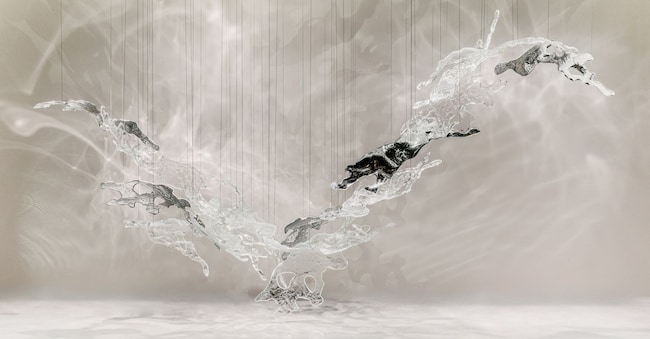
Il vetro è il protagonista dell’installazione luminosa“Splash” nell’ambito della mostra “Soakedin Light”, firmata da Martin Gallo per LASVIT, proposta in occasione di Euroluce 2025. (ph Igor Zacharov)

6' min read

6' min read

Light to see, but not only. Artificial light can create suggestions, landscapes, scenery. Precisely for this reason it plays an essential role in cinema: the dance scene in the The Leopard filmed in the hall of mirrors in Palazzo Valguarnera Gangi would not have been so sumptuous and poignant without the languid glow of the hundreds of candles that Luchino Visconti demanded in the chandeliers that flanked the off-stage projectors. The world of lighting was at its best this year at Euroluce, a section of the Salone del Mobile, travelling the roads of artistic craftsmanship and technological innovation.
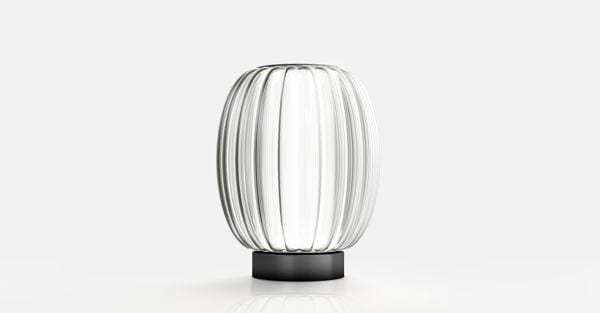
Paralume parte della collezione Alma, nato dalla collaborazione tra lo studio di design Controvento e CONTARDI. (ph courtesy Contardi)

Some interesting solutions approach the creation of a luminaire by moving away from the traditional interpretation of materials that have always met the design of light. An approach that seems to suggest how much, in the exploration of its potential, there is still to be discovered. Glass, which was the protagonist of the Splash light installation, as part of the Soaked in Light exhibition, designed by Martin Gallo for Lasvit, a Czech company specialising in tailor-made lighting systems and glass processing, communicates precisely this principle: it seems imbued - as the title of the exhibition says - with light, transfigured by the encounter with water, a moving spray on the verge of changing shape. Even two classics such as the fabric lampshade and blown glass can be reinterpreted: the Alma lamp, born from the collaboration between the Controvento and Contardi studios, brings out the magic of two materials that transform. LEDs, inserted into the structure, conceal the light source and illuminate the lampshade without the use of visible bulbs, creating an optical illusion that emphasises its essential design.
Loading...

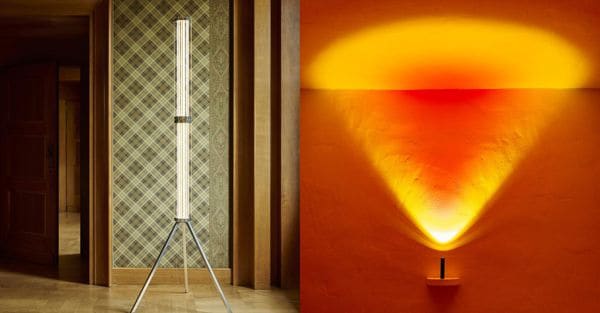
Da sinistra, lampada Super Wire floor, Formafantasma x FLOS (4.700 €). A destra, Halo Mag 2 Sunset, illuminazione portatile magnetica di HALO EDITION (440 €), esposta durante la Design Week alla Galleria Rossana Orlandi. (ph Robert Rieger, COURTESY Mandalaki)

Belonging to the world of art are the pieces created by Christian Pellizzari, whose work consists of a poetic interweaving of art and nature, through glass and light sculptures that recall mutant creatures. Petra Aere Pendant, designed for Nilufar, is made of hand-blown glass and emanates a warm light; it has a shape halfway between a bamboo plant stem and the soft, segmented body of a reptile. Frosted Mirror Syriacus, also for Nilufar, takes the body of a reptile at the end of which a flower blooms: it symbolises the resilience of nature and its ability to adapt to climate change, and offers a reflection on the fragility and beauty of the global ecosystem.

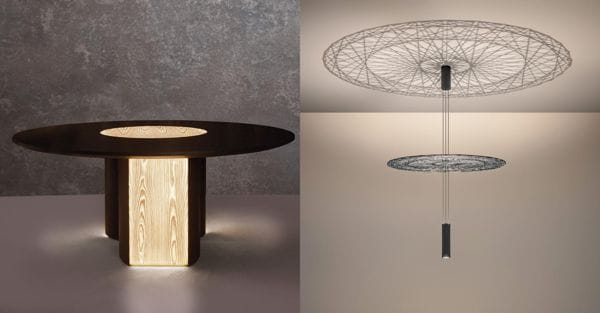
Glass is only one of the materials that can encounter light. Another side of the research focuses on the potential of materials apparently far removed from the production universe of lighting. The designer Gianluca Regazzo, for example, is inspired by the language of fashion in the creation of a fabric suspended in the air in the Genesis chandelier, produced by Terzani, which is created from a thin, knitted steel wire whose light weave refracts light with a delicate transparency. Metal is also at the base of LikeShadow by Olev, a cylindrical light source that emits light upwards and downwards: a hand-woven carbon fibre wire plate creates plays of shadows that change as the lampshade is raised or lowered.
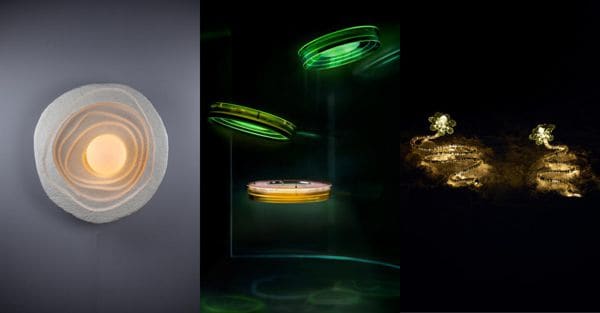
Da sinistra, lampada Terrace Sconce di MUSHLUME (da 750 $): le lampade del brand non vengono costruite, bensì crescono dal micelio, le radici dei funghi. Al centro tre lampade a sospensione Phebe, collezione Transparency Matters, di DRAGA & AUREL: vengono esposte alla Galleria Rossana Orlandi. A destra, due installazioni d’arte luminosa “Frosted Mirror Syriacus”, realizzate dall’artista e designer italiano Christian Pellizzari, esposte da NILUFAR a Nomad St. Moritz 2025. (ph COURTESY MushLume Lighting, courtesy Draga & Aurel, Filippo Pincolini)

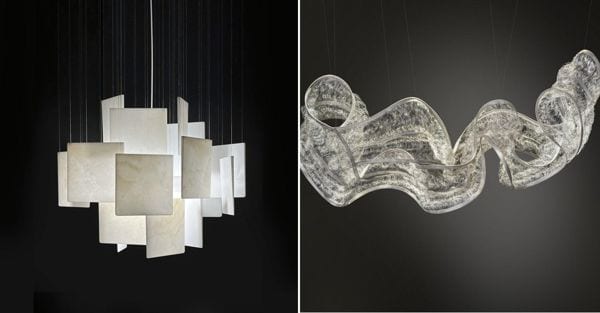
At Bufalini's, Paolo Ulian uses square tiles of natural stone, waste from the processing of the Spacco bookcase, to make them the raw material for the Ingo lamp, an example of virtuous recycling and, at the same time, a tribute to a design classic signed by Ingo Maurer. Each marble, obtained by a process of lightening the stone, is supported by thin steel cables fixed to the ceiling that conceal the light source, creating a diffuse and enveloping illumination.
Equally far removed from transparency seems to be Brightwood, an idea covered by a patent. Instead, it is a wood that emanates light, revealing extraordinary depth. The natural beauty of each fibre is amplified by the LED technology integrated in the material, which emphasises the grain with a 3D effect. One of the applications is the Ippolita armchair, which houses dimmable panels on its sides, equipped with an extra-low voltage battery, as well as the Teseo table, which integrates lighting technology into the central covering of its three semi-circular legs. "We select only wood species that can enhance the light without losing their authenticity, evaluating grain, colour and texture. Each piece is unique, just like the wood it comes from,' explains Leonardo Gianfrate, one of the founders of Brightwood. Also confronted with an unusual material is the Valor.S line of lamps, designed by Philippe Starck for Cassina's Lighting collection. The inspiration is a tribute to Vallauris, the village on the Côte d'Azur where Pablo Picasso settled from 1948 to 1955 to devote himself to ceramics, creating an artistic community around a material of great creative power. Starck interprets that epic by giving the organic shape of the lamp the chromatic vivacity of orange, gold, silver and ivory enamels.

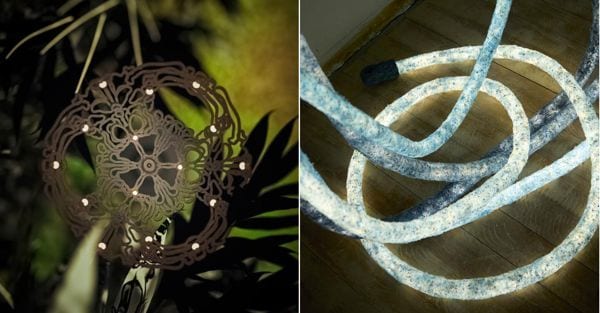
Da sinistra: la lampada Living Light crea luce sfruttando l’energia prodotta da un organismo vegetale, NOVAINNOVA in collaborazione con Plant-e. A destra “Untitled”, opera dell’artista spagnolo Nacho Carbonell in collaborazione con LUCE5 (45.000 €), realizzata in bronzo fuso con rami luminosi in polvere di vetro ed esposta da Galleria Rossana Orlandi a Nomad St. Moritz 2025. (ph In-lite, Davide Gallizio)

Rossana Orlandi's Milan gallery has always been home to the most innovative design proposals. Here we find the Phebe pendant lamps from the Transparency Matters collection, handmade in the Draga & Aurel atelier, composed of two discs with adjustable inclination to diffuse light with changing intensity, in the materials favoured by the designer couple: epoxy resin with different colours and shades, and lucite, an acrylic resin. Also exhibited by Rossana Orlandi is Untitled, a work by Spanish artist Nacho Carbonell, known for his tactile approach to sculpture, created in collaboration with Luce5 and made of cast bronze. A structure that extends into luminous branches made of delicately coloured glass powder, defining an organic and ethereal landscape.

Playing instead with a kaleidoscopic and lively imagery are the Halo lamps, which project coloured lights and create luminous scenographies, protagonists of the exhibition The Beauty of Nature, still at the Rossana Orlandi Gallery. The Halo Edition brand, under the guidance of the Mandalaki group, continues a research aimed at maximising the pure language of light, experimenting with perspectives that evoke rarefied atmospheres and manifest a tension towards the subtraction of matter, a point they have in common with the research of the Formafantasma design duo. "A few years ago, while working on our Wireline lamp, we experimented with the illuminating filament of LED bulbs. We liked its aesthetic presence and flexibility, so we imagined using it as a light source that could be removed and replaced not by a technician, but by anyone,' explain Andea Trimarchi and Simone Farresin of Formafantasma. SuperWire is the result of a journey and owes much to the Flos research and development team, who transformed the functional detail of a mainstream product into a light source that is original in its essentiality. Made of planar glass and polished aluminium, the lamp emits a homogeneous light across its entire surface, and is a kind of lantern ferried into the contemporary world by the quality of basic, accessible lighting.

Lampada a sospensione Ingo, design Paolo Ulian per BUFALINI; lampadario Genesis, creato con un sottile filo d’acciaio lavorato a maglieria, design Gianluca Regazzo per TERZANI. (ph. courtesy Bufalini, Fabio Mandosio)

Marjan van Aubel is a solar designer who questions the widespread use in elements such as lamps, windows, furnishing accessories, of solar energy as a zero-cost source, until now only used in solar panels integrated into buildings. The work of many lighting designers rethinks the relationship with nature, not as a resource to be exploited, but as a partner with whom to create new development possibilities that respect the ecological balance. The ways in which certain living materials can be used in lighting develop solutions that interact with the environment. For example, Danielle Trofe, founder of MushLume Lighting, uses an energy-efficient biofabrication process that integrates mycelium and hemp fibre. The mycelium grows rapidly and develops symbiotically with the plant substrate, producing a biodegradable, lightweight, heat-resistant and easily mouldable material that is ideal for the production of lampshades. The biodesign studio Nova Innova, founded by Ermi van Oers, has instead produced some lamps, such as Living Light, in collaboration with Plant-e, a company specialising in technologies that can generate electricity from plants. The light unit creates light by harnessing the energy produced by a plant organism through a technology that converts the energy from the plant's photosynthetic process into electricity, enabling the lamp to light up. These are just a few flashes in a vast universe, ranging from the candelabra of Palazzo Valguarnera Gangi to the table that lights up with solar energy designed by van Aubel. That of devices to produce and manage light is an evolving path, still much to be traced.

Tavolo Teseo, che integra nel legno la tecnologia Led, BRIGHTWOOD (13.500 €); sospensione a Led Like Shadow, design Andrea Lanaroper OLEV (da 2.318 €). (ph. COURTESY Brithwood, COURTESY Olev)

Copyright reserved ©
Loading...
Loading...

Newsletter

Notizie e approfondimenti sugli avvenimenti politici, economici e finanziari.

Iscriviti