
What the three faces of Ptolemy say

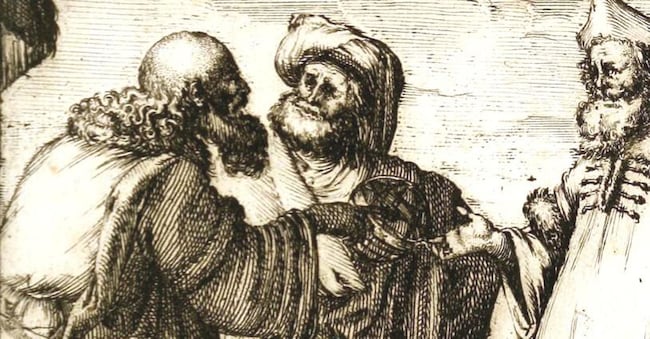
Everyone knows the famous image that opens Galileo's Dialogo sopra i due massimi sistemi (1632). It is the engraving made by Stefano della Bella for the volume's frontispiece: the illustrated page that, in seventeenth-century books, preceded the title page and offered the reader a visual key to the work. On the left are Aristotle, old and balding, and Ptolemy wearing a turban; on the right, separated from them, is Copernicus wearing a canon's tricorn.
A distance that is not only spatial, but conceptual, and that sums up in image the conflict between traditional and modern knowledge. In this way, the scene anticipates what will happen during the four days of the Dialogue: a lively discussion in which the heliocentric system of Copernicus is pitted against the geocentric system of Aristotle and Ptolemy.
Although universally known, this engraving nevertheless conceals a curious detail that may perhaps be overlooked: the faces of Aristotle, Ptolemy and Copernicus have the same features and all reflect the physiognomy of Galileo himself. The impression created is therefore that Galileo is simultaneously Copernicus, Aristotle and Ptolemy. Not only in the almost obvious sense that it is always he who expresses their doctrines, but in a deeper one: he knows them very well from the inside and evaluates them with acumen, identifying the elements to be accepted and those to be rejected.
The interpretation suggested by the antiporta now finds concrete confirmation in the specimen of the Almagest postilluminated by Galileo, found by Ivan Malara in the Kniabek collection of the Biblioteca Nazionale Centrale in Florence. It is tangible evidence that Galileo had read and studied Ptolemy's text in his youth, carefully analysing its technical details and complex mathematical demonstrations. With this discovery, Malara - already the author of a well-documented book on the subject (Galileo's and the Almagest, c. 1589-1592, Palgrave-Macmillan 2024) - has proven that Galileo's innovative Copernican choice was rooted in a precise and thoughtful knowledge of Ptolemy's work.

