Games

WhatsApp, parent-managed accounts for pre-teens arrive

by Luca Tremolada

3' min read

Translated by AI
Versione italiana

3' min read

Translated by AI
Versione italiana

Meta's messaging platform introduces parent-managed accounts, a new mode designed for pre-teens. The idea is simple: allow kids to use WhatsApp but with a control room in the hands of adults.

Technically speaking, it is an answer to an increasingly widespread demand. The first smartphone now arrives between the ages of 11 and 13. And the first app installed is almost always WhatsApp. Usually around that age the phone when given (the writer is convinced that the later a smartphone arrives in the hands of a minor the better) the devices are given for important reasons and in any case with the possibility of controlling what goes on in there. All this for obvious reasons related to digital and other security. There are also those who use sophisticated parental control systems on video content.

Loading...

The invisible infrastructure of families

One premise: WhatsApp is not a social network. It is a network of private conversations. No followers, no feeds, no algorithms suggesting content. Just phone numbers and chats. However, no one can exclude the possibility of private groups, class groups or other.

That is why it has become a kind of digital home infrastructure. The 'I have arrived' message. The class parents' group. The school play photo. Every day billions of conversations pass through here and all are protected by end-to-end encryption, a system that makes messages readable only by the sender and the receiver, even from the same platform.

The parent administrator

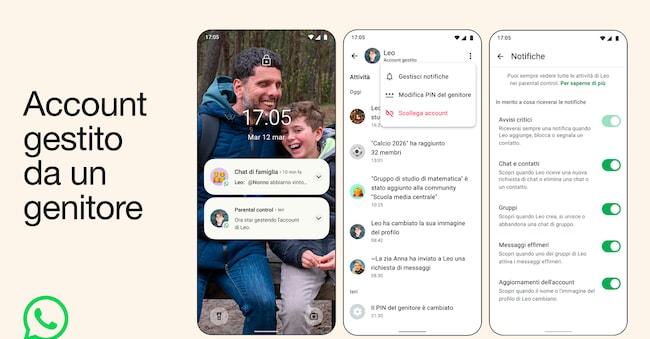
What is new is the arrival of a real family administrator. The parent becomes the supervisor of the child's account. The set-up requires two phones placed on the table: the child's and the adult's. During registration, the two accounts are linked and from then on, the parent can control various aspects of the child's digital experience. He or she can determine who is authorised to contact him or her, check for message requests from unknown persons, decide which groups he or she can join and change all the main privacy settings.

Changes are protected by a dedicated code, the parent PIN, which prevents children from changing settings without authorisation.

A smaller WhatsApp

The version for pre-teens is deliberately simplified. It is a kind of WhatsApp 'reduced to the essentials'. The experience focuses on chats and calls with familiar people. Some functions of the standard app are not available: gone are Channels, Statuses and Meta's new artificial intelligence functions. Messages that are automatically deleted in private conversations are also not present. The aim is to keep the platform in its original function: communicating with people you trust.

The filter against strangers

Security is above all a matter of controlling interactions. When a number not saved in the address book tries to contact the child's account, the message does not immediately appear in the main chat but ends up in a separate request folder. To view it, the parent's PIN must be entered. In this way, adults are the first to see any suspicious contacts.

Other small tricks also help to reduce risks. Images sent by unknown contacts are shown blurred and links remain disabled until the user explicitly decides to open them.

The jungle of groups

One of the most complex messaging territories are groups. Here the control is even tighter. For accounts managed by a parent, entry into groups always requires the approval of the adult. Invitations arrive in the form of links that only the parent can accept by entering their PIN. The app also shows some useful decision-making information: who are the group administrators and how many members are in the group. If the group changes size or activates new functions, the parent receives a notification.

What happens next?

The system is designed to accompany the growth of children. When the user reaches a higher age, the account can change to a standard WhatsApp profile. Before the transition, parents and children receive a notification and adults can decide to postpone the transition for up to twelve months.

Copyright reserved ©
  • Luca Tremolada

    Luca TremoladaGiornalista

    Luogo: Milano via Monte Rosa 91

    Lingue parlate: Inglese, Francese

    Argomenti: Tecnologia, scienza, finanza, startup, dati

    Premi: Premio Gabriele Lanfredini sull’informazione; Premio giornalistico State Street, categoria "Innovation"; DStars 2019, categoria journalism

Loading...

Brand connect

Loading...

Newsletter

Notizie e approfondimenti sugli avvenimenti politici, economici e finanziari.

Iscriviti