When British haute couture meets African style
Every creative person has their muse. Between savoir-faire and the future, three brands combine business and powerful bonds of affection capable of uniting different cultures, traditions, experiences and worlds.
7' min read
7' min read
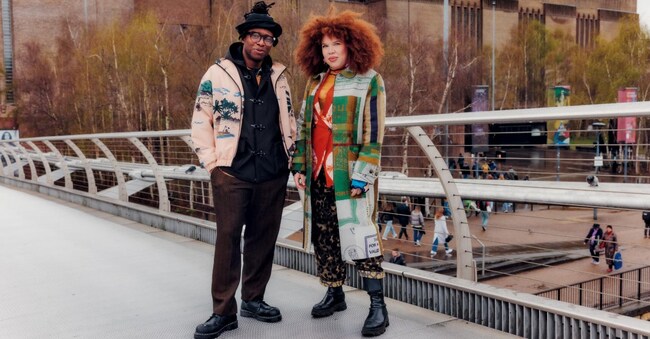
We met about seven years ago in London, during a Tate Late event, thanks to a mutual friend, Monique'. This is how Foday Dumbuya, creative director and founder of Labrum - a menswear brand inspired by British and African traditions - describes his first meeting with Zezi Ifore, artist, presenter, journalist and creative consultant (she has worked with Prada Mode, the Venice Biennial and the Tate). 'You two are great, and now you'll be great together,' Monique had decreed (platonically and professionally, they pointed out). "I liked him straight away, however, I can say I was really won over during a performance at the House of St Barnabas, when a person in front of me took off his jacket: it was a green bomber jacket from Labrum," recalls Ifore. 'You could tell from the inner seams how carefully it had been made. Fods (the name by which she and close friends call Dumbuya, ndr) is a real talent'. Winner of the Queen Elizabeth II Award for British Design, Labrum is celebrating its 10th anniversary this year. Before launching the brand, Dumbuya worked as a bespoke design specialist for Nike in London. "I always carry some notebooks with me, so having lots of pockets is an obsession of mine. To make them, I would collect scrap fabrics," he explains, recalling an advanced flyknit material he used to create patch pockets on his shirts.
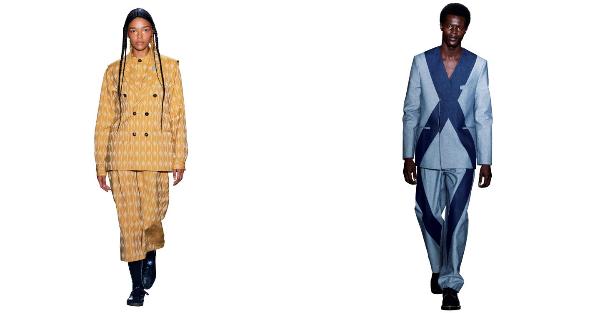
He founded Labrum because he felt that African fashion was not sufficiently represented: his parents are originally from Sierra Leone and he has always wanted to promote his country's music, food and culture. "At the same time, it is important for me not to forget where I come from: London, where I grew up and was educated". The brand's aim is to offer the best of British tailoring combined with West African style. A mix that has impressed Ifore and helped her reconnect her British identity (she grew up in the London suburb of Vauxhall) with the Nigerian origins of the Isoko tribe, from which she hails. Attention to craftsmanship is another characteristic of Labrum that fascinated her. Her mother, a talented seamstress, designed and imported traditional Nigerian textiles, and ran a shop set up in her living room. "She made many of my dresses with her own hands," she still recalls.
Dumbuya describes Labrum as a brand made with love, not only because each garment is made with care, but also because he prefers to work with close friends. Among his main collaborators are Yinka Ilori and artist Julianknxx: Ifore calls the trio the Destiny's Child. One of the episodes he likes to remember is when 'Foday invited me to the Vietnamese restaurant where he, Yinka and Julian often go to eat a special fish dish. From then on, I felt like an integral part of the group'. For her part, the trio confirms that she accompanies them step by step on their adventure, inspiring them.
Ifore and Dumbuya appreciate the melting pot of cultures and stimuli that characterises London. On the street, at the Tate and even in an Uber. "I had five exceptional experiences in the car this week," jokes Ifore: "Today, for example, a driver explained to me how to make masala." "Here you have the freedom to experiment and be yourself, and that brings joy, just like the people you surround yourself with should," Dumbuya concludes. He nods to Ifore, smiling, and she smiles back. INÈS CROSS
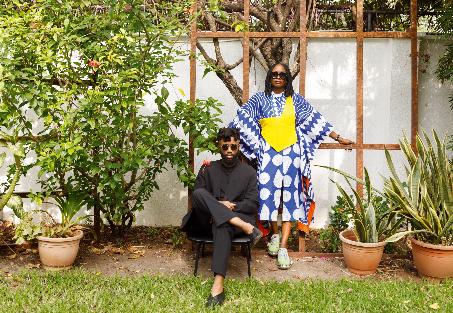
Rukky Ladoja & Ré Olunuga - Photo by Manny Jefferson