
When children’s independence hinges on their smartphones
A study reveals that mobile phones are increasingly becoming part of children’s first experiences of independence, whilst allowing parents to maintain constant supervision from a distance. The risk is that smartphones may limit opportunities to develop self-confidence, decision-making skills and risk management

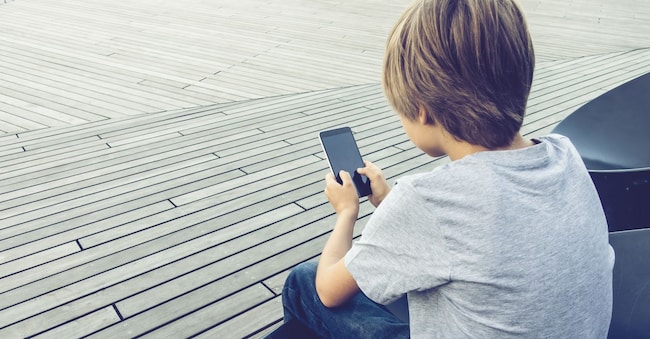
Smartphones are becoming part of children’s lives at an increasingly early age, but their role seems to go beyond mere entertainment. According to research by the Institute of Cognitive Sciences and Technologies of the National Research Council (CNR ISTC), mobile phones are becoming a sort of ‘pass’ to children’s independence: parents grant their children greater freedom of movement provided they can remain in constant contact with them. The study, carried out as part of the international project ‘The City of Girls and Boys’ and published in the journal ‘Intelligent Systems’, involved 234 children aged between 5 and 10 and 215 parents living in Castel Madama, Latina and Rome.
The data
The data shows that the smartphone is the most common personal device: 49.8 per cent of the children surveyed own one. The average age at which children get their first smartphone is just 7.2 years.
The device is mainly used for playing games (47.4 per cent), but its primary function appears to be keeping parents and children in touch. 46.7 per cent of children say their parents use the phone to call them when they are home alone, whilst 30.3 per cent report being contacted when they are out with friends. Parents’ responses also confirm this trend.
Redefining children’s independence
“Research shows that the early introduction of smartphones is helping to redefine the ways in which children’s autonomy is granted and experienced,” explain researchers Daniela Renzi and Marica Notte of the CNR-ISTc. “Autonomy, which is fundamental to the development of self-esteem and the ability to manage risk, is increasingly becoming a privilege contingent upon the ability to exercise remote control, rather than a process based on trust in the child’s abilities.”
Mainly used in solitude
When are these devices used? The research shows that they are predominantly used whilst alone. 56.5 per cent of children say they use them on their own, compared with 33.2 per cent who use them with their parents. Whilst television and smart TVs dominate young children’s media ‘lives’, the real news concerns the role these devices play in children’s development. They are the most commonly used device (58.9 per cent according to children and 78.4 per cent according to parents), followed by the smartphone (52.4 per cent and 61.9 per cent).
Concerns regarding the context of use
The context in which these devices are used is also a cause for concern: 37.7 per cent of children say they use them before going to sleep and 23.4 per cent during meals. According to the children, the device is mainly given as a reward (44.4%), whilst parents most often cite use during car journeys (20.9%). The findings relating to emotional wellbeing are particularly interesting. When playing outdoors with friends, 90.4% of children say they feel happy. In contrast, when they play alone at home with digital devices, the percentage reporting happiness drops to 56.7 per cent, whilst feelings of boredom (26.8 per cent) and loneliness (22.9 per cent) increase. Among older children, individual use of devices is associated even more frequently with feelings of boredom and isolation.
“Technology cannot replace the value of peer relationships and free play,” emphasise Renzi and Notte. “The data clearly show that outdoor experiences shared with friends continue to be the main source of well-being for children.”

Brand connect


Newsletter Scuola+
La newsletter premium dedicata al mondo della scuola con approfondimenti normativi, analisi e guide operative
Abbonati