
When cloud meets sea: the high-speed spectacle of the Rolex SailGP

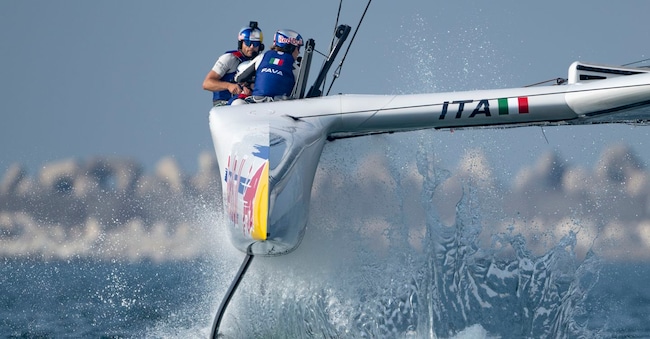
(Il Sole 24 Ore Radiocor) - Breathtaking immersive filming and technological innovations that push the limits of performance further and further: this is what happens when the cloud meets the sea and digital becomes a valuable resource at the service of champions who, aboard futuristic boats, compete to the last metre to cross the finish line first. Launched in 2018 as SailGP, and renamed the Rolex SailGP Championship at the end of 2024, the circuit pits 12 identical F50 catamarans - 15 metres long, 8.8 metres wide and 24 metres high - against each other as they race across the waves in 13 stages, with the grand finale in Abu Dhabi on 29 and 30 November. For some time now, the event has been usingOracle's cloud technologies to provide fans with an unprecedented spectacle that combines cutting-edge technology with maximum public involvement.
The importance of this competition is growing: Italy was the twelfth nation, along with Brazil, to join the circuit with the Red Bull Italy SailGP Team, led by champions James Spithill and Ruggero Tita, and has already shown aconstant growth by obtaining excellent results and confirming its competitiveness.
Behind the scenes of the regattas is a digital cloud infrastructure working tirelessly. The technological heart is Oracle Cloud Infrastructure's (OCI) FastConnect, the private network connection that connects boats, race directors and data centres in Great Britain. An invisible backbone that transfers huge amounts of data in real time: an indispensable condition when boats fly over the water at dizzying speeds and every millisecond can turn the tables. But the power of the cloud does not stop at connectivity. Thanks to the computing power of Oracle's supercomputing clusters, designers have perfected the foils, the submerged carbon and titanium wings that lift the catamarans by reducing friction. From the first 'L' models, they arrived at the more efficient 'T' foils, capable of propelling the F50 to record speeds: 101.98 km/h in San Francisco in October 2024. A concrete demonstration of how digital simulation and computing power can turn into real competitive advantage, even in a sport that takes place in direct contact with the most unpredictable natural elements: wind and sea.
Each boat is a concentrate of technology: hundreds of sensors monitor hydraulic pressures, pumps and fly-by-wire systems in real time. The data, processed with Oracle cloud technologies, allow, for example, the detection of faults not only during the race, but also beforehand, thanks to predictive artificial intelligence and machine learning. Today, the 12 sailing teams, which receive all the same information - on sea, wind and competitors' moves - in real time from the cloud, can replace components before they break, reducing risks and increasing crew safety. An epoch-making leap forward if you consider that, until a few years ago, these analyses were only carried out once the race was over, with long lead times and much higher margins of uncertainty.
On land, 4G and 5G networks continuously transmit data via satellite, while smart cameras mounted on buoys - new in 2025 - capture spectacular images using cloud-based artificial intelligence. The result? An unprecedented video stream, which transforms the regatta into an immersive experience that gives fans the thrill of experiencing a tack just a few centimetres from the buoy as if they were on board the boat. Emotions that can also be experienced from home via the SailGP+ app, also based on Oracle Cloud. On smartphones, tablets or AR viewers it is in fact possible to reconstruct the race course, follow your favourite team in real time and access detailed statistics. A function that makes SailGP one of the most digital and accessible sports in the world, capable of bringing even the less experienced public closer to the fascination of high-speed racing.


