When the Pope marked the path of an Ai at the service of mutualism and cooperation
In his speech to the G7 in June 2024, Bergoglio warned against the illusion of algorithmic objectivity

3' min read
Key points
3' min read
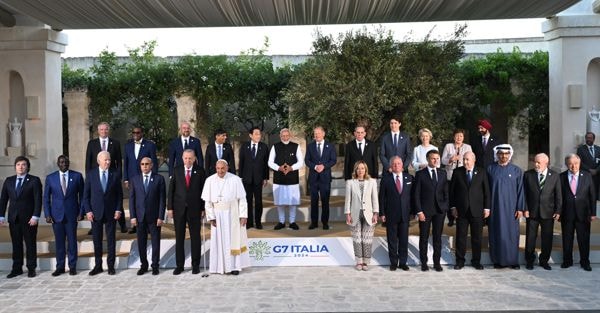
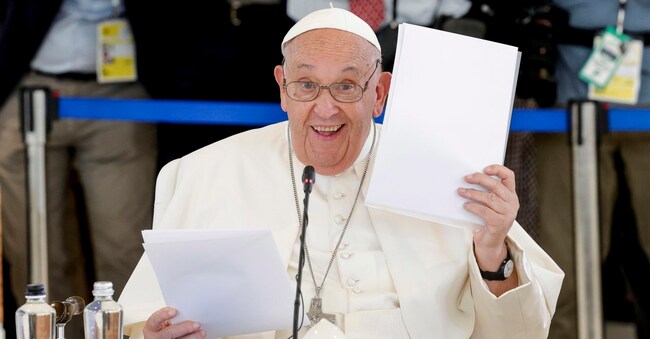
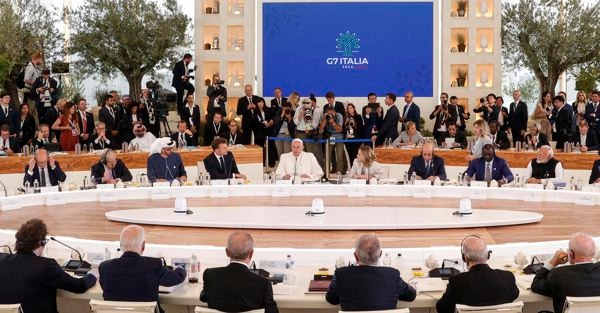
In June 2024, in the heart of the G7, amidst the algorithms of power and the rhetoric of unlimited growth, Pope Francis burst in as a foreign body, uttering words that are not simply words, but deeds. His speech on artificial intelligence was not limited to a moral concern or a call to responsibility: he unmasked the true face of what we are building - or allowing to be built - without real awareness.
We are not dealing with a mere technological advancement, but with a profound restructuring of the human condition. Machines do not just 'do', they begin to 'decide', and in this semantic and practical shift our future is at stake. The Pope knows this well: any choice delegated to a machine is not only a loss of control, but a surrender of our very freedom. It is not AI that is the problem, but the form of world that it presupposes and reproduces: a calculable, predictable, functional world, where the margin of the unexpected - that is, of life - is eroded.
It is not enough to talk about ethics
.In his speech, Francis rejected the illusion of algorithmic objectivity, reminding us that every technology embodies an idea of man, a vision of reality, a hierarchy of values. AI is never neutral, and its apparent impartiality often conceals the darker face of power. In this sense, talking about ethics is not enough. What is needed is a new critical thinking, capable of recognising in technology not just a tool, but an environment, a device that shapes subjectivities, relationships, imaginaries.
But right here a chink opens up: Francis, after all, makes a powerful symbolic gesture. He does not simply ask to 'regulate' artificial intelligence, but to remove it from the sacredness that surrounds it today. He desacralises its language, breaks its spell, invites us to rethink it from the human and for the human. It is an invitation to profane the device, to return it to common use, to the community, to what is not productive but generative. This is the task entrusted to us.
An Ai that does not feed inequalities
In this direction, this pope also leaves us a track to work on: to put on the path of fraternity - the very one strongly evoked in the encyclical Fratelli Tutti - also the development of the technologies we are aiming at, first and foremost artificial intelligence. It is not enough to imagine a 'just' or 'responsible' AI: we need an AI that participates in the project of a civilisation based on care, encounter, and the building of bonds. An AI that does not foster new inequalities, but opens up avenues of cooperation, mutualism and shared dignity.