Artificial Intelligence

When Ai seems able to imagine and perhaps dialogue

Writing the prompt is like asking the machine to imagine something. All this generates amazement

5' min read

5' min read

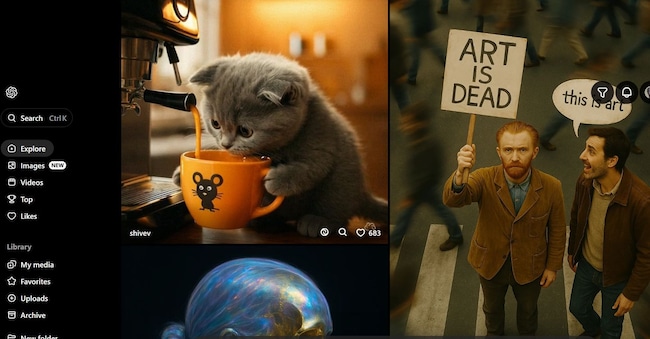
It was a few weeks ago that OpenAI announced ChatGPT's new image generation feature. In just a few hours, the network was flooded with images generated with the new feature, causing everyone to be amazed at the quantum leap that the machine can generate. With a prompt of just a few lines, one can ask the artificial intelligence to generate images that are practically perfect and full of detail.

It is not just a matter of realising an image, like a graphic or photo retouching software. What ChatGPT manages to do, thanks to the integration with the DALL-E model, appears to our eyes, something closer to imagination than the simple technical realisation of an image from the description of a sentence.

Loading...

Writing the prompt is like asking the machine to imagine something. It is like talking to a good draughtsman, describing to him the details of what we want, nurturing his ability to listen to us and put the image of our words on a sheet of paper.

All this generates amazement. It literally leaves one open-mouthed. It forces us, in front of that imagined and generated image, to look closer for details that betray the precision of the executor.

Astonishment is generated by the feeling that these machines, better and better trained, are getting better and better and more surprising. One does not have time to become familiar with the potential of a feature, when a new one appears, more refined, more powerful, more precise and more surprising.

There is never time to get to grips with it.

On the contrary. The astonishment generated by this new world of AI suggests a complexity that can only be incomprehensible to ordinary people and the exclusive preserve of programmers and computer scientists.

But, if you stop and look, this is not exactly the case.

The mechanisms that make these machines so extraordinary are, of course, based on complex technologies, but they function on the basis of deeply human behaviour.

After all, it is man who invented them and it is man who is called upon to train them, every day, to make them ever more competitive and innovative

To understand how we got here, we have to take a leap into the past. Not such a recent past. AI, in fact, was certainly not born yesterday.

We have to go back to 2014, when Ian Goodfellow, a pioneer of machine learning and artificial intelligence, conceived a new computer architecture.

He calls it GAN an acronym for Generative Adversarial Network. GAN is based on an innovative algorithmic mechanism that may recall, in a metaphorical way, certain dynamics of comparison and verification typical of human thought.

The GAN, in fact, works thanks to two different digital neural networks.

A first one, called, generator which, precisely, has to generate the images and a second one called discriminator which intervenes to observe and judge them.

The former creates, the latter judges.

The former proposes the latter criticism.

The two neural networks literally talk to each other, in a continuous game of twos that increasingly refines the precision and quality of the generated image.

The generator, thanks to its competence, seems almost to set itself the goal of not only doing the best possible job of satisfying the discriminator's critical sense, but also activates the attitude of trying to deceive him. The discriminator, in fact, is trained to judge the image according to the criteria - on which he has been trained - that correspond to human judgement.

The two neural networks, give rise to a real dialogue. A dialogue that closely resembles the human behaviour we find in the Socratic dialogues of the 5th century BC.

In the Theaetetetus, Socrates questions the brilliant young Theaetetetus about what knowledge is. The two dialogue starting from Socrates' own admission that he himself does not know what knowledge is. On equal terms, therefore, exchanging opinions and going by trial and error, the two walk to arrive at the best possible definition of knowledge.

Neither possesses the tools to generate an answer, and it is the union of the two thoughts that brings them closer to the definition of knowledge.

Although in a very different way, the confrontation between generator and discriminator in GANs may recall by analogy the Socratic dialogue, where knowledge is built through mutual confrontation and attempts. The ultimate in technology, therefore, is rooted in a human mechanism that is the confrontation and dialogue between two subjects, in search of truth.

But technology since 2014 has evolved and the architecture that ChatGPT uses today is no longer that of GANs.

However, the principle that governs algorithms has not been lost but, just like the history of thought, has evolved, keeping intact the value of relationship and dialogue that underlies human thought.

After the GANs, in fact, new roads and solutions have arrived.

First the Transformer model, born to understand and generate text, becomes the basis for evolutions that also lead to the generation of images sequentially or by progressive approximations.

There is the Diffusion model, which instead works in reverse: it starts with an image composed only of noise - imagine television fog that does not pick up the signal - and, step by step, removes the noise to reveal a coherent image

Pixel by pixel, the algorithm removes, like the sculptor removing pieces of marble from a single block, until it finds the image that the block contains, behind the fog.

And there is the latest one, the one that everyone is talking about and that we are seeing more and more at work. It is ChatGPT 4o Vision's own multimodal architecture that has also been addesrted with techniques such as RLHF, an acronym that stands for Reinforcement Learning With Human Feedback, which improves the quality of responses through human interaction.

And it is this architecture that - today - allows for extraordinary and surprising results, to the point that the machine, really, is able to imagine.

It is the DALL-E 2 and 3 models that generate images by interpreting the prompt provided by the human being and give the illusion of being able to imagine. They do this by reading and interpreting the prompt, but above all they do this by opening a dialogue with the human being typing on the keyboard.

Dialogue returns again after 10 years as a useful approach to constructing the best possible images.

The dialogue of GAN was an all-machine dialogue, with the human spectator - silent - waiting for a response.

The dialogue of the multimodal, acting DELL-E model allows a continuous interaction between human and machine, in which the prompt can be progressively refined to achieve the desired image. Together, the two seem to dialogue and arrive at the desired image one step at a time.

The machine that has learnt to interpret the prompt, that knows how to generate one pixel after another and subtract from the noise all that it does not need, now listens and interrogates those who produce the prompt until it arrives at what man is trying to imagine.

If we thought that AI was only based on a statistical calculation, interpreting the order of words and providing answers - or images - based only on a calculation, we underestimated the ingenuity of the humans who are changing the rules of the game through the development of AI. It is an ingenuity that starts from the most authentic and ancestral human mechanisms, in the belief that, transformed, they can also make a difference to machines.

* Matteo Scortegagna is co-founder of Next14 integrated marketing and communications agency.

Copyright reserved ©
Loading...

Brand connect

Loading...

Newsletter

Notizie e approfondimenti sugli avvenimenti politici, economici e finanziari.

Iscriviti