At the homes of the great photographers

Where the Adriatic and the Ionian meet, at Uli Weber’s retreat

Photographing Italia bathed in moonlight: this is the latest project by the ‘gentleman of light’, who, from his home in Salento, in Santa Maria di Leuca, reflects on a lifetime of photography.

by Angelica Moschin

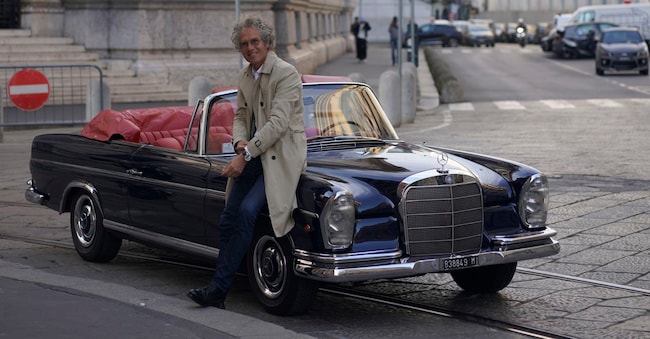
Uli Weber a Milano, con la sua Mercedes-Benz 300 SE Cabrio del 1966 con gli interni in pelle rossa. (© CLAUDIO MOSCHIN)

7' min read

Translated by AI
Versione italiana

7' min read

Translated by AI
Versione italiana

Looking at him, one might be tempted to imagine him as having been born somewhere between Chelsea and Belgravia, with a penchant for bespoke jackets and the ease of someone who moves from a Christie’s auction room to a lunch in Mayfair without ever loosening his tie. With his measured manner, dry wit and typically British understatement, Uli Weber perfectly embodies a certain idea of the gentleman photographer of England. And yet he is German through and through: born in Ulm, shaped by that Central European discipline which can still be sensed today in the composition of his images.
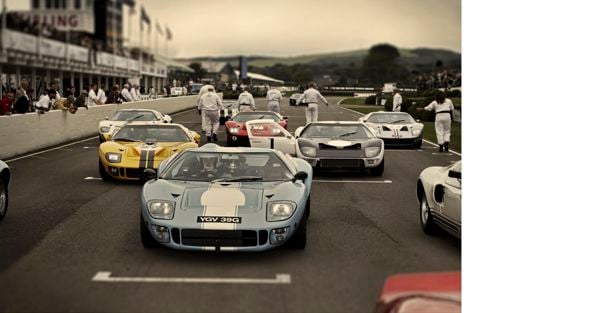
“1968 Ford GT40 P/1085” (2013). Entrambi gli scatti sono tratti dal suo libro “Goodwood Revival”.

When we meet for the first time, he turns up in one of his two classic cars, a rare 1966 Mercedes-Benz 300 SE Cabrio. He’s wearing a white shirt under a light trench coat. The first thing he notices is the way I’m looking at the crimson red leather interior. He gives a faintly smug smile. ‘It’s just been restored. The red leather is its hallmark. And probably my most expensive indulgence too,’ he says.
Loading...

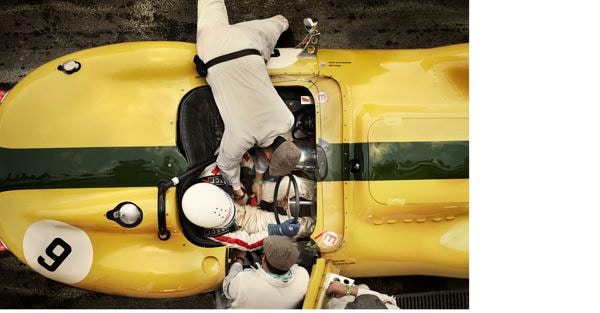
“1958 Lister-Jaguar ‘Knobbly’” (2014), entrambi gli scatti sono tratti dal suo libro “Goodwood Revival”.

Weber has an unbridled passion for Italia, which for him is not so much a summer destination as a veritable aesthetic obsession, to the extent that it has led him to put down roots in Salento. In Italia, he has exhibited from north to south, from Milan to Palermo, via Venice, Rome and Lecce. His most recent book, *i* *Il Mezzogiorno* */i*, is in fact entirely dedicated to our country. On a bright morning, feeling more like spring than summer, he opens the doors of his home in Santa Maria di Leuca to me, the southernmost tip of Puglia where the Adriatic and the Ionian Seas meet almost seamlessly. Here, far from the London photography studios and the frenetic pace of Milan – the two cities where he lives for the rest of the year – Weber reveals a more private side of himself: more relaxed, more unpretentious.

As soon as you step through the threshold of his home-studio, the visual impact is striking: highly polished dark marble, raspberry-coloured wallpaper, and objects that strike a balance between Mediterranean flair and Teutonic rigour. On the walls hang his fine-art prints dedicated to Irezumi, the ancient Japanese art of tattooing that transforms bodies into vast canvases brimming with symbols, colours and stories. Everything in Weber’s home seems to speak the language of his photographs: sophisticated, sensual, yet always meticulous in its detail. It is no surprise, then, that his style has been honed within the hyper-controlled world of international fashion publishing, between London and New York, whilst working for Vogue America, under the guidance of Anna Wintour. His work has been exhibited at institutions such as the Victoria and Albert Museum, the National Gallery of Victoria in Melbourne and the Saatchi Gallery in London. But to truly understand him, one must start at the beginning, with those projects that defined his stylistic signature.
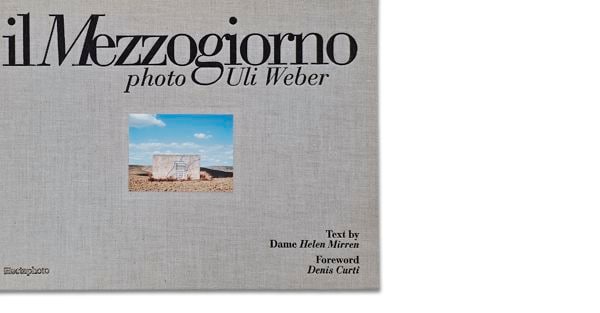
Il sesto libro di Weber, uscito nel 2025, è un intenso omaggio al Sud Italia meno scontato, accompagnato dai testi di Dame Helen Mirren, che in Puglia vive ed è impegnata nella protezione degli ulivi.

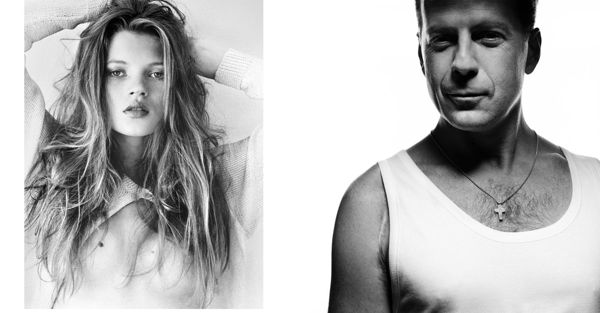
‘The first books I produced were very British. Portraits featured almost exclusively British figures: Jeremy Irons, Hugh Grant, Eddie Redmayne, Kate Moss, Keira Knightley, Sting, Daniel Radcliffe… Then came GoodwoodRevival, which is probably the most British project I’ve ever undertaken, and finally The Allure of Horses, conceived as a tribute to the British equestrian world. The British adore these animals; it’s simply part of their DNA.” Speaking of Goodwood Revival, now in its third edition, the project is proof that, in photography, time is not necessarily synonymous with quality. In fact, it came about spontaneously during the years when Weber was working for Tatler, a staple of the British upper class: just three days, a total immersion in the impeccable and theatrical microcosm of Goodwood, in the county of West Sussex, in the south of England. The magazine sent him to photograph Lord March, now the Duke of Richmond, host of the famous Goodwood Revival motoring festival, for a feature article.
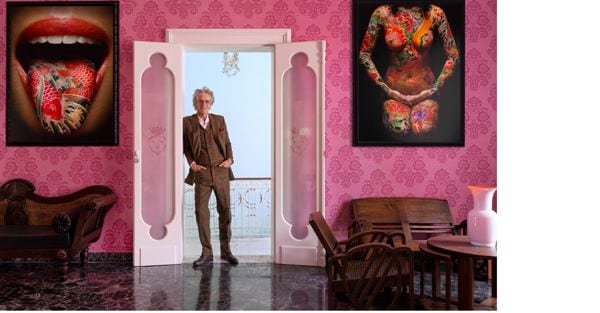
Un ritratto di Uli Weber tra due immagini della sua serie “Irezumi” (2012). (© CLAUDIO MOSCHIN)

‘The Duke then invited me to come back again during the event, saying: “Bring your camera, because it’s all incredibly photogenic”. So I turned up without any real plan in mind. There I found men in perfectly tailored tweed, women in pencil skirts and fur boleros, even children in period costume, and, of course, immaculately polished classic cars (Ferraris, Aston Martins, Jaguars…). It felt as though we’d been catapulted into the middle of a historical re-enactment. After taking the first few shots, I immediately thought: ‘This has to become a book.’

Uno scatto di Kate Moss e Bruce Willis, sempre dalla serie “Portraits”. Il libro omonimo che raccoglie tutti i ritratti delle dive è stato pubblicato nel 2010.

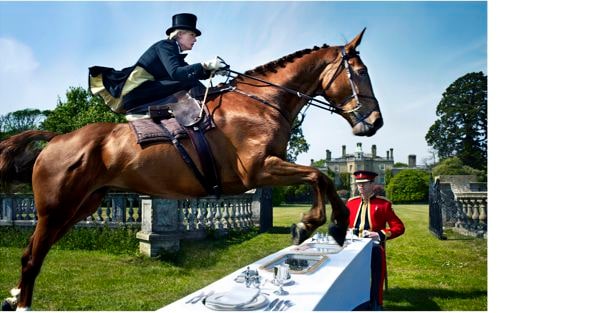
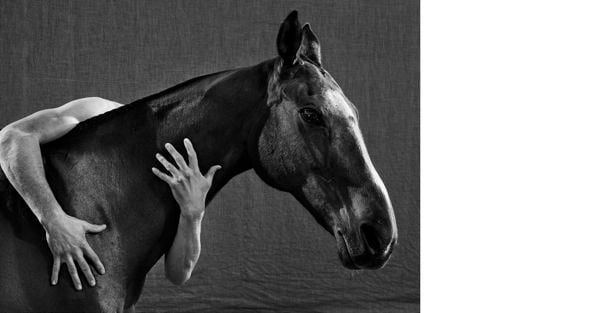
It was then, shortly afterwards, the turn of The Allure of Horses. Published by the long-established publishing house Assouline, the book offers a sophisticated exploration, in both black and white and colour, of the ancient and almost symbiotic bond between man and horse, covering a wide range of topics: from show jumping to parades, from polo fields to rides through the English countryside at sunset.

“Philippa Holland & Capt. Billy Morley, Pylewell Park, Lymington” (2013), da “The Allure of Horses”.

Curiously, at a certain point, the tone shifts. We move from the horses of the most illustrious aristocracy to those trained for military service, set against muddy, gloomy, almost primeval landscapes that seem to have stepped out of a painting by the English artist John Constable. On the cover is Lady Amanda Harlech, Karl Lagerfeld’s long-standing muse, not coincidentally ‘dressed entirely in vintage Chanel’ and photographed alongside her inseparable mare. A portrait from a bygone era.

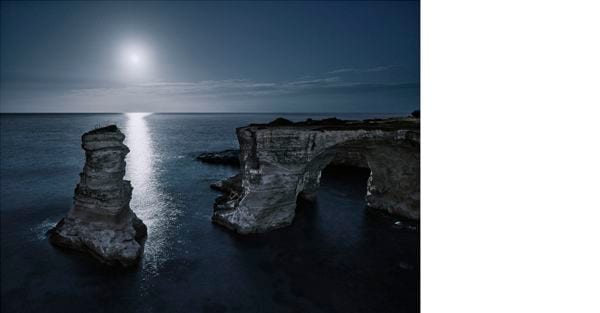
“Torre Sant’Andrea, Puglia” (2023), che fa parte del romantico progetto “L’Italia baciata dalla Luna”.

‘Some photographs from The Allure of Horses ended up at Christie’s as part of a charity auction. They filled all the shop windows facing King Street, including those on the ground floor. One day, whilst walking around that area, I came across my own photographs almost by chance: it had quite an effect on me.”

“Polo 01” (2019), tratto dalla serie “Polo”.

Vintage cars, horses and famous personalities. The key word: versatility. Because shortly afterwards, Weber would be making his debut at the 2024 Venice Film Festival with his Dive & Madrine, a project conceived and commissioned by the Ministry of Culture in collaboration with Cinecittà. For him, this means taking on a prestigious challenge: that of Italian cinema, preserved in the archives of Cinecittà Luce. A comparison between the great divas of Italian cinema and the contemporary ‘godmothers’ of the Venice Film Festival: Vittoria Puccini, Sveva Alviti, Kasia Smutniak, Caterina Murino, Anna Foglietta… Thus, the black-and-white archive met the colour portraits created by Weber in the very same studios. ‘One of the most successful pairings? That between Monica Vitti and Sveva Alviti, who was the festival’s patron that year. That portrait of Vitti laughing, with her hair tousled and her hands clasped near her face, is iconic. An image that all Italians have in mind. I delved into the archive and interpreted it all in my own way. It was important to find images that worked well together, not only aesthetically but also emotionally.’ He succeeded perfectly in his aim: the shot of Alviti mirrors that of Vitti in its innocence, yet presents a more mature and restrained, almost melancholic version.

When talking to Weber, you quickly realise that the common thread linking works that appear to be quite different is always one and the same: Italia. ‘I moved to Rome as a young boy, where I studied photography at the European Institute of Design. I know Italia almost better than I know Germany. I adore it, especially the South. My sixth book, Il Mezzogiorno, is perhaps the most personal project of my career. I drove thousands of kilometres through Salento, Sicily, Calabria and Campania, making a total of ten trips. I wanted to portray a raw South – beautiful yet controversial – capturing glimpses of unspoilt nature alongside traces of neglect and architecture eroded by time. Could I live only in the South? No. Could I live only in Milan? Not at all. I prefer a constant mix.”

The book includes a foreword by Helen Mirren, who is, incidentally, her neighbour in Salento and has for years been at the forefront of the Save the Olives campaign to protect olive trees devastated by Xylella fastidiosa. As an internationally renowned portrait photographer and a regular in immaculate photographic studios, Weber seems to have gradually shifted his focus towards landscape photography in recent years. Indeed, there is a project to which he intends to devote himself in the long term: Italy Kissed by the Moon, a late-Romantic ode to Italy on full-moon nights, which seems to be the perfect accompaniment to Debussy’s Suite Bergamasque as a backdrop to Verlaine’s verses: “Votre âme est un paysage choisi” (your soul is a chosen landscape, ed.).

“Some of these photographs have already been exhibited at the Italian Cultural Institute in London, in a villa on Belgrave Square,” says the photographer. “The inspiration came from a Turkish word, yakamoz, voted the most beautiful word in the world in 2007 by the German magazine Kulturaustausch, which we could translate as ‘the luminous trail left by the moon as it rises’. I have about half an hour during which the water turns into pure molten silver. I want to capture that moment. I keep working on it whenever I can, at least once a month, because obviously it all depends on the weather, the clouds… And on certain nights, the moon simply doesn’t play ball. But when it does, it’s incredible. It’s a fragile and unrepeatable light.’ Just as fragile was the Arch of the Lovers in Otranto, a rock bridge that Weber captured shortly before it collapsed completely into the sea this year: romantic ruinism, unadulterated.

Uli Weber con in mano il numero di HTSI Giugno con la sua intervista

I asked him whether, of all the projects he’d worked on, there was one that had made a particular impression on him. ‘Without a doubt, a shoot with Bruce Willis, who’s more frail these days and has stepped away from the limelight. He was filming in Philadelphia and had no intention of coming to New York, so we went to him and set up a makeshift studio in a hotel. It was meant to be a quick job, but I ended up photographing him for a full eight hours. I always put on some music during shoots: it’s essential for me. Every now and then, Bruce would stop, listen to a song and send his bodyguard off to buy the CD. It was still the era of CDs,’ he laughs. “At the end of the day, he’d left two bottles of Dom Pérignon for us with a note: ‘Thanks for the shoot. Tonight come to my party, I’m DJing’. And sure enough, we all went to this crazy party where he really was behind the decks. He was playing soul, rock, 70s tracks… Chatting to him, I realised that, as well as being a film star, he was also an incredibly kind person. That night was unforgettable.”

Copyright reserved ©
Loading...
Loading...

Newsletter

Notizie e approfondimenti sugli avvenimenti politici, economici e finanziari.

Iscriviti