The book

Where does the dollar go? The unilateralism of US policy

Trump has stated that he is no longer willing to pay the costs of offering a public good such as the dollar as a reserve currency, although he does not wish to give up the privileges it entails

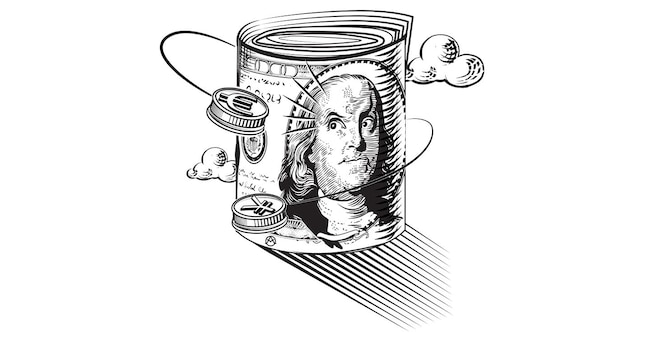
(Illustrazione di Missieri)

4' min read

4' min read

Our Dollar, Your Problem is the title of the latest book by Kenneth Rogoff, professor at Harvard University and former IMF chief economist. The phrase was uttered in 1971 by John Connally, Secretary of the Treasury under the Nixon administration, during a meeting with some European leaders who were irritated by the American decision to suspend the dollar's convertibility to gold, impose tariffs on imports and let the US currency devalue.

With cynicism, Connally summarised the unilateralism of American economic policy, aimed at protecting its own economy regardless of the negative effects on other countries. It was a key moment of the 'Nixon Shock', when the president effectively announced the end of the international monetary system designed at Bretton Woods in 1944.

Loading...

In those years, as today, the United States had a large trade deficit, which was counterbalanced by a massive accumulation of financial assets in dollars by central banks and the private sector of other countries. These assets could not be converted into gold, as predicted by Robert Triffin in his famous dilemma, which highlighted the difficulty of the global reserve currency in providing ample liquidity while ensuring confidence.

However, the US currency, after a period of turbulence, did not lose its centrality, as many economists, including Charles Kindleberger, had predicted. Thanks to the strength of its institutions, the regained independence of the Fed, the presence of liquid and deep financial markets, and the solidity of its economy and military apparatus, the dollar remained the 'anchor' for many countries, the main reserve, invoicing and financing currency for international trade. Network economies - everyone uses it because everyone else does - further strengthened the position of the American currency, so much so that some economists spoke of a second Bretton Woods.

As Valéry Giscard d'Estaing first pointed out, this gave the United States 'enormous privileges', as it allowed them to borrow at low interest rates, run huge and persistent trade deficits, and issue vast amounts of currency and government bonds ($36 trillion!) to finance government deficits.

However, in the face of these privileges, the role of international currency also has 'enormous costs', related to financial instability and the fact that the US currency tends to appreciate. Thus Stephen Miran, current president of the Council of Economic Advisers, argued that the global role of the dollar 'has imposed undue burdens on our companies and workers', making American goods and labour 'uncompetitive on the global stage and forcing our manufacturing workforce into an inexorable decline'.

Hence, the Trump administration has declared that it is no longer willing to pay the costs of offering a public good such as the dollar as a reserve currency, even though it does not wish to give up the privileges it entails.

"The best solution," according to Miran, "is one in which America continues to create global peace and prosperity and remains the supplier of reserves, while other countries not only share in reaping the benefits, but also bear the costs. By improving burden-sharing, we can strengthen resilience and preserve global security and trade systems for many decades to come'.

Hence the demand to provide more defence contributions, impose tariffs, open foreign markets more to US companies and reduce their taxation.

However, in the face of a budget policy that remains highly expansive, a ballooning public debt and continuous attacks on the central bank's independence, the markets are showing a growing disaffection towards the dollar. Thus the US currency experienced a sudden devaluation starting on 2 April (so-called Liberation Day), an increasing increase in the spread of US Treasuries against risk-free Cds, and a divergent trend between the exchange rate and long-term interest rates, typical of an emerging country.

Add to this the continuing rise in the price of gold and cryptocurrencies, and one can understand why some have glimpsed the end of the dollar's unchallenged dominance. Today, however, unlike sixty years ago, there is the euro, China has quite different ambitions for its own currency, and stablecoins are advancing powerfully.

ECB President Christine Lagarde wrote an article in the Financial Times last June entitled: 'This is Europe's global euro moment'. In it she listed the three fundamental pillars to be strengthened to achieve this goal: geopolitical credibility, economic resilience, and legal and institutional integrity. However, it avoided discussing whether Europe was really willing to bear the costs of becoming a global currency.

China itself, while determined to gain an international role for the yuan, is unwilling to liberalise its financial markets, with obvious consequences in terms of exchange rate volatility and risks for its manufacturing apparatus.

Finally, the stablecoins are still too dependent on the dollar and the US administration, to which they are tied, to be able to really disregard them.

In conclusion, it is likely that, just as it did in the 1970s, after a period of turbulence, the 'king dollar' will continue to remain the reference currency of the international system, perhaps surrounded by larger satellites and a lower exchange rate, especially in the unfortunate event that Jerome Powell is sacked. A more unstable system, at least until someone has shoulders broad enough to be willing to shoulder not only the benefits, but also the costs of becoming a global currency.

Copyright reserved ©
Loading...

Brand connect

Loading...

Newsletter

Notizie e approfondimenti sugli avvenimenti politici, economici e finanziari.

Iscriviti