
Rich through merit or luck? Inequality erodes social capital in either case

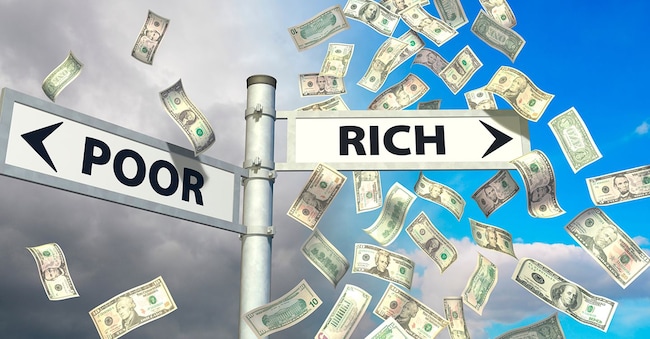
According to the World Inequality Report, the total income of the poorest half of the world’s population is less than that of the richest 0.1 per cent. It is therefore hardly surprising that economic inequality has returned to the forefront of public debate, and not merely for reasons of justice. A vast body of empirical literature links high levels of inequality to greater poverty, higher crime rates, poorer mental and cardiovascular health, and lower life expectancy. But there is a less visible and perhaps more insidious cost: inequality erodes social capital – that is, the set of networks, norms and mutual trust which, according to Robert Putnam’s famous definition (1993) – developed precisely through his study of Italian regions – enables a community to cooperate towards common goals. Where social capital is lower, economies grow more slowly, investments yield lower returns, and public administrations function less effectively. A recent meta-analysis of around a hundred studies confirms a negative, albeit small but systematic, relationship between inequality and prosocial behaviour (Yang and Konrath, 2023).
There is, however, another social factor that complicates the picture. People do not, in fact, judge all forms of inequality in the same way. The origin of inequality – that is, the way in which these inequalities have arisen in the market – appears to strongly influence individuals’ value judgements regarding its acceptability. A now extensive body of experiments shows that we are willing to accept, and even appreciate, income differences resulting from effort or talent, whilst we reject those that depend on luck (Almås et al., 2020). Starmans, Sheskin and Bloom (2017) even argue that what people detest is not inequality per se, but unjust inequality: when faced with a choice, they prefer an unequal but ‘meritocratic’ society to an egalitarian but arbitrary one. This preference for merit appears to run deep: it can already be observed in pre-school children and, in rudimentary forms, even in non-human primates. And it underlies the most widespread justification for inequality in public discourse, the so-called rhetoric of meritocracy: if the rich are rich because they have earned it, there is nothing to be corrected.
So much for judgements. But do judgements translate into behaviour? If I live in a society where inequalities stem from differences in merit and talent, am I more inclined to trust others, to cooperate and to coordinate with them, compared to a society where wealth depends on chance – such as societies where starting conditions, family ties or the privileges of power in the mechanisms of resource allocation? This question is crucial to understanding whether a meritocratic society, as well as making inequality more acceptable, also makes it less damaging to the social fabric.
In an article recently published in the Journal of Economic Behaviour and Organisation, co-authored with Sanket Sen, Abhijit Ramalingam and Ananish Chaudhuri, we sought to answer these questions through an online experiment involving over a thousand participants (Sen et al., 2026). In our experiment, we assigned each participant to one of four ‘societies’. In two of these, everyone received the same monetary endowment – either high or low – to replicate fully egalitarian societies. In the other two, different monetary endowments co-existed within the same society. In one, high productivity in a task that everyone performed at the start of the experiment guaranteed a higher endowment: a perfect meritocracy. In the other, the endowment was allocated by lot, so in this society luck was the sole source of inequality. We then measured the social capital of these ‘societies’ through three classic games from experimental economics: a trust game, the prisoner’s dilemma (which is a classic cooperation game), and a coordination game. The key point of our experiment is that, in all comparisons, we keep the pairings of players fixed – rich with rich, poor with poor – and change only the ‘society’ in which the players are embedded. In this way, we isolate the effect of inequality itself and its origin from any other possible effects linked to reciprocity or aversion to inequality.
The first finding confirms the prevailing findings in the literature on the impact of inequality on social capital. The mere fact of living in an unequal society reduces trust in the ‘trust game’ and, above all, the willingness to co-operate. It is not one’s own circumstances that change, but the context: simply knowing that there are rich and poor people around us is enough to make us more cautious and less cooperative.

