Energy

Which nuclear power for the future? The modular mini-reactor model

Small Modular Reactors would reduce investment risks and payback time. But some knots remain to be solved

by Giovanna Mancini

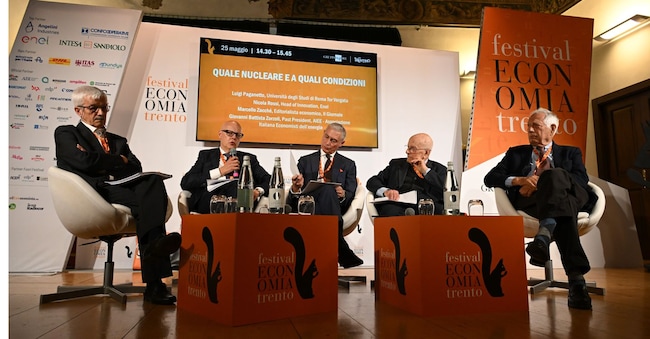
Quale nucleare e a quali condizioni  Nella foto: Luigi De Paoli, Nicola Rossi, Marcello Zacchè, Giovanni Battista Zorzoli, Luigi Paganetto

5' min read

5' min read

If there is a chance for Italy to re-enter - after 40 years - the nuclear game, that chance must be played now and it must be played at the system level (State, companies, research bodies) but also at the European level, because there is no single country, to date, that has all the skills, technologies and resources needed to tackle such a complex and costly challenge with long-term effects.

This was explained today by Nicola Rossi, Head of Innovation at Enel and member of the board of Nuclitalia, the company controlled by Enel and participated by Ansaldo Energia and Leonardo to evaluate and possibly adopt or develop advanced technologies and market opportunities in the new nuclear sector, speaking at the panel 'Quale nucleare e a quali condizioni' (Which nuclear power and under what conditions) organised at the Trento Festival of Economics.

Loading...

Why we are talking about nuclear power today

.

"Today, because the existing technologies that are being tested and studied globally make it possible to have a different nuclear power than in the past," explained Rossi, referring in particular to the so-called Small Modular Reactors (SMR), which have a power of 100 to 3-400 Megawatts compared to the power of up to 1,600 Megawatts of current plants, on which research is already at an advanced level and of which there are some prototypes in the world, particularly in China and Russia.

It is precisely the still experimental and prototype phase of these technologies that would allow Italy, obviously within a broader integrated European system, to enter the game.

Today, moreover, because the scenario has changed,' Rossi added: "In the coming years we will see a sharp increase in electricity consumption, which will come to double in 2050, mainly to support the development of digitalisation and artificial intelligence." Nuclear power is not an alternative to renewables but, adds Rossi, an 'enabler, because it complements them and solves some critical issues such as intermittency'. It is a piece of research and part of a system aimed at decarbonisation in 2050 and based on an energy mix of which nuclear power could represent 10-20%.

Today, finally, because there is also a geopolitical issue and, after the recent events following the war between Russia and Ukraine, we can no longer afford the risk of a third country cutting off our gas supplies, from which we produce 50 per cent of our electricity, putting our economy in crisis.

What nuclear power? The advantages of modular reactors

But which nuclear, then? Rossi again explained the advantages of technologies related to the new nuclear fission, represented by SMRs and, in a second phase, in the second half or end of the next decade, AMRs (Advanced Modular Reactors). Nuclitalia was created precisely with the aim of studying these technologies, their validity and applicability, and their economic sustainability. According to Rossi, these are smaller reactors that would make it possible to reduce the investment risk on the part of private individuals (who are currently reluctant to undertake high investments and whose return is uncertain over the long term) and to bring the plants closer to the centres of consumption, i.e. cities or factories, thereby also reducing transmission and transport costs.

The goal is to build 20-25 reactors by 2050. A feasible undertaking, not a dream, says Rossi.

SMR, state of the art and criticalities

On this point and on the actual validity of SMRs, however, some experts who spoke at the Trento panel raised doubts. "The plurality of energy sources is an important and timely idea, and I am a firm believer in the need for Italian industry to become proactive and active on nuclear energy. But at the moment the Italian technology is not there and we will not have it tomorrow,' noted Luigi Paganetto, professor at the University of Rome Tor Vergata.

The point, according to Paganetto, is to assess the cost-benefit ratio, which is still uncertain, especially since SMRs are currently 'a prospect that has yet to be defined. They only exist at a prototype level'.

Giovanni Battista Zorzoli, past president of Aiee (the Italian Association of Energy Economists), also insisted on this point: 'SMRs today are like the phoenix: no one knows where they are,' he said. 'To date, there are only two in the world: one in China, but it is a prototype, and one in Russia, which was however developed as a propulsion system for icebreaker ships. In the US, on the other hand, the Safety Authority rejected a project because it did not meet safety criteria. Finally, Zorzoli added, in Italy there is no industry that manufactures nuclear fuel.

As for the timing, Luigi De Paoli, professor at Bocconi University, said he was sceptical about the possibility of a nuclear reactor in Italy in 2035. 'But I support the study of nuclear power through SMRs, which will be able to make a contribution within a global system that will develop in other countries,' the professor said. We are talking about a very long timeframe'. As far as the cost-benefit ratio is concerned, according to De Paoli under current conditions there are still doubts as to whether it is really worthwhile. 'But renewables also have very high costs and, from an energy mix perspective, it is important that there is also a share of nuclear power in Italy. Furthermore, investing in research and studying these technologies is crucial, in order to acquire and maintain national expertise and to have an authority that is able to make an informed assessment of the evolution of the technologies'.

While recognising the legitimacy of these critical issues, Nicola Rossi emphasised that the foundations - scientific and technological - for developing a system based on these new technologies in Italy, within the planned timeframe, are there. Obviously, all the available elements need to be assessed in order to develop the best, most sustainable model (including economically) and one that is best suited to the needs and specificities of our country, creating an integrated system that also dialogues and collaborates with other countries engaged in this field (European countries in the first place), to provide our country with the missing technologies or skills, such as fuels, and conversely, to become our own suppliers to other countries for certain ocmponents.

"It is precisely for this purpose that Nuclitalia was set up, which will be responsible for selecting a technology from among the most advanced at a global level and analysing its technical aspects and spin-offs on Italian territory, also looking at the possibility of developing an Italian supply chain, which today counts about 70 companies with 2,800 employees working in the nuclear industry. We will also have to customise these technologies to Italy's needs'.

Copyright reserved ©
Loading...

Brand connect

Loading...

Newsletter

Notizie e approfondimenti sugli avvenimenti politici, economici e finanziari.

Iscriviti