
Al Green, the congressman defying Congress with silent protests against racism
A former justice of the peace, Green interrupted Donald Trump's State of the Union address by displaying a sign protesting what he considers offensive rhetoric towards African-Americans

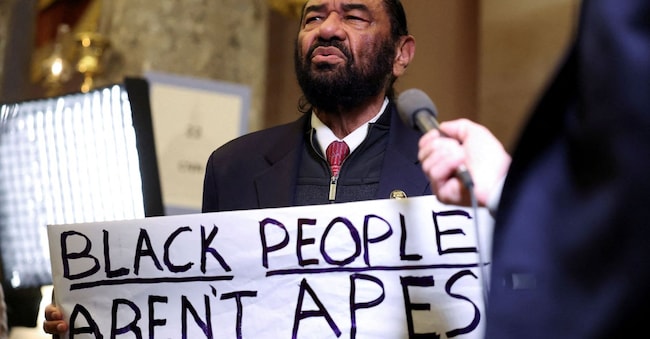
He had already done so last year, and even then he was escorted out of the chamber amidst protests from Republicans and the applause -- more discreet but convinced -- of a section of Democrats. On Tuesday, during on the State of the Union speech by Donald Trump, Democratic Congressman Al Green stood without saying a word, clutching a sign with a print inscription: "Black people aren't apes!" - "Black people are not apes." A few moments later he was escorted out of the chamber of the United States House of Representatives.
Green did not interrupt with shouts or slogans. He remained silent, letting the sign do the talking. The reference was explicit: a racist video relaunched in recent days on social media by the president, in which former president Barack Obama and former first lady Michelle Obama were depicted as monkeys. Content that sparked outrage and accusations of racism, and that crossed a red line for Green.
The former justice of the peace who became an MP
Al Green has indeed been a justice of the peace for most of his life. Before arriving in Congress, he held the post of justice of the peace in Harris County, Houston, Texas, for more than 20 years: a figure who in the United States deals with minor civil disputes, administrative matters and notary functions, with strong territorial roots. It is there that he has built his reputation as a man of institutions close to working-class neighbourhoods.
Born in New Orleans in 1947, raised in the still segregated South, a lawyer by training, Green entered the House in 2005. Over the years, he has become one of the most recognisable voices of the progressive Democratic wing, especially on issues of civil rights and racial justice. He was among the first parliamentarians to call for Trump's impeachment during his first term, long before the party united on that line. A choice that isolated him initially, but reinforced his image as a Member of Parliament willing to pay a political price in order to remain consistent.
Protest as political identity
Tuesday's episode is not an isolated gesture. Already last year, Green had interrupted a similar presidential speech, being ejected from the chamber. For him, protest is not theatre but testimony: a way of breaking the solemn ritual of Congress when he feels that that ritual covers up deeper injustices.

