Who creates and who captures value in artificial intelligence?


Since March this year, companies have been seeing Excel files with far more worksheets, complex formulas and colours, and PowerPoint presentations with more slides, lots of rectangles and a great deal of text – often in unbearably small font sizes. Today, the most advanced AI models can work directly within files on PCs and create ‘artifacts’ in a matter of minutes, and so intellectual output is proliferating. In March, an issue of *Family and Trends* stated: “The impact of AI on intellectual work will be similar to that of factory robotisation on manual labour: greater standardisation of quality, less scope for craftsmanship.”
Will productivity grow as much as the enormous technological and financial enthusiasm suggests? On the financial front, Professor Damodaran recently stated: “I have noticed that investment banks estimate xAI’s addressable market at 22 trillion, which I think is more of a delusion than an estimate”. As for potential profitability, he drew an interesting comparison: “The success of streaming companies has not only been at the expense of traditional entertainment firms, but, on the whole, has made the sector less profitable.”
From a technological perspective, analyses and documents will certainly be produced more quickly, and quality will become standardised. Some intellectual jobs will disappear, just as they did with the advent of office automation and the end of typewriters, ledgers, desktop calculators, hand-drawn charts, transparencies, photocopiers and all the people whose expertise was based on using these tools. Parkinson’s Law, i.e. ‘in intellectual activity, work expands to fill the time available for its completion’, has, however, allowed many activities to evolve whilst keeping working hours unchanged, if not increased. With the arrival of Excel, for example, those working in administration, finance and control seem to spend more time at the office. Excel has also introduced many levels of control, verification and analysis that were unthinkable when working solely with a calculator.
For the time being, since we’ve been using AI to analyse and prepare documents, it seems we’re spending more time interacting with the AI, and that’s a good thing. However, it also seems we’re spending more time reading longer and less clear documents, and that’s a bad thing. It is becoming clear that improving intellectual work requires a combination of human and AI. It is not enough simply to hand our work over to AI. This is an advantage for young people entering the world of work, just as it was in the 1990s for those who knew how to use Excel and its macros, compared to those who merely ‘ticked the boxes’ when doing sums.
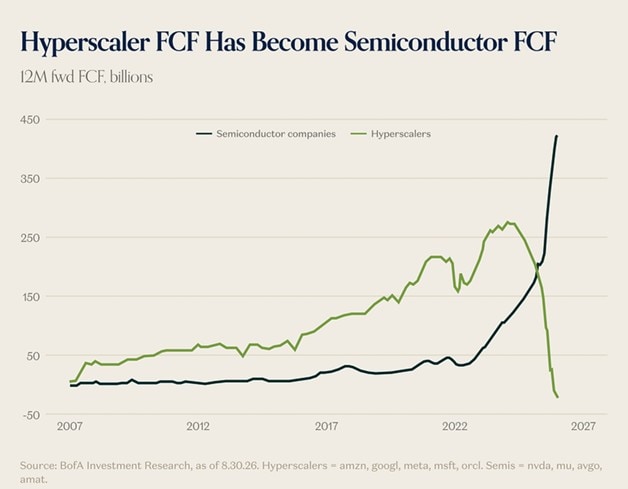
Productivity may well increase. But who is already reaping the benefits of the value created by AI? For now, it is those who provide the inputs needed to develop it. A previous familyandtrends article compared AI to a diamond: in the 1940s, the stone became a symbol of eternal love and an essential element for proposing to one’s beloved. Since then, it has been De Beers that has truly profited, because it owned the mines. In the AI sector, the cash flow of semiconductor suppliers has risen from less than 50 billion in ’22 to more than 400 in ’26; that of the hyperscalers (Amazon, Google, Meta, etc.) has fallen from more than 250 to… zero.