Physics

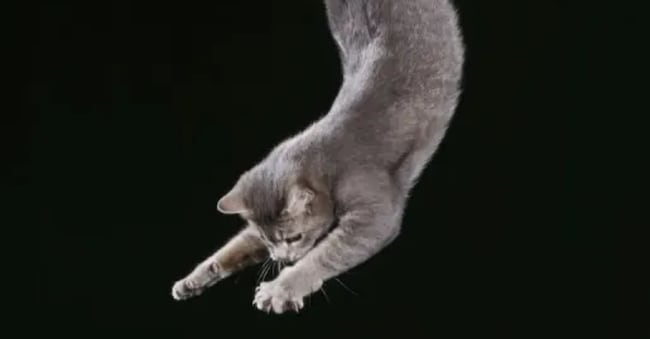
Why do cats always fall on their paws? Knowing this is also useful for astronauts and robots

The problem has been open since 1894, when the French scholar Étienne-Jules Marey attempted to solve it using a purely scientific and experimental method

by Leopoldo Benacchio

3' min read

Translated by AI
Versione italiana

3' min read

Translated by AI
Versione italiana

There is not only quantum physics or artificial intelligence, both of which are all the rage and have been present in our lives in recent years, Physics still has several old and important problems to solve, with unhoped-for benefits in many areas of our lives.

One of these took a major step forward a few days ago. It concerns the age-old problem of why, apparently, cats always fall on their paws, as popular wisdom has it. This is no joke, mind you, and the problem has been open since 1894, when Étienne-Jules Marey, a leading French scholar of human physiology and otherwise, attempted to solve it using a purely scientific and experimental method. He found that indeed cats always seemed to land on their paws, obviously not from above a certain height.

Loading...
Gatti volanti, il video da cui tutto è cominciato

The contribution of two other distinguished scientists

He was not the only one at the time to start the problem, two other outstanding minds also tried their hand at it: George Gabriel Stokes, the great Irish mathematician and physicist, and James Clerk Maxwell, the important Scottish physicist and father of classical electromagnetism.

The former was also president of the Royal Society of Scientists in the United Kingdom, a very prestigious position, and is the author of the partial differential equations that are still used today, for example, in the calculation of weather forecasts, while the latter is the author of the beautiful classical theory of electromagnetism, which described electricity, magnetism and electromagnetic radiation, starting with visible light, as different manifestations of the same phenomenon: electromagnetism.
These two illustrious scientists, who disrupted physics and everyday life, then as now, approached the problem somewhat as a curiosity, as was often the case in those days.
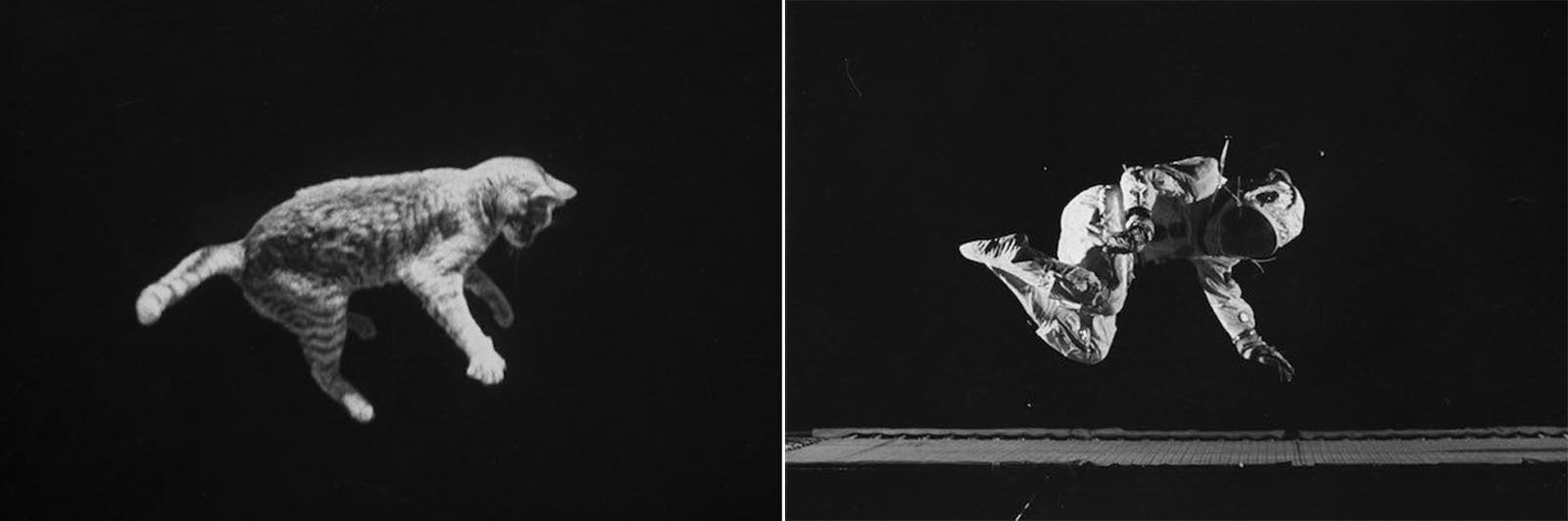
Etienne-Jules Marey's 'photocannon'

Marey, on the other hand, was, although a physiologist, an experimentalist and built different machines to study animals - another of his fields was the flight of birds - also taking advantage of the very modern invention of the time: photography. He even built himself a 'photocannon', to take very close sequences of images in time.

To make a long story short, he confirmed with his films that, falling from a certain height and on their backs, cats could turn around and land on their paws. And therein lies the problem because this manoeuvre apparently requires violating one of the fundamental principles of classical physics: the conservation of angular momentum, which is well exemplified by ice skaters, for example, when they rotate on themselves and increase or decrease their rotational speed simply by extending or retracting their arms.

A new perspective on the fall of felines

But back to cats: at the University of North Carolina at Charlotte, in America's famous 'Research Triangle', scholars have offered a new perspective on the fall of felines, published after a couple of years of research in a paper published in February in the journal 'The Anatomical Record'.

Part of the difficulty lies in the fact that the cat's anatomy had not been studied in detail, explained Yasuo Higurashi, physiologist at Yamaguchi University in Japan and lead author of the study. And the solution lies in the spine, which had not been given due consideration. It is she who explains how the beloved feline can turn in flight without sending a fundamental principle of classical mechanics into the dustbin.

In their study, Higurashi and colleagues examined, from an anatomical point of view, the various spinal column segments of cats, on naturally dead specimens, and also by dropping a pair of cats in various ways from a height of one metre, without any danger as they landed on a cushion.

Variable flexibility spine

The secret lies in the hitherto unknown fine anatomy of the cat: the feline spine has variable flexibility, greater at the top and much stiffer and heavier at the bottom.

The videos taken of the two cats who patiently 'collaborated' in the research show exactly this: first they easily rotate their front paws, and so also see where they are falling, and then their lower body, more slowly.

Applications also for astronauts and robots

It is not the ultimate solution to the problem, but a good step forward: the cat is more complicated than the equations we currently know how to put down on paper to describe it: cats are always eluding us, but less and less, and we will soon be able to 'cage' them in four definitive equations.

One might wonder what the point is of studying the fall of cats for almost two centuries. Research is certainly not an end in itself: there is much to be improved in mathematical models of animal movement, useful for helping veterinarians to treat fractures, but also for analysing the movements of astronauts in space in microgravity or for having more agile robots than those of today.

Copyright reserved ©
Loading...

Brand connect

Loading...

Newsletter

Notizie e approfondimenti sugli avvenimenti politici, economici e finanziari.

Iscriviti