Digital Economy

AI in the workplace: why do companies set up separate entities to innovate without slowing down their business?

Inaz opens its artificial intelligence ‘garage’: Initia HRTech is launched, an independent company dedicated to AI research and development

5' min read

Translated by AI
Versione italiana

5' min read

Translated by AI
Versione italiana

There is one image that often crops up when people talk about major technological revolutions: the garage. The one in Silicon Valley has become a symbol. A small space, separate from the rest of the company, where people can experiment without the burden of red tape and deadlines.

In Milan, the Inaz Group has decided to build on this very idea. It has set up Initia HRTech, an independent company dedicated to research and development in artificial intelligence. Not a business unit, not an internal reorganisation, but a new legal entity built from scratch with a clear mission: to become the group’s AI centre of excellence.

Loading...

“We set up Initia,” explains Enrico Abaterusso, CEO of Inaz, “because we were finding it difficult to integrate artificial intelligence into our processes and products, working according to the standard procedures of a research and development unit within highly structured processes involving approval workflows, authorisations – in short, all the organisational systems that are functional to industrialisation, but which stifle creativity. And so, drawing on the concept of garages that launched innovations, this separate entity was created.”

This decision says a great deal about the current situation facing Italian businesses. Artificial intelligence has made its way onto the agendas of boards of directors, but the issue is no longer whether to adopt it. It is about understanding how to do so without stifling innovation within processes designed for a different era.

That is why Inaz has decided to separate these two areas. On the one hand, there are the operational activities that deal with software, clients and deadlines on a day-to-day basis. On the other, there is a small team tasked with exploring, testing and even making mistakes.

The idea is simple: innovation requires a different timeframe to production. Those working on existing products must ensure reliability. Those working on the future must be able to proceed by trial and error.

This philosophy is summed up in a phrase spoken by Linda Gilli, president of Inaz and recipient of the ‘Cavaliere del Lavoro’ honour: ‘being allowed to make mistakes in order to learn’. It is a concept that often struggles to gain acceptance in traditional companies, but which is almost a prerequisite in the world of artificial intelligence.

Initia was thus founded as an in-house start-up, backed by a group with almost eighty years’ experience in software and services for the world of work.

The project is led by Massimo Pegori, the group’s Director of Innovation and Software and Infrastructure Development. His role is to bridge the gap between research and business, ensuring that experimentation does not remain confined to the laboratory and that the solutions developed are put to practical use in the company’s products and processes.

“The first solution we’ve been working on is called LexMate,” explains Massimo Pegori. It operates on several fronts: on the one hand, it answers regulatory questions relating to the specific situation of individual employees, such as the notice periods to be applied in a given context, or how to verify a non-competition agreement entered into years earlier that may have changed in the meantime due to subsequent regulatory changes. On the other hand, the automated component independently analyses all documents relating to the employee, flagging those that may present issues in relation to the updated regulations.”

Loading...

The key difference compared to a generic tool such as ChatGPT is that here we work with certified sources that we manage directly. Our team, with the support of employment lawyers and the INAZ research centre (which has been interpreting legislation as it is enacted for over 40 years), has selected and validated the sources on which the system is based. It is not simply a matter of copying and pasting the legislation: it is about understanding and contextualisation.

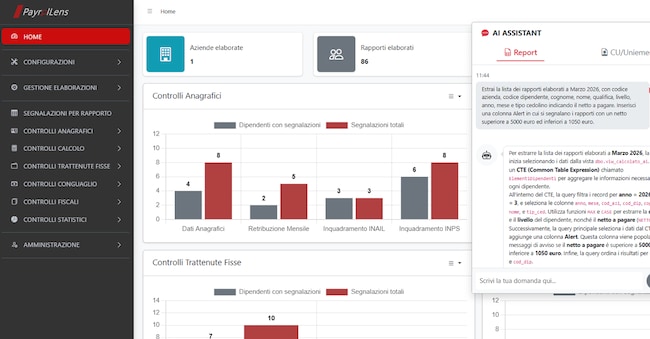
The other solution is called PayrolLens. It is a tool designed to help companies carry out payroll checks. The payslip production cycle always involves thorough checks to ensure there are no errors; these are almost never attributable to the software, but rather to the complexity of remuneration structures: every company has its own specific characteristics.

With PayrolLens, rather than following the old approach (manually extracting a thousand entries, creating an Excel spreadsheet, and cross-checking), the operator simply describes in natural language within the system which checks they wish to carry out.

The most interesting aspect is the design of the agent-based assembly line that Inaz is working on.

‘We envisaged it in truly collaborative terms,’ explains the director of innovation, ‘in the sense that, by choice, we have not implemented any fully automated processes based on artificial intelligence at any stage. So it is not the AI that decides to make a change to the document, but rather the AI is capable of performing its task autonomously, which is to analyse vast amounts of data very quickly and identify the areas where the user can intervene, whilst providing the user with the certified sources on which its assessment is based. So, when the user sees that the AI is suggesting a change, they also see, right there on the screen, all the sources that have been retrieved; they can analyse these point by point and, at that stage, validate the suggestion made by the artificial intelligence.’

The team consists of six people. It is deliberately small. Data engineers, data scientists, software engineers and AI specialists work within a lean structure, without complex hierarchies. Each week, time is also set aside for personal research projects – a sort of permanent laboratory where they can explore emerging technologies and new applications.

Initia will not develop software intended directly for the market. Its role will be to design AI solutions to be integrated into the group’s products, or tools to improve internal processes. This is a pragmatic approach that focuses less on making a splash and more on creating measurable value.

There is also a second factor that sets the project apart. INAZ regards its wealth of knowledge about the world of work and human resources as a strategic asset. At a time when many organisations are entrusting their data and expertise to external platforms, the company has chosen to establish an in-house unit to oversee the adoption of artificial intelligence.

The key word is control. Control over data, intellectual property and the ways in which algorithms are trained and used.

This is why Initia is presented not only as a technology laboratory but also as a guardian of ethical standards. Its stated aim is to develop AI systems that respect clients’ privacy and build on the wealth of expertise accumulated over almost a century of operation.

Rather than a Californian start-up, perhaps, Initia is more like a Renaissance workshop. A small team of specialists, diverse skills, ongoing research and the freedom to experiment. With one key difference: instead of painting frescoes, their raw materials are data, algorithms and artificial intelligence models.

Copyright reserved ©
  • Luca Tremolada

    Luca TremoladaGiornalista

    Luogo: Milano via Monte Rosa 91

    Lingue parlate: Inglese, Francese

    Argomenti: Tecnologia, scienza, finanza, startup, dati

    Premi: Premio Gabriele Lanfredini sull’informazione; Premio giornalistico State Street, categoria "Innovation"; DStars 2019, categoria journalism

Loading...

Brand connect

Loading...

Newsletter

Notizie e approfondimenti sugli avvenimenti politici, economici e finanziari.

Iscriviti