
Why the debut of Rog Xbox Ally is important for the video game market
The Asus and Microsoft handheld console arrives in Italy on 16 October. Here's what we can expect.

2' min read
2' min read
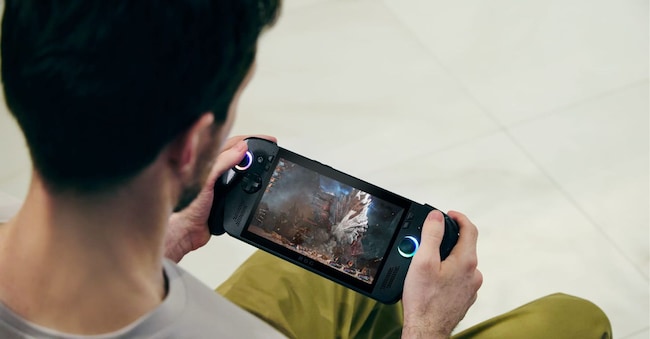
On 16 October, the ROG Xbox Ally, the portable console from Asus and Microsoft, debuts in Italy. Technically, it is a Windows 11 mini-PC disguised as a gaming machine. Unlike the Steam Deck which has SteamOS (Linux + Proton), the Ally needs no special translations or compatibility: it can install and run any PC client. What makes it different from its native competitors such as the MSI Claw A8, Lenovo Legion Go and the other Steam Decks is its agreement with Xbox.
The ROG Xbox Ally is powered by an AMD Ryzen Z2 A processor with four Zen 2 cores and eight threads, eight AMD RDNA 2 GPU cores, 16GB of LPDDR5X-6400 RAM, a 512GB M.2 SSD, and a 60Wh battery for extended sessions. In addition, Xbox brings to Ally an advanced shader management system, which allows the Xbox client to pre-load shaders during download. This allows supported games to start up to 10 times faster, run more smoothly and consume less battery power when first run. Technically, then, the promise is that we have a powerhouse on our hands capable of enabling artificial intelligence features such as Super Auto Resolution (Auto SR), a system feature that uses the NPU to upscale games to higher resolutions, ensuring more detailed graphics and fluid frame rates without developer intervention. And Highlight Reels which automatically captures highlights of gaming sessions - such as epic boss fights or important victories - and generates short clips to share with friends or on social media.
For Microsoft, the mission is to bring its dominance as the biggest video game publisher ever onto a dedicated hardware platform. Technologically, it is an important step towards a unified Windows-Xbox experience. Windows 11 has been criticised for not being a suitable software platform for console-like gaming experiences. The success of this device will depend on Windows. But also on its decision to want to be agnostic and thus allow access to platforms like Steam, Xbox Game Pass, Epic, Ubisoft Connect and any PC launcher. Conceptually, it is a machine daughter of the philosophy of Microsoft's number one Satya Natella, a machine therefore that does not seek exclusive experiences but intends to federate different services. In this sense, it is the opposite of Nintendo's closed and perfect world. Precisely for this reason, the two models are worth keeping an eye on because they plastically represent the two souls of the video game industry. Spoiler: there will be no winner. Nintendo Switch 2 has no rival. It has proven it over time, they are the best at what they do and they know more than most what gamers want. What will be interesting to see is whether a new breed of video games optimised to take advantage of this platform will be born. If so, we may have something new in an industry that is going through one of the most difficult times in its history.


