Digital Economy

Why are Gen Z students at university giving artificial intelligence the cold shoulder?

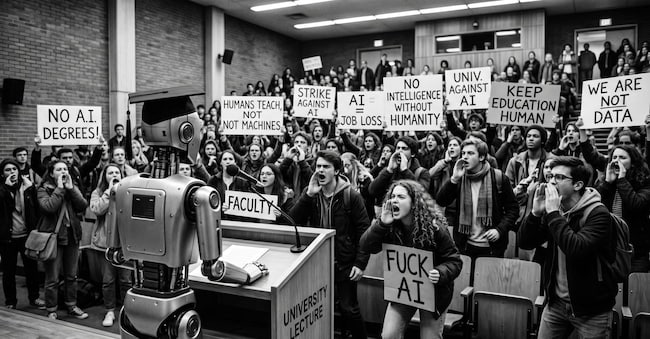
On American campuses, Silicon Valley executives are met with protests from students. This is not neo-Luddism, but the very real fear of a generation that sees AI wiping out the entry-level jobs in the labour market. And they are now demanding answers about their future.

by Luca Tremolada

3' min read

Translated by AI
Versione italiana

3' min read

Translated by AI
Versione italiana

Luddism in the age of AI doesn’t sound like hammers smashing industrial machinery, but rather the more spectacular sound of boos in university lecture theatres. What happened in American universities this spring resembles a scene that Silicon Valley hadn’t anticipated. For years, the script was simple. Managers, entrepreneurs and innovators take to the stage. They talk about the future. The students applaud. End of story. Not this year. When the speakers uttered two letters — AI — the boos began. Some have called it the first form of emotional strike against artificial intelligence.

The videos that have gone viral in recent weeks all tell the same story.

Loading...
Loading...

At the University of Central Florida, Gloria Caulfield describes AI as “the next industrial revolution”. Boos. When she tries to recover by explaining that “AI’s capabilities are right in the palm of our hands”, the students respond with shouts and protests.

Loading...

At the University of Arizona, it was the turn of Eric Schmidt, Google’s former CEO. He, too, arrived with the classic Silicon Valley message of optimism. He, too, was met with a hostile audience. So much so that he had to deviate from his script and publicly acknowledge an uncomfortable truth: the fear that jobs are disappearing.

At Middle Tennessee State University, music producer Scott Borchetta takes a hard line: the world is changing, so adapt. “Deal with it”. The result? An even louder outcry.

Then there is the almost symbolic case of Glendale Community College. Here, AI isn’t celebrated. It’s simply used. A software programme reads out the names of the graduates, gets several wrong and skips a few. When the college apologises, explaining that it is a new AI-based system, the hall erupts in a roar.

This scene is worth more than many academic studies.

The point isn’t that young people are afraid of innovation. Generation Z has grown up surrounded by technology. They use ChatGPT, Midjourney, TikTok and Claude with a natural ease that fifty-something managers can only imitate. The point is something else. For the first time, a generation is entering the job market whilst technology openly promises to replace some of the jobs they studied for. In the 1990s, the internet promised new careers. In the 2000s, smartphones created new industries. Generative AI arrives with a different message: we can do the same work with fewer people. It is a huge difference. And the younger generations have understood this.

The entry-level paradox

The divide is particularly evident in entry-level roles. Historically, the labour market functioned as a training ground. You started as a junior. You carried out repetitive tasks. You learnt by observing your seniors. You grew. Artificial intelligence is automating precisely that segment of the workforce. It is as if a staircase had lost its bottom few steps. Managers look at the top floor of the building and see greater efficiency. New graduates look at the entrance and can no longer see the door.

So what? The problem isn’t AI. It’s the narrative

The reaction of American students is, above all, a case of miscommunication. If someone tells you that the latest software might render some of the skills you’ve just acquired obsolete, you’re not exactly going to take it well. It’s a classic case of ‘failure to read the room’, as several American commentators have observed. Not because the analysis is necessarily wrong. But because the context is completely wrong.

The sound coming from the future

That is why the boos on American campuses are not a Luddite revolt. They are not a rejection of technology. They are something more interesting. They are the first visible sign of a shift from enthusiasm to ambivalence. Generation Z is not saying: stop AI. They are saying: explain to us what place we will have in the world you are building. Until that answer comes, every presentation on artificial intelligence risks turning into a referendum on the future of work. And the boos heard on American university campuses may be just the beginning of the conversation.

Copyright reserved ©
  • Luca Tremolada

    Luca TremoladaGiornalista

    Luogo: Milano via Monte Rosa 91

    Lingue parlate: Inglese, Francese

    Argomenti: Tecnologia, scienza, finanza, startup, dati

    Premi: Premio Gabriele Lanfredini sull’informazione; Premio giornalistico State Street, categoria "Innovation"; DStars 2019, categoria journalism

Loading...

Brand connect

Loading...

Newsletter

Notizie e approfondimenti sugli avvenimenti politici, economici e finanziari.

Iscriviti