
Why is Mark Zuckerberg banking on the 'generalist' agent start-up Manus?
With this move, Meta aims to monetise its investment in Ai by entering the intelligent agent economy.

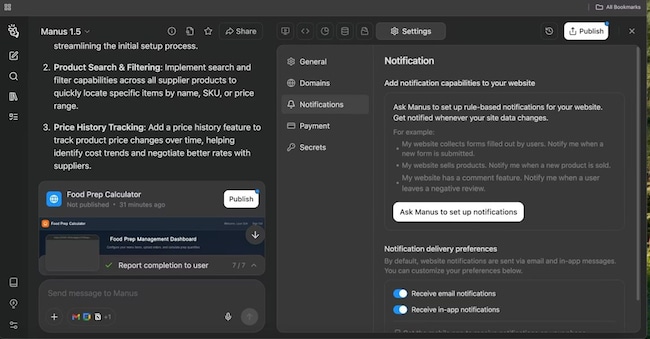
After years of talking about artificial intelligence as the new electricity, what was needed now was a powerhouse that actually produces power, not just slides for investors. The acquisition of Manus, a start-up that became famous for building one of the most advanced AI agents around, is the clearest sign that Meta Platforms wants to move the game from AI that talks to AI that works. As the Wall Street Journal wrote, this deal, which is expected to be around $2 billion, Mark Zuckerberg is aiming to monetise his investments in Ai by entering the intelligent agent economy.
Manus is not an LLM (large language model). The Singapore-based start-up has created a 'general AI agent' - an artificial intelligence that does not just respond to prompts, but makes complex decisions and performs multi-step actions, such as analysing markets, synthesising research, scheduling or automating workflows, without constant supervision.
That is, a system that receives a target, breaks it down, decides which tools to use, checks if it is making a mistake and goes on its own. It is the difference between a sat-nav and a driver. And for Meta, this difference is worth billions. Because language models alone have become a commodity: powerful, expensive, increasingly similar. Agents, on the other hand, are the new frontier. They are the ones that companies can use to automate processes, reduce costs, increase productivity. And above all, they are the ones you pay for.
What changes for Meta?
Inside Meta this move answers a question Wall Street has been repeating for two years: where are the revenues from AI? The company has invested tens of billions in data centres, chips and research, but so far artificial intelligence has mainly served to improve advertising feeds and recommendation systems. Useful, sure. But invisible as a stand-alone line of business. Manus changes the music because it brings in paying users, subscriptions, revenue. It is AI that goes straight onto the balance sheet, not a quarterly presentation promise.
Then there is an even more interesting strategic message. Meta is not abandoning its language model. On the contrary. With this acquisition it is making it clear that LLaMA remains the technological heart of the house.


