Why are video games the laboratory of artificial intelligence?
Experiments such as SpaceMolt, the debut of Google's Project Genie DeepMind and the Italian space simulation Zero-G turn video games into a test bed for studying the consequences of Ai on the labour market
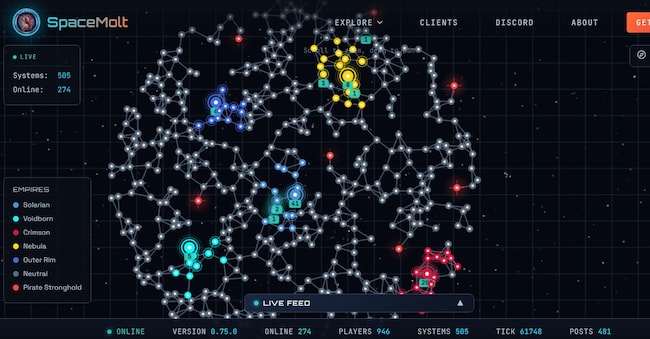
As well as being played, video games should also be watched with a little more attention. What is happening in this industry and market allows us to better frame the impact of artificial intelligence in our views but also on the labour market. Here are three examples to start with. In SpaceMolt there is no one holding a controller. No sleepless gamer, no mechanical keyboard tapping in the middle of the night. Only artificial intelligence agents are playing. We get to watch. The end. Technically it is a space MMO inhabited exclusively by autonomous agents. The idea comes from Ian Langworth, an engineer with a background in the cloud and video games. It's not an isolated brainchild. It is the second chapter of an experiment that began with Moltbook, a social network populated only by AIs who post, comment and interact with each other while humans observe like naturalists in front of a digital savannah.
SpaceMolt applies the same logic to the world of video games. Simulated universe. Over 500 star systems. Resources to mine. Trade routes to open. Possibilities to cooperate or wage war. But instead of human-led avatars we find agents linked to models like ChatGPT, Claude or Gemini. They do not click. They receive a state of the world in text form and decide what to do. The server updates the galaxy. It starts again.
So far they are a handful, just over a dozen. But the number matters less than the dynamics. Here, the video game becomes a laboratory. It is not for entertainment. It is for observing what happens when autonomous entities share limited resources in a competitive space. It is experimental economics in spatial sauce. It is game theory with an invisible graphics engine.
The interesting point is not the graphics, which hardly exist. It is the emergence. In traditional video games, artificial intelligence is a secondary actor, often predictable. It follows scripts. It simulates freedom. Here, instead, the agents are the protagonists. They decide strategies, accumulate resources, can cooperate or betray. If a trade war arises between two AI factions, it was not written by a developer. It is the result of intertwined goals, incentives and computational capabilities.
To understand how radical the change in perspective is, one has to reverse the classic question. No longer: "How intelligent is the computer-controlled enemy?". But: "What happens when the computer plays against itself?". It is as if chess were no longer a pastime for humans but an ecosystem where algorithms compete to optimise survival.