
Wide field, can the recipe of Genoa and Ravenna be extended to the whole of Italy?
Schlein: we win where we are united. But in the M5s the desire for independence and resistance to converging on Dem candidates remain strong. In Matera divided even at the ballot

3' min read
Key points
- Schlein rejoices at the victory of his 'stubbornly unitary'
- The case of Matera ("no affiliation between 5 Stars and Dems") and Conte's silence
- In the M5s, the vocation for independence and resistance to converging on Dem candidates remain strong
- While the centre-left is strong in urban areas, the centre-right continues to dominate in small towns
3' min read
"By now it is clear, the centre-right rejoices in the polls, we win the elections. Being stubbornly united, it is necessary to repeat today more than ever, is not a thesis or a political debate but an objective fact: united we win, congratulations to all the forces that have contributed to these fine victories!"
Schlein rejoices at his 'stubbornly unitary' victory
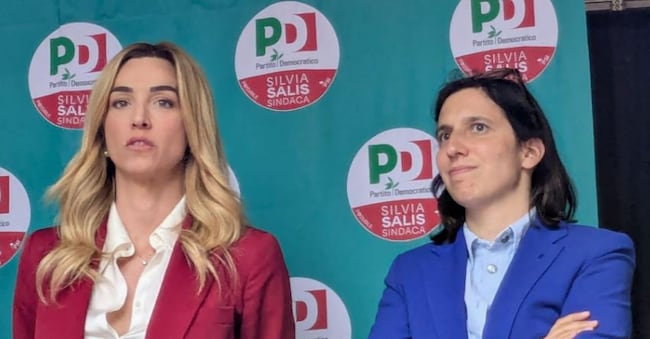
.By the time PD secretary Elly Schlein issues her evening note, the newly elected 'civic' mayor of Genoa Silvia Salis has already received the congratulations of her centre-right rival Pietro Piciocchi for her election ('it was a victory with great numbers, congratulations') and the victory of the Dem Alessandro Barattoni in Ravenna is also more than consolidated. Two first-round victories in two provincial capitals, at a time when the centre-right is pursuing its anti-ballot proposal to lower the threshold for election from 50% to 40%, to which is added the victory of the newly elected mayor of Assisi Valter Stoppini. Optimism also in Taranto, where the candidate of the PD and the centre-left (but not of the M5s) Pietro Bitetti is clearly ahead. The most evident political datum, net of the fact that both Genoa and Ravenna are two cities historically oriented to the left, is precisely that the three newly elected mayors are all supported by an extra wide field: from the M5s to Avs to the centrists of Azione, Italia Viva and Più Europa. Hence the exultation of Matteo Renzi, often victim of the vetoes of M5s leader Giuseppe Conte: 'When the centre-left does not put vetoes, as happened at the last Liguria regional elections, it happens that it wins,' says the former premier and leader of Italia Viva. 'Today Meloni has taken a real beating. The dragging effect and the idea of a honeymoon.... It's not like that. The spell is a bit broken'.
The case of Matera ("no affiliation between 5 Stars and Dems") and Conte's silence
Certainly, as Schlein herself says, the need for unity is not a whim but, so to speak, a mathematical necessity: only united can the oppositions be truly competitive. But the Dem secretary's 'stubbornly united' strategy, while remaining the only one possible to try to defeat the centre-right in the next general election, is struggling to take flight and make itself rule. It is enough to look at Matera, the fourth capital where the vote took place in this first round that involved 117 municipalities, 31 of which over 15,000 inhabitants: the centre-left candidate Roberto Cifarelli, of the Democratic Party but in the field without a symbol, is in the lead with over 40%, but the M5s candidate Domenico Bennardi, who has already been mayor of Matera and who is at 8%, has already declared that he will not let his votes converge on Cifarelli: "We will not support anyone and we will not make any alliances. We will leave it up to our voters'. So much for the extra-large camp. For his part, Conte, while he does not deny the position of his own in Matera, limits himself to praising the sole choice of the civic candidacy in Genoa ('it is the demonstration that projects born from the bottom and inclusive of the proposals of civil society are perceived by citizens as closer to their needs and, for this reason, deserving of trust and enthusiasm').
In the M5s, the vocation for independence and resistance to converging on Dem candidates remain strong
.In short, the main obstacle to the unity of all the oppositions remains precisely the most important ally of the PD, that M5s which declares itself to be 'independent progressive' and which always struggles to find unity. And it struggles even more to give its contribution to candidates who are an expression of the PD. How will Conte behave when the time comes to choose the coalition's prime ministerial candidate (a hypothesis that is not peregrine, given the centre-right's intention to overcome the Rosatellum's single-member constituencies for a proportional system with a 55% majority prize and indication of the coalition leader on the ballot paper)? And what will happen when an electoral programme has to be drawn up, given the anti-Ukrainian and partly anti-EU positions of the 5 Stars?
While the centre-left is strong in urban areas, the centre-right continues to dominate in small towns
.It must also be taken into account that the centre-left, and in particular the PD, is historically strong in urban centres but very weak in the provinces and small towns, where the centre-right prevails. Once again, it is necessary to wait for the final data to read any regional trends. In short, Schlein's 'stubbornly united' path is still all uphill.


