
Wikipedia, Jimmy Wales: ‘Artificial intelligence can help, but the final decision must remain in human hands’
The co-founder of the free encyclopaedia discusses his difficult relationship with AI: the models are fed by the knowledge produced by volunteers, but they continue to make mistakes. And whilst the tech giants are building new businesses around open data, Wikipedia is defending its non-profit status. Not to mention the privacy risks faced by contributors.

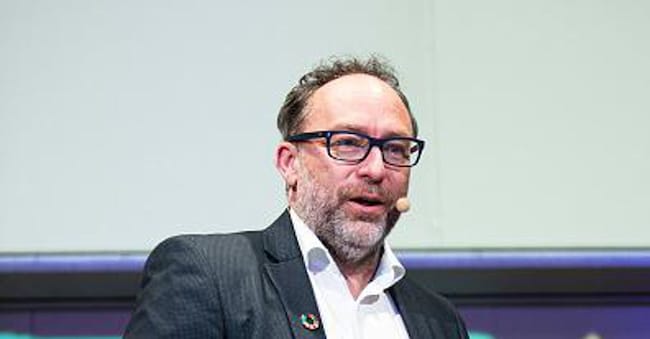
In 2001, it gave life to one of the Internet’s greatest utopian visions: the idea of a world in which every human being could freely access the sum of all knowledge. Twenty-five years on, Wikipedia is not merely one of the most widely consulted encyclopaedias on the planet. It has become one of the pillars of knowledge upon which the entire web rests, including the artificial intelligence giants that use its archive to train their models. Perhaps for this very reason, Wikipedia represents the most vulnerable and defenceless sacrificial lamb of the AI giants. Jimmy Wales, co-founder of the free encyclopaedia, knows this only too well. Yet he does not seem at all as angry as one might expect. Even when asked whether governments should oblige AI companies to pay a fee or to cite Wikipedia for the use of its open data in training their models?
“Wikipedia was created as a gift to the world under a free licence to allow for any form of reuse,” he explains calmly to *Il Sole 24 Ore*. Although attribution of sources is required and technology companies are not always rigorous in providing it, the preferable approach is to encourage voluntary support for Wikipedia from those who benefit from its data. Direct government intervention would, in many respects, prove more dangerous than direct negotiation between the parties.” Wales, who comes across as incredibly diplomatic, defends the model he has built, but does not hide the contradictions of artificial intelligence. Above all, he does not believe that the future of knowledge should be entrusted to machines. On this point – regarding the risks that AI might destroy humanity or wipe out all jobs – he appears particularly far-sighted. The message is clear: AI is not the apocalypse, but we cannot trust it blindly. ‘Neither scenario seems plausible.’ Wales plays down both the idea of artificial intelligence gaining the upper hand over humanity and that of widespread job losses.
‘I don’t think either scenario is very plausible. Certainly – he smiles – I haven’t yet come across a computer capable of holding its own against a Navy SEAL, so I’m not really sure. Humans are quite adept with weapons when necessary, so that’s still a long way off; if you think about it, much of this discussion is just science-fiction fantasy. I don’t believe in the ‘job apocalypse’ either: in the software sector, people say it’s all over, but the demand for programmers is higher than ever, and I think it’s actually expanding opportunities, since even a junior programmer can now create incredible things for clients. Obviously, such a powerful technology will have different impacts in different areas. At the moment, I don’t see it having a major impact on electricians and joiners. And even if you think about mathematicians (a very small sector that’s been causing quite a stir lately, where AI is proving theorems and solving open problems – ed.), I don’t see anyone saying we no longer need mathematicians. Rather, I see mathematicians saying: ‘Wow, this is a fantastic tool we can use. There really is a lot of hype at the moment, and it’s difficult for anyone to distinguish what’s real from what’s just noise. Furthermore, these companies are burning through a huge amount of money without having a sustainable business model for what they’re doing, and they may have to slow down. I don’t know if they’re stirring up undue fear with all these dramatic claims, whilst respecting people like Demis Hassabis of DeepMind, who isn’t an AI alarmist but does say that the risks are serious.”
Whilst we wait to gain a better understanding of the sustainability of the AI giants’ business model, for Wikipedia, however, the problem is more immediate and critical. Since the advent of chatbots, there has also been a heated debate within the open encyclopaedia itself about how and whether to use a technology that promises to accelerate the production of knowledge, but which continues to invent facts. ‘In my view, it’s appropriate to use AI for suggestions or to help find things, but the final decision, at least for now, must rest with a human being, simply because we know that AI systems are inaccurate and prone to hallucinations. They’re improving,’ he admits, ‘but the problem of hallucinations is still quite significant, particularly when it comes to more obscure and little-known topics, where one might think Wikipedia needs the most help. If you ask the AI to help with a short article on a little-known topic, it’ll do a terrible job because it doesn’t know anything about it; but if it helps you find sources, reads them for you and tells you ‘this one looks good, this one’s interesting, this one might not be much to write home about’, I think that’s useful and very interesting. So our community is engaged in a long process of discussing when we can trust AI, for what purposes, and when we cannot, and obviously this will change over time because the technology is changing very rapidly.”
Anyone expecting Walles to take a principled stand against automation is very much mistaken. The community is therefore openly discussing where artificial intelligence can be trusted and where human oversight is essential. What is at stake is not just the quality of individual entries; it is the credibility of the entire encyclopaedia.


