Disaster

Wildfires: the emergency shifts to Greece – 7,000 people evacuated in Crete

State of emergency lifted in Spain. A further 126 wildfires in France. George and Amal Clooney among those displaced in Brignoles. Fires in the UK

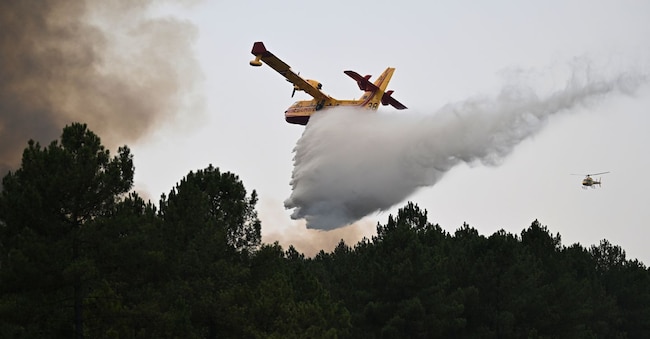
Un aereo scarica il proprio serbatoio d'acqua su un incendio nei pressi di Saint-Jean-d'Illac, durante gli incendi boschivi nel sud-ovest della Francia, martedì 28 luglio 2026. (AP Photo/Emma Da Silva)     Associated Press / LaPresse Solo Italia e Spagna APN

4' min read

Translated by AI
Versione italiana

4' min read

Translated by AI
Versione italiana

The wildfire crisis is shifting across Europe from the western to the eastern part of the continent. Whilst in France and Spain the damage caused by the catastrophic fires around Bordeaux and Madrid is being assessed, and isolated emergencies remain, including in Portugal, all eyes are now on Greece.

More than 7,000 people have been evacuated from the Greek island of Crete due to the fires, according to the deputy governor of the Rethymno region, Maria Lioni. “We have evacuated Agia Galini, a very large town with around seven to eight thousand inhabitants,” Lioni said in an interview with broadcaster ERT. Lioni added that several villages had also been evacuated. Furthermore, in the areas of Agios Pavlos, Ligres and Triopetra – traditionally popular tourist destinations – the authorities had to evacuate people by sea, as road access was impassable for buses. According to the deputy governor, Crete has endured “a nightmarish day and night”. The fire has caused extensive damage, the full extent of which cannot yet be assessed as the flames are still burning. Yesterday, two firefighters died on the island whilst battling the blazes.

Loading...
Turchia, incendi in quattro province dell'ovest del Paese

The situation in France

In France, the peak of the emergency has passed, but the alert has not been lifted. “Yesterday we recorded 26 fires, which flared up very quickly and with great intensity,” said French Interior Minister Laurent Nuñez, as reported by the broadcaster Bfmtv. “The situation remains complicated,” added the Chief of Police, announcing that “the total area burnt amounts to 117,000 hectares” across France.

The fire that had broken out in the Brignoles area, in the Var department in southern France, was brought under control during the night between Wednesday and Thursday. George and Amal Clooney are also among the more than 220,000 people evacuated due to the fires in France. The couple, aged 64 and 48, along with their 9-year-old twins, Alexander and Ella, had to leave their home in Brignoles, in the Provence-Alpes-Côte d’Azur region, one of the areas affected by the fires.

Spain lifts the state of emergency

The Spanish Prime Minister Pedro Sánchez has announced the end of the national state of emergency declared due to the wildfires that have affected the province of Ávila and the region of Madrid, given the improvement in the situation. Speaking from the Forward Command Post in Navaluenga, in the province of Ávila, the Socialist leader stated that the response to the fires, led by central government and in particular by the Military Emergency Unit, had been a “success”, and had involved “more than 150 hours of tireless work by all the operational units that fought on the front line against the fire”. Sánchez warned that the emergency, which has been downgraded to level two and will therefore now be managed by the regional authorities of Castile and León, is still ongoing and that the authorities will remain on high alert.

Over the last 45 years, the number of summer days with conditions conducive to forest fires has more than doubled across large parts of the Iberian Peninsula, France, Italia and Greece. Although progress made in managing these emergencies has helped to reduce the number of fires, those that do occur are becoming increasingly intense and prolonged, to the point where they are increasingly exceeding the available fire-fighting capacity. This is demonstrated by a study published in the journal *Scientific Reports* by an international research team led by the University of Groningen in the Netherlands.

Spagna, droni riprendono incendi a Castellon: le fiamme sono ancora fuori controllo

The number of days at risk in Southern Europe has doubled in 45 years

The team analysed national statistics on forest fires in Portugal, Spain, France, Italia and Greece, alongside meteorological and climatic data collected between 1981 and 2025. It was found that in some areas of France and Spain, the intensity of weather conditions conducive to wildfires (heat, drought and wind) increased by up to 50 per cent between 2016 and 2025, compared with the 1981–2010 period. The number of days with conditions highly conducive to wildfires has also increased, rising from fewer than 10 days per summer in the 1981–2010 period to around 25 days over the last decade in some areas of each country studied. However, the annual number of fires over the last decade has been around 40 per cent lower than the average for the 1981–2010 period in each country. The researchers suggest that this may be due to improvements in forest fire management, such as better training for firefighters and public awareness campaigns. The frequency of fire-prone weather conditions reflects an increase in hot, dry days and is linked to large-scale climate patterns, including El Niño. Smaller differences in atmospheric pressure over the North Atlantic have coincided with an increase in fire-favourable weather conditions in parts of Greece, Italia, Corsica and Spain. Sea surface temperature anomalies in the tropical Pacific, associated with El Niño, preceded fire-favourable weather conditions in parts of the north-western Iberian Peninsula, Sicily and southern Greece.

Regno Unito, incendio sulla costa del Suffolk: "Evento grave"

UK, fire on the Suffolk coast: “Serious incident”

The fire service in Suffolk in the UK has released images showing burnt vegetation and trees following the massive fire that struck Dunwich Heath, a coastal area in the south-east of the UK. Around 90 firefighters were deployed to tackle the blaze, which was declared a ‘major incident’ ‘due to the scale and complexity’ of the fire, which covered an area roughly the size of 140 football pitches.

Several homes and around 200 caravans have been evacuated; the Suffolk Fire and Rescue Service has stated that no injuries have been reported so far. At present, the flames are not affecting Sizewell B, the nuclear power station situated approximately four miles (6.4 km) from the moorland, but the authorities are monitoring the situation.

“Our teams have been battling the fire all night, ensuring that people and property are protected. We are also striving to minimise the impact on the environment as much as possible. The crews will continue to tackle the blaze in the region for probably another 24–48 hours, given the scale and complexity of the incident we are facing, and we are still in a serious situation,” said Christopher May, operations commander at Suffolk Fire and Rescue Service, on social media.

Copyright reserved ©

Brand connect

Loading...

Newsletter

Notizie e approfondimenti sugli avvenimenti politici, economici e finanziari.

Iscriviti