Space

The first home for the astronauts going to the Moon will be Italian

The Italian space agency has entrusted Thales Alenia Space with the final design of the living module presented to Nasa last year and approved by the US agency in September

by Leopoldo Benacchio

4' min read

4' min read

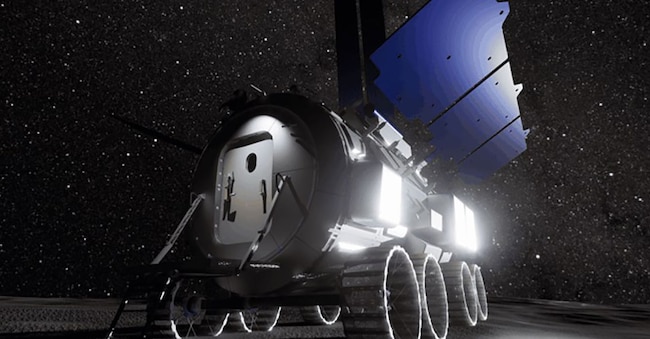
The first house for the astronauts who will go to the Moon in the 1930s will be Italian. Our space agency, Asi, has in fact entrusted Thales Alenia Space with the final design of the living module presented to Nasa last year, and approved by the US agency in September. The study phase will last two years and will see Thales Alenia Space Italia as prime contractor. The company will work in collaboration with Altec, a Turin-based centre owned by ASI and Thales Alenia Space Italia itself, and with other Italian industrial players.

The vehicle, Mph, Multi Purpose Habitat, will probably be very similar to the prototype presented a year ago, but it will be self-propelled, with wheels and motors to propel it at a speed of a few kilometres per hour. At a length of 4-5 metres, this sort of sophisticated lunar motor home will have space inside for the astronauts to rest, communicate with the vehicles on the lunar surface and with the Earth, and there will probably also be space for some technical-scientific activities. We will see the final design.

Loading...

This is excellent news, also for the American Artemis project to return to the Moon, which sees NASA as the main proposer and to which as many as 53 nations have signed up at the moment, Italy among the first. Nasa is not in an easy moment, far from it: the Trump administration is planning a substantial reduction in its budget, talk of 40% even, along with that of all American research agencies. For Artemis, funds would have recently been secured on other chapters of expenditure, but such a macroscopic downsizing of Nasa will certainly complicate things and risk China being the first to reach the Moon, at the South Pole, in the early 1930s.

Italy, on the other hand, is at the forefront of this important project, which will take mankind back to the Moon, but this time to stay there, build housing, laboratories, roads and points of departure from the Moon to the planned cislunar orbiting station, already under construction, or directly back to Earth.

Seen from afar, perhaps on one of these beautiful summer nights, the Moon is a friendly and even winking presence, but standing on it is a very hostile environment.

The difficulties for man on the Moon

.

The first major difficulty is due to the absence of an atmosphere, which allows cosmic rays to reach the ground without problems, and for humans they can be lethal beyond a certain amount.

If there is no atmosphere, it is obvious that one cannot even think of breathing, so the astronauts' suits must act both as shields for cosmic rays and energetic particles arriving from the Sun and as systems in which air and water are guaranteed as a minimum. In practice, contrary to what one might think, they are actual spaceships protecting the space workers. As other functions, we can add that the spacesuits must allow for radio communication, power supply and more; if we consider that the astronauts must also move as easily as possible to get around and work, we understand that the design of these envelopes is not easy, which often makes the astronauts look clumsy. On the Moon, gravity is one-sixth that of the Earth: a 60 kg person there 'weighs' only 10 kg, with the result, visible in the films of the Apollo missions of more than 50 years ago full of falls, of having to learn to walk on lunar soil.

The lack of atmosphere then creates a big problem with the temperature, which ranges from 150 degrees to -150, to get an idea, and is very sharp, in the sense that, ideally, if we were exactly where the solar illumination ends and we spread our arms one hand, in the illuminated part, would be at 150 and the other would freeze at -150. You can see that these are not simple conditions to take into account.

Lastly, and certainly not better than the other conditions, we have the problem of the dust, very fine, a practically uniform layer of many centimetres, which sticks to the astronauts' suits and vehicles, penetrates everywhere in a pervasive manner, blocking or even contributing to the breakage of instruments and mechanisms, starting with the wheels of the rovers, as has happened several times. Think of the problems induced by the dust attached to the astronauts' suits when they return to the living quarters: a real nightmare.

From this list of problems, which we have not exaggerated, it is clear that it is not just a matter of building a kind of lunar bivouac, similar to the high-altitude terrestrial ones, but of designing a very sophisticated, safe and efficient structure for the lunar programme of this century. Thales Alenia Space, with its partners in this endeavour, will arrive at the definition for construction in a couple of years: a launch to the Moon is planned for 2033, certainly hoping that the current impasse on launchers will be overcome. In fact, we are in a critical situation, both because of the problems linked to the unfortunate choice of Nasa's SLS launcher, which has been revised and upgraded and has already caused delays of years with respect to the schedule, and because of the substantial failure of the last test launches of Elon Musk's Starship, the largest and most powerful rocket ever designed.

Spazio: fallisce il nono test del razzo Starship di SpaceX
Copyright reserved ©
Loading...

Brand connect

Loading...

Newsletter

Notizie e approfondimenti sugli avvenimenti politici, economici e finanziari.

Iscriviti