
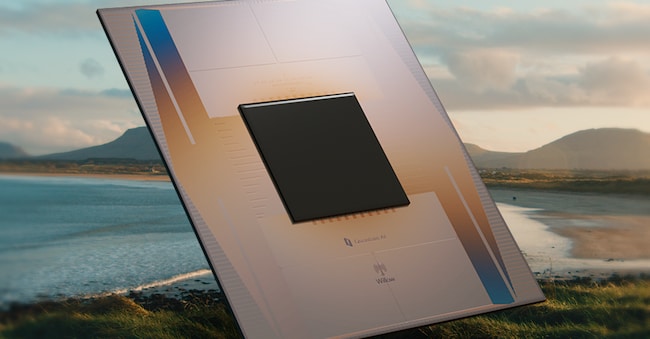
Willow, the Google chip paving the way for quantum computing, is born
Sergio Boixo (Quantum Artificial Intelligence Lab) talks: within two to three years we aim to make a logical Qubit, i.e. a 'quantum transistor'.
3' min read
3' min read
After proclaiming quantum supremacy in 2019, Google presented Willow, a quantum chip architecture that promises to pave the way for the construction of large-scale quantum computers. As Principal Scientist of Google's Quantum Artificial Intelligence Lab Sergio Boixo explained, thanks to this new step forward in the 30-year-long quantum computer race, for the first time we have managed to reduce errors exponentially as more qubits, i.e. the units of computation in quantum computers, are used. In our experiment published in the journal Nature 'we managed to perform in less than 5 minutes a standard benchmark calculation that would now take Frontier, the world's second fastest supercomputer, 10 septillion years, a number that far exceeds the age of the Universe'.

If you want to write it down, it's 10,000,000,000,000,000 years. Let's try to better understand the scope of this discovery, which after years of announcements and promises could make the race for the greatest technological promise of computational computing finally accelerate.
Loading...
Because it is an important discovery.
Google's latest quantum processor, Willow, was manufactured in its new state-of-the-art fabrication facility in Santa Barbara, one of the few in the world built from scratch for this purpose.

Technically, the team used a 101-qubit quantum processor. going from a grid of 3x3 encoded qubits, to a 5x5 grid, to a 7x7 grid - and each time, using our latest advances in quantum error correction, they were able to halve the error rate. In other words, they achieved an exponential reduction in the error rate."
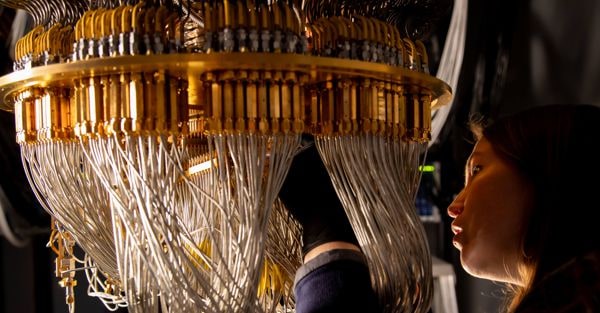
'Errors,' explained Sergio Boixo, who has joined the Quantum Artificial Intelligence Lab led by Hartmut Neven practically since its inception in 2013, 'are one of the biggest challenges in quantum computing, as qubits, the units of computation in quantum computers, have a tendency to rapidly exchange information with their environment, making it difficult to protect the information needed to complete a calculation. In general, the more qubits you use, the more errors grow'. Quantum error correction (QEC) is therefore an essential technique for protecting quantum information from noise, but its effectiveness depends on being able to achieve error rates below a certain threshold. 'We have been able to reduce errors by increasing the number of qubits,' Boxio notes, 'and it has been an exceptional challenge since quantum error correction was introduced by Peter Shor in 1995. This gives us strong confidence that we can build a large-scale quantum computer that is not troubled by errors."


Brand connect
Loading...
