
Offshore wind, Europe relaunches with first common hub
With the Bornholm Energy Island project, the Danish and German energy systems will be interconnected, powering three million households
Key points
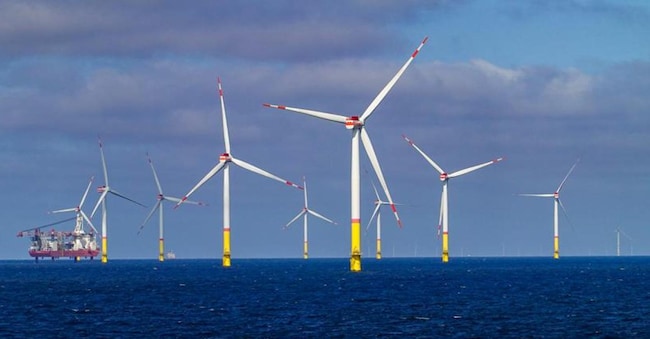
Offshore wind is trudging along in the United States after the total blockade imposed by Trump, but Europe is starting to redeem itself. The European Commission has granted EUR 645 million in funding to the Bornholm Energy Island project, which aims to create the first offshore wind hub shared by Germany and Denmark. The funds come under the Connecting Europe Facility and the initiative is being jointly led by the two grid operators, Germany's 50Hertz and Denmark's Energinet, with the status of a project of European interest. "As the world's first DC hybrid interconnector, the Bornholm Energy Island project represents a new era of energy cooperation in Europe," according to the Commission. By pooling offshore generation and connecting national grids, 'wind energy will no longer be exploited exclusively by individual countries'.
How many countries will be involved?
The idea is to link three gigawatts of new offshore wind farms (yet to be put out to tender) into a single energy hub, installed on the Danish island of Bornholm in the Baltic Sea, with the option of adding a further 800 megawatts of wind power to the hub and extending the system to other Nordic countries. The project is part of an agreement, made as early as 2020 between Germany, the Netherlands and Denmark, which also includes an artificial energy island in the North Sea, still to come, to create another joint hub with the Netherlands, with 3 gigawatts of offshore wind capacity, to be increased over time to 10. Feasibility studies are underway on this artificial island, but the project is more complex than the one just financed.
Four hundred kilometres of cables
The energy generated in the parks south of Bornholm will power at least three million households by 2030 and will reach Denmark and Germany via almost 400 kilometres of high-voltage DC cables, mostly submarine, to ensure the integration of this renewable energy into the electricity grids of both countries. The contracts have already started, with Siemens securing a EUR 1 million order for the delivery of four conversion systems, while Denmark's Nkt will supply EUR 650 million of high-voltage DC cables to connect Bornholm to Denmark. In Bornholm alone, around 900 new jobs are expected to be created and 2,000 new residents added to the current 39,000.
Energy Transition
The aim is therefore to create a circuit by 2030 that can easily and quickly connect generation and consumption, even if separated by the sea, using the island of Bornholm as a lintel. The point is to demonstrate how offshore wind power can be exploited on a large scale, with the potential for similar projects elsewhere in Europe. In this way, the Commission expects to push the energy transition forward: with an installed offshore wind power capacity of 21 gigawatts at the end of 2024, the European Union is lagging behind its new targets of 111 gigawatts of offshore wind power by 2030 and 317 gigawatts by 2050, so it wants to spur European industry into action.
Germany, the Netherlands and Denmark
Of the 27 member states, to date only 15 have set binding targets on offshore wind power to 2030, totalling 99 gigawatts, according to a recent report by Ember. More than half of these targets are covered by Germany (30 gigawatts) and the Netherlands (21 gigawatts). Denmark has a target of 12.9 gigawatts by 2030, France 4 gigawatts and Italy 2.1. Poland, which is emerging as a new European power in the sector, has just installed its first offshore blades in the 1.2 gigawatt Baltic Power project and has a target of 5.9 gigawatts by 2030.

