
The National Recovery and Resilience Plan (PNRR) provides a 34 billion boost for transport. “The challenge now is to complete the projects”
Destro (Confindustria): turning this momentum into a structural infrastructure policy whilst ensuring continuity of investment

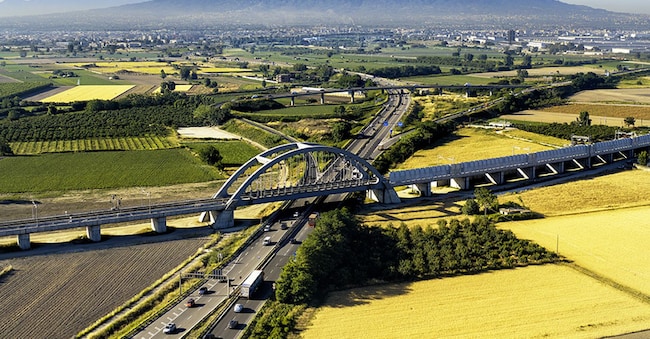
The National Recovery and Resilience Plan (PNRR) has channelled resources totalling around €34 billion into the infrastructure and transport services sector, with over a third invested in Southern Italy and three-quarters directly supporting the climate transition. These are some of the figures that emerged from the conference ‘The future of Italian infrastructure, transport and logistics after the PNRR’, organised in Rome by Economia Pulita at the European Parliament’s Representation in Italia. The PNRR has also delivered 10 systemic reforms and left behind a legacy of stricter and more precise procedures for launching projects and monitoring their progress.
But the work to make passenger transport and freight logistics more efficient is not yet complete: in addition to the full commissioning of the new kilometres of high-speed railway lines and those equipped with the most modern train control systems (ERTMS), there are more than 190 priority projects identified by companies that are yet to be completed. This figure emerges from the latest White Papers drawn up by Uniontrasporti (a company belonging to Unioncamere): 54 per cent of the priority projects identified relate to the rail network, 40 per cent to roads and motorways, and the remainder to ports, freight terminals and airports. Work on the majority of ongoing construction sites is not expected to be completed until after 2030.
In the Centre-North, some railway projects stand out as among the most significant, including from an economic perspective: the Genoa–Milan Third Pass, the Pescara–Rome line, the Brenner Base Tunnel (BBT) and its southern access route, and the Pontremolese line. Over 50 per cent of the investment value is concentrated in the South, where, according to the companies surveyed by Uniontrasporti, the priorities are the Salerno–Reggio Calabria high-speed railway line (an initial section from Battipaglia to Romagnano has been partially funded by the NRRP), the modernisation of the SS 106 Jonica state road and the A2 Salerno–Reggio Calabria motorway, the Palermo–Catania high-speed rail link, and the Bridge over the Strait.
Leopoldo Destro , vice-president of Confindustria for transport, logistics and the tourism industry, says: “The NRRP has acted as an unprecedented catalyst. We must now transform this momentum into a structural infrastructure policy, ensuring continuity of investment.” The challenge is considerable: in Italia, transport infrastructure requirements up to 2040 are estimated at around 550 billion euros. Destro observes: “This is an investment that no single public source can sustain on its own. Confindustria’s proposals are clear: a long-term national framework for the mobility of people and goods; a five-year fund for strategic transport and logistics infrastructure; national resources, European funds, guarantees and private capital operating within a clear public framework.”
Confindustria proposes strengthening the CEF (Connecting Europe Facility), the European Union’s main funding instrument created to support and accelerate investment in the development of trans-European networks in the transport, energy and digital sectors; to expand guarantee schemes for strategic investments and to build a European debt and equity platform capable of attracting long-term capital towards logistics, energy and digital networks. Destro adds: ‘The post-PNRR era is a matter of industrial policy: without efficient and competitive connections, “Made in Italy” cannot fully realise its potential on global markets.’


